
Imperial diploma granting Count Amadeus VIII the title of Duke of Savoy
State Archives of Turin
Turin, Italy
www.archiviodistatotorino.beniculturali.it

King Sigismond grants the title of Duke of Savoy to Amedeus VIII
Materie politiche per rapporto all’estero,
Diplomi imperiali, mazzo 8.2, fascicolo 7, 1416 febbraio 9
© Archivio di Stato di Torino
Text: State Archives of Turin
On February 9, 1416, in the castle of Chambéry, the King of the Romans, Sigismund of Luxembourg, granted Count Amadeus VIII the title of Duke of Savoy, in a splendid ceremony prepared for months. The celebration marked a legal event, embodied in the solemn diploma that we preserve at the State Archives of Turin.
At first glance, Amadeus VIII seems to have received this prestigious recognition as a reward for his support to the king during Sigismund’s journey to persuade the antipope Benedict XIII to accept the decisions of the Council of Constance. In 1415, Amadeus welcomed Sigismund with all honors in Seyssel and accompanied him along the Rhône to Lyon. Upon Sigismund’s return in early 1416, he awaited him again in Lyon to accompany him to Chambéry, where he finally received the investiture. Beyond the occasion, the granting of the title is primarily a consequence of Amadeus VIII’s diplomatic skill, of the Empire’s need to reaffirm its rights over the territories of the ancient Kingdom of Arles by removing the County of Savoy from the influence of powerful neighbors, as well as of the long tradition of vassal relationships between the emperors and the counts of Savoy. Amadeus also obtained confirmation of the title of verum principem, bestowed upon the counts of Savoy since 1310, thus seeing his power over the territories of the Duchy legitimized once again.
In reality, the elevation of Savoy to a duchy brings no substantial changes to the life of the state, but it certainly constitutes a symbolic success, the culmination of a skillful visibility policy implemented by Amadeus through artistic patronage, court ceremonial, and the construction of a historical memory. It is perhaps no coincidence that in 1417, Jean d’Orville, known as Cabaret, was commissioned by the duke to write the Chronicles of Savoy, the first major narrative of the dynasty’s events, for which he invented a Germanic ancestor, Berold of Saxony, coincidentally related to the Ottonian emperors. Although the successors of Amadeus VIII did not prove as authoritative as their ancestor, the newborn duchy survived with varying fortunes until the Treaty of Utrecht in 1713, before becoming a kingdom, first of Sicily, then of Sardinia, which lasted until 1861.
Sigismund’s diploma is preserved in the Court Archives. Crafted by the chancellery, the diploma is the written manifestation of the sovereign’s order for measures intended to endure over time: it is no coincidence that the expression ad perpetuam rei memoriam, followed by the greeting formula graciam regiam et omne bonum, reminiscent of those used in papal documents, is present. The wording uses terms of strong legal value: te Amedeum (…) in verum principem et ducem creamus constitutes the heart of the document. The sanction for non-compliance with royal determinations is set at 1000 gold marks. The document is written on 36 lines in small French chancery script. Some graphical devices immediately highlight the importance of the act: Sigismund’s name is in elegant gothic-like script (the text is in lettre bâtarde, with very large and thick characters). Many of the letters with larger characters than the rest of the text also feature ornaments resembling human profiles with chin, mouth, and beard. The diploma is adorned with a wax seal, with a red and blue silk cord, representing Sigismund crowned and in royal attire, seated on a throne, holding a scepter and orb. At his feet are shields with the heraldic symbols of the King of the Romans, Hungary, Bohemia, Luxembourg, and Croatia. The seal strengthens the authenticity of the document.
To read the full document:
https://archiviodistatotorino.beniculturali.it/iorestoacasa-diploma-sigismondo/
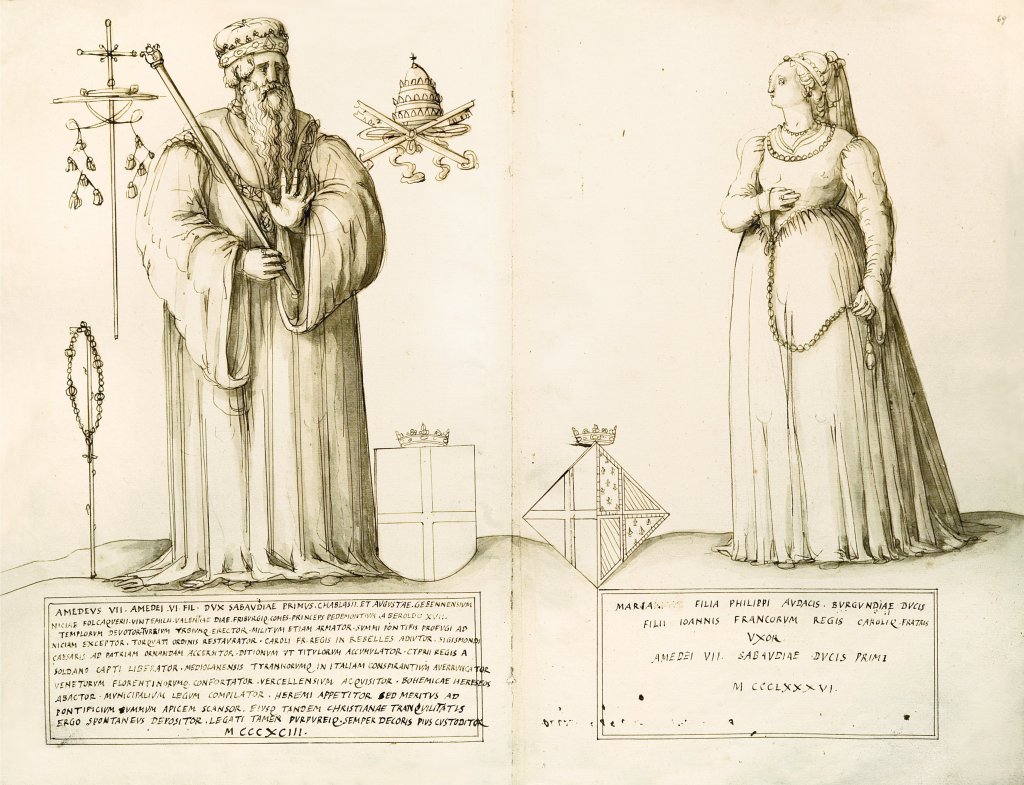
Amedeus VIII and his wife Mary of Burgundy,
in Imagines ducum Sabaudiae by Filiberto Pingone.
Storia della Real Casa, categoria II, Storie generali, mazzo 3, 1572
© Archivio di Stato di Torino
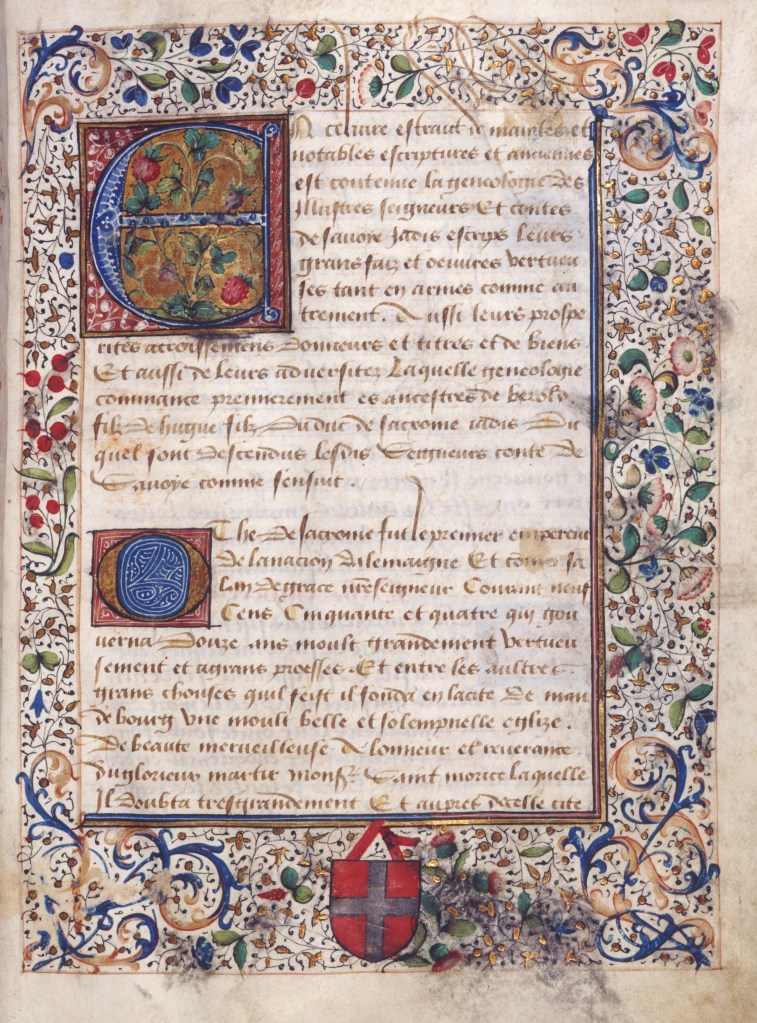
Jean d’Orville, dit Cabaret, Chroniques de Savoie,
Museo storico dell’Archivio (già Storia della Real Casa, categoria II, Storie generali,
mazzo 1, fascicolo 1, foglio 21r), XV secolo
© Archivio di Stato di Torino
 LES AMIS DU PATRIMOINE EUROPÉEN