Glamis Castle
Glamis, United Kingdom
www.glamis-castle.co.uk
🇫🇷 🇬🇧

Glamis Castle and grounds © Strathmore Estates (Holding) Ltd.
Texts: Ingrid Thomson, Glamis Castle Archivist.
In 1372, King Robert II granted the Thanage of Glamis to Sir John Lyon for services to the crown, and four years later Sir John married the King’s daughter, Princess Johanna Stewart. The origins of the Lyons are obscure, but according to family tradition, the Lyons (‘de Leonne’) came to Scotland from France, by way of England, in the late 11th century.
Glamis was believed to be a royal hunting lodge at the time of its first grant, but the building of the castle, as we know it today, dates from the 1400s. Between 1435 and 1459, Patrick, 1st Lord Glamis began work on building an enormous detached L-Tower of three floors, all of which were vaulted, and the work was completed by his widow, Lady Isobel Ogilvy. The castle was seized by King James V of Scotland, who maintained a royal establishment there from 1537 to 1542, during which time it was remodelled into a palace, whereby the older hall-house became the Royal apartments, which was connected to the halls in the newer L- Tower by means of a double flight staircase. In 1603 Patrick, 9th Lord Glamis (the 1st Earl of Kinghorne from 1606) began the transformation of the L-Tower into a Renaissance Palace, marked by two further floors of chambers and galleries, a magnificent stair tower and impressive roof-line. H Gordon Slade states that ‘French influence is clearly to be seen, but the work – Huntly [previously known as Castle Lyon] in 1602 and Glamis in 1606 – is a little old fashioned by French fashions of the day. It is tempting to conclude that a member of the Bell family [the great Aberdeen dynasty of castle masons] brought back his own memory of France.’ [Slade, H. Gordon, Glamis Castle 1372-1626: From Medieval Hunting Lodge to Feudal Castle and Renaissance Palace, p.234 (Chateau Gaillard, XVI, 1994)]
Patrick, 3rd Earl of Strathmore and Kinghorne (the Strathmore title was granted in 1677), began the transformation of the medieval castle into a symmetrical and castellated mansion in the architectural style of baronial baroque and the West wing and NE wing (Chapel) were built around 1679-1683. He also set the Castle in a complex of formal gardens and laid out the main avenue at 45 degrees to the Castle. John, 9th Earl, pulled down the west wing and added new kitchens and the Billiard Room in 1773 and new service courts beyond the east wing. He began remodelling the policies pulling down the garden walls in front of the Castle and moving, in 1775, the gates to the periphery of the policies. Although his son, John, 10th Earl, lived largely on his estates in County Durham, he continued his father’s work at Glamis and re-roofed the east wing in 1797 and rebuilt the west wing in 1798-1801.
Claude, the 13th Earl modernised the Castle and gas was introduced in 1865, along with running water and then in 1866, central heating. Gas was replaced by electricity in 1929. The 13th Earl also built a 5-acre walled garden in 1866 to provide fruit, vegetables and flowers for the Castle and the Chapel re-opened in the same year. He refaced the servants’ courts beyond the east wing in 1891-1897 and created the Dutch garden in 1893. This return to a formal style was continued with the creation by The Queen Mother’s parents of the Italian Garden in 1910. This was the last major alteration and completes the modern-day appearance of the Castle. Timothy, the 16th Earl, opened the Castle to visitors in 1950.
The surname ‘Bowes’ arrived at Glamis in the 18th century. Mary Eleanor Bowes was the daughter and sole heir of George Bowes, MP, the prominent coal magnate, who held extensive lands in the County of Durham and elsewhere in England and was a direct descendant of Sir Robert Bowes, who was Queen Elizabeth I’s Ambassador to Scotland from 1577 to 1583. Mary Eleanor married John, 9th Earl, in 1767 and a stipulation of her marriage contract, previously laid down by her father in his will, was that any future husbands should take the name of Bowes. The 9th Earl did so, but although the marriage resulted in 5 children, it was not a happy one and it ended with the Earl’s death in 1776. As a wealthy heiress, Mary Eleanor soon became the focus of fortune hunters, the most persistent and devious of which was her second husband, Andrew Stoney Bowes, who duped her into marriage following a fake dual in 1777. After years of mental and physical abuse, Mary Eleanor managed to escape from her psychopathic second husband and was granted a divorce in 1786. Her son from her first marriage, John, 10th Earl of Strathmore, took the name of Bowes, but following his death the Scottish title passed to his brother, Thomas, and the name gradually changed to Lyon-Bowes and then gradually evolved to Bowes Lyon (without the hyphen, so that the emphasis was on the Lyon surname).
Glamis is probably best known for its association with Shakespeare’s play Macbeth, written for King James VI of Scotland and I of England after his accession to the throne of England in 1603. Patrick, 9th Lord Glamis accompanied his royal master to the English court, where he would have met Shakespeare, and three years later the King elevated him to the Earldom of Kinghorne. Although there is no record of Shakespeare visiting Glamis, he is believed to have been part of a touring theatre company which visited Aberdeen in 1599, so it is possible that he may have passed by Glamis during his travels. The slaying of King Duncan by Macbeth in fact took place at Elgin, nevertheless the Macbeth tradition lives on at Glamis.
Glamis Castle was the Scottish childhood home of Lady Elizabeth Bowes Lyon, the youngest daughter of the 14th Earl of Strathmore and Kinghorne. She married Prince Albert, Duke of York in 1923 and subsequently spent many happy holidays at Glamis with her husband. They were crowned King George VI and Queen Elizabeth Queen Consort in 1937, and their children, Princess Elizabeth (Queen Elizabeth II) and Princess Margaret Rose, who was born at Glamis in 1930, also enjoyed visiting Glamis during their childhood. The 19th and present Earl, Simon, succeeded his father in 2016.
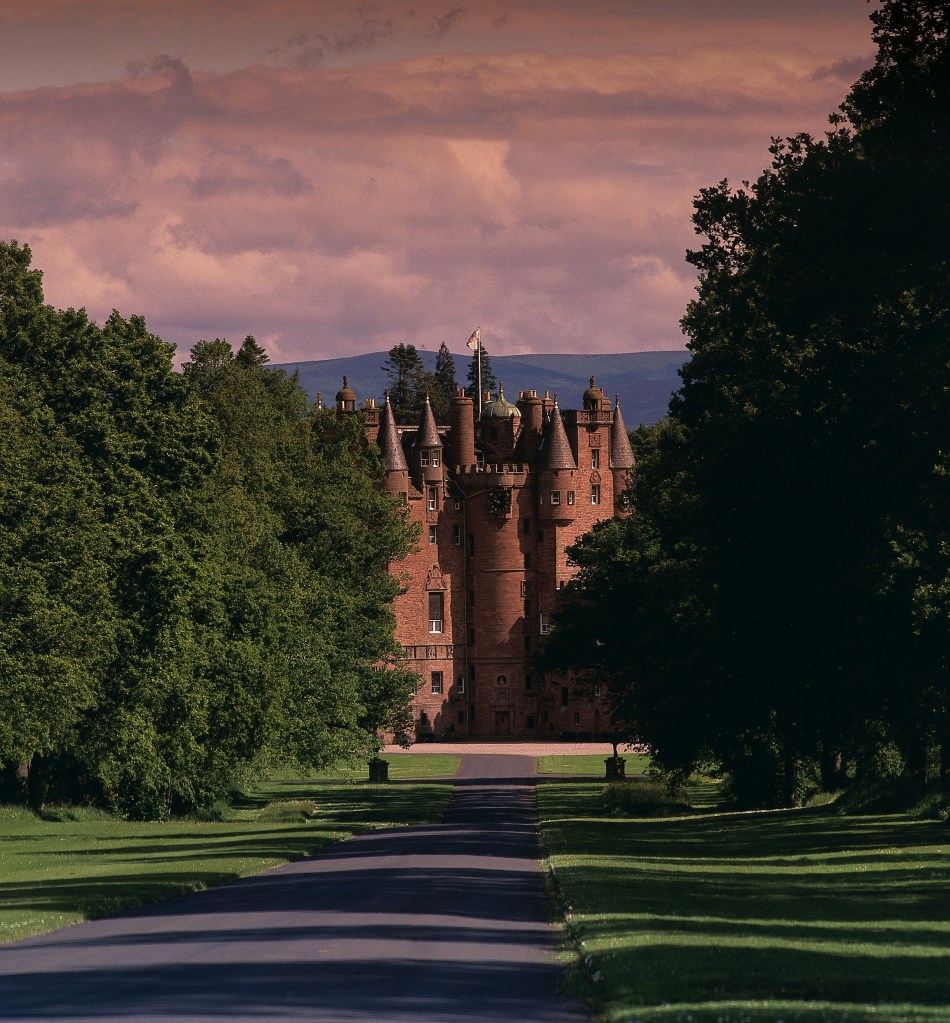
Glamis Castle © Strathmore Estates (Holding) Ltd.
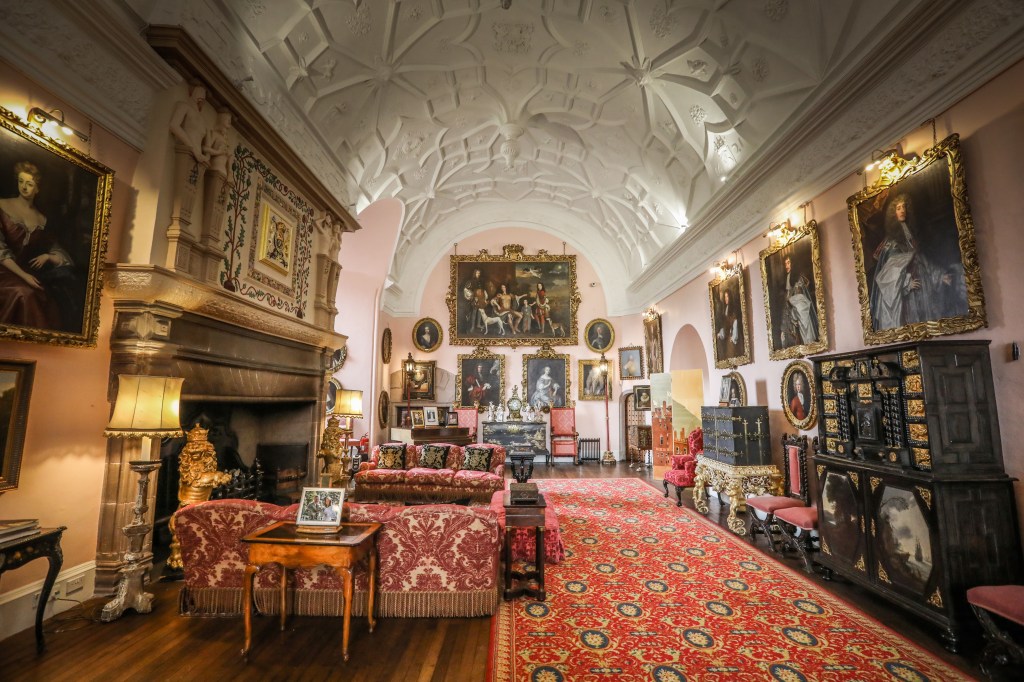
Glamis Castle Drawing Room © Strathmore Estates (Holding) Ltd.
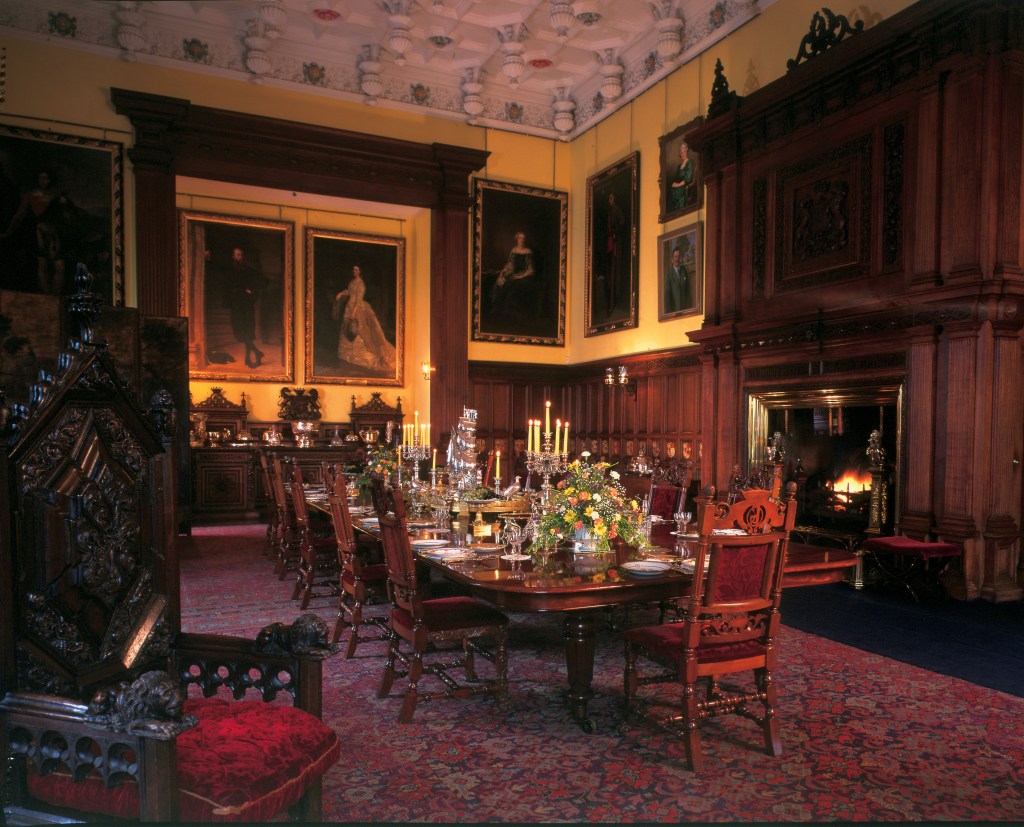
Glamis Castle Dining Room © Strathmore Estates (Holding) Ltd.
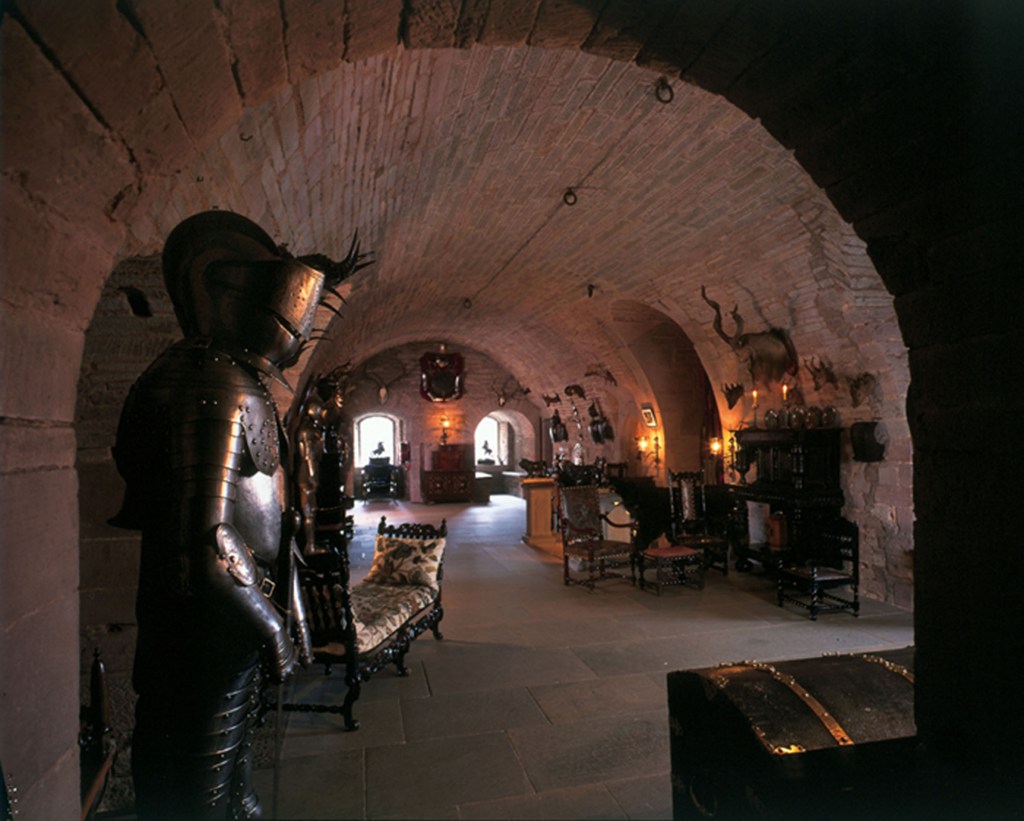
Glamis Castle Crypt © Strathmore Estates (Holding) Ltd.
Portrait of the third Earl and his sons
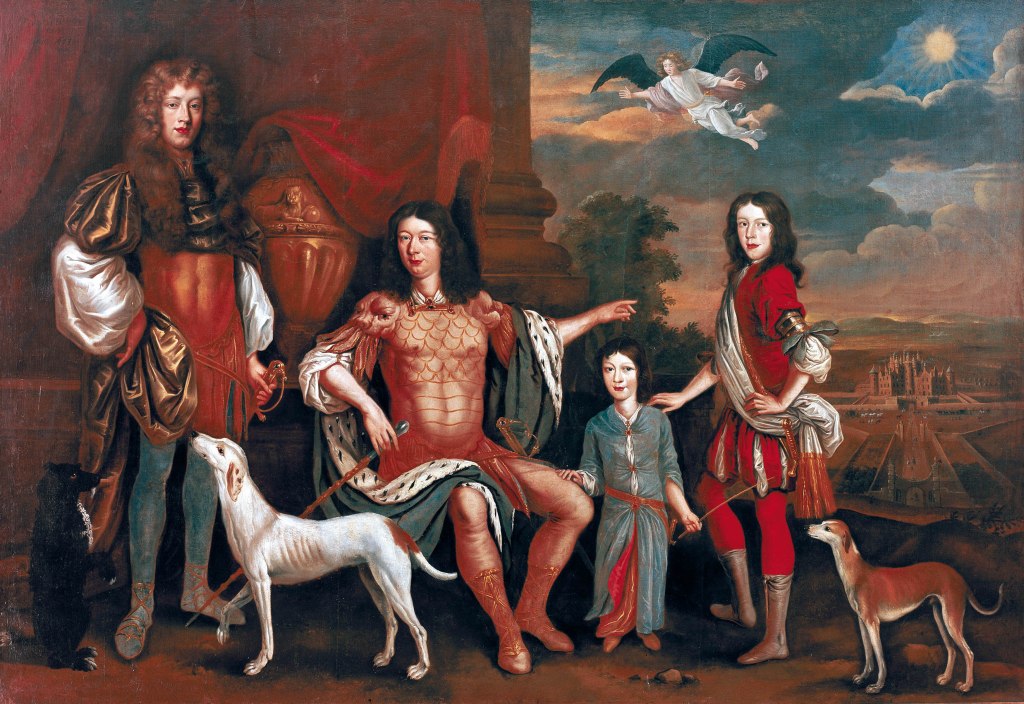
Painting of Patrick, 3rd Earl of Strathmore and Kinghorne with his three sons, pointing proudly at Glamis Castle in the background, by Dutch artist, Jacob de Wet.
© Strathmore Estates (Holding) Ltd.
This exceptionally ambitious oil on canvas portrait group, which celebrates the 3rd Earl’s reconstruction of Glamis, ranks as one of the masterpieces of Dutch artist, Jacob de Wet, who arrived in Scotland in 1673, as a portraitist. Patrick, 3rd Earl of Strathmore and Kinghorne (1643-1695) was de Wet’s most loyal Scottish patron. The painting measures 90” x 116” and the frame is the most elaborate of a series executed for the 3rd Earl which are among the most notable of their date in Scotland.
Wearing an impressive Romanesque flesh-coloured armour with lion epaulettes (fashionable attire for portraits of noblemen at the time, perhaps to display power) Patrick gestures toward Glamis Castle, which he restored and remodelled in the late 17th century. Patrick is flanked by his sons – John, Viscount Glamis, later 4th Earl (1663 – 1712) on the left, with Charles Lyon (d. 1692), and Patrick Lyon of Auchterhouse, M.P. (d. 1715) on the right. All are in classical hunting costume, with two hounds, on a draped terrace with an urn carved with a lion, with Glamis Castle and its policies beyond. The black winged angel appears to be embracing the scene from above.
Among the personal papers of the successive Earls of Strathmore and Kinghorne is the original manuscript of the Book of Record – a detailed journal or diary written by Patrick, the 3rd Earl between 1684 and 1689. Patrick’s father, John, 2nd Earl of Kinghorne, died in 1646 when Patrick was just two years old and the infant Earl inherited an enormous debt of £400,000, Scots from his father (which would equate to around £4million today). This was exacerbated five years later by the fact that Oliver Cromwell placed a large garrison of English soldiers in Glamis Castle and imposed an annual tax of £1000 upon the estate. Patrick’s business skills allowed him to make substantial additions to his remaining estates and he spent large sums on improvements at Glamis Castle. The Book of Record provides a unique insight into Patrick’s life and this impressive painting rightly portrays a strong and successful Earl
The Chapel
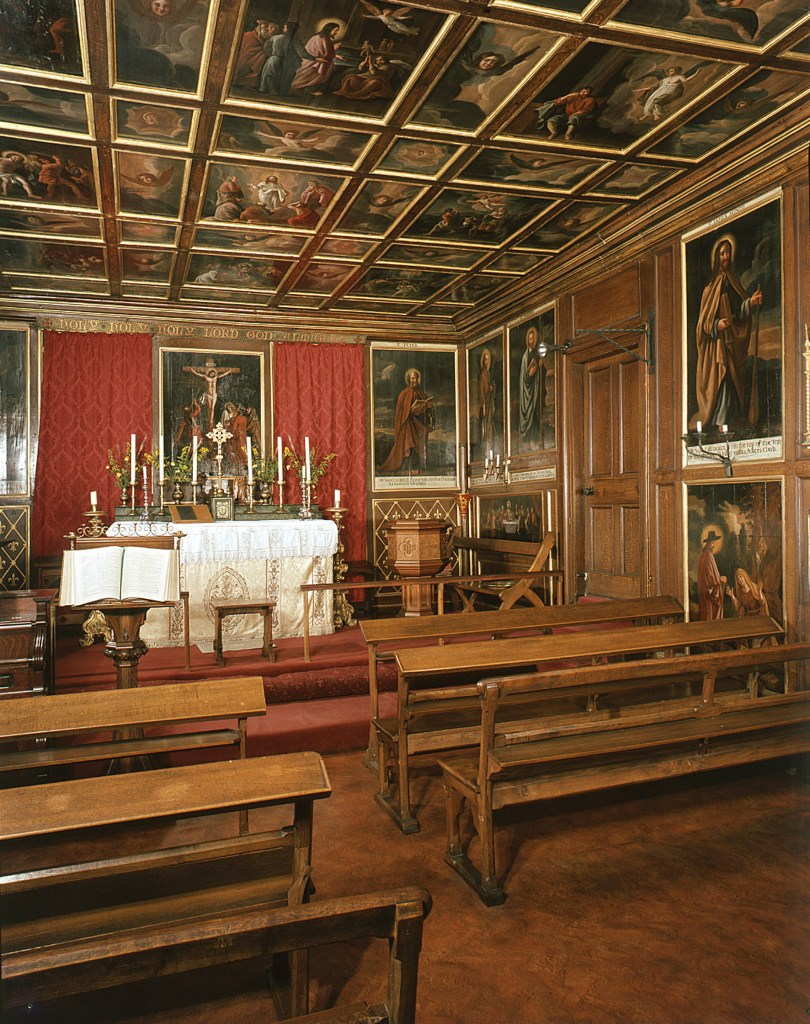
Glamis Castle Chapel © Strathmore Estates (Holding) Ltd.
The richly decorated panels on the walls and ceiling make the Glamis Castle Chapel one of the most beautiful small private chapels in Europe. Built between 1679 and 1683 by the 3rd Earl of Strathmore and Kinghorne, the ceiling and wall paintings were added in 1688 when the 3rd Earl commissioned Dutch artist Jacob de Wet to paint scenes. De Wet came to the Castle after he had finished a commission at the Palace of Holyrood in Edinburgh for King Charles II. His contract, dated 18 January 1688, stated that de Wet was to receive £90 and the paintings were to conform to scenes in Lord Strathmore’s Bible. That Bible has not been traced but recent research suggests that the ceiling panels, which depict fifteen scenes from the Life of Christ, were based on engravings by Boetius à Bolswert, dated 1622, and the wall paintings of the Twelve Apostles were based on engravings by Jacques Callot published in 1631. One of the curiosities of these scenes is that depicting Christ in a hat mistaken for a gardener by Mary Magdalen. The Chapel was consecrated in 1688 once the work had finished.
However, the Chapel is not only noteworthy for its religious art, but also for its historical, and paranormal significance. The Jacobite King James VIII and III, known by his enemies as the ‘Old Pretender’, visited Glamis in January 1716. He conducted a ceremony in the Chapel at which sufferers of the ‘King’s Evil’ (another name for the disease of scrofula, a form of tuberculosis which caused swelling of the lymph nodes in the neck) were presented to the King and “touched”, as it was believed that only rightful monarchs could successfully bring about cures. The King would also give the sufferer a coin known as a ‘touch-piece’, one of which survives in the Castle Archives.
James was the son of the deposed King James II and VII and his second wife, the Catholic Mary of Modena. The birth of James on 10 June 1688 precipitated the invasion of England by the Protestant William, Prince of Orange, who was married to Mary, daughter of King James II and VII and his first wife, Anne Hyde. When William landed in England in 1688, James’s army deserted, and he went into exile in France. James remained king until 4 April 1689, when the Convention of Estates voted that he had forfeited the crown and offered the throne jointly to William and Mary. James attempted to recover his kingdoms but after his defeat at the Battle of Boyne in July 1690, he returned to France, where he spent the rest of his life in exile. When James died in 1701, his son James Frances Edward Stuart took up the reins of the Jacobite cause, declaring himself King James VIII of Scotland and III of England.
After Queen Anne, James’s half-sister, died in 1714 the throne passed to a distant relative, the Protestant Elector of Hanover, who succeeded as King George I. Jacobite supporters used the occasion to attempt a rebellion in 1715 and John, 5th Earl of Strathmore and Kinghorne raised a Strathmore Regiment of around 300 men to fight for the Jacobites, but he was killed at the Battle of Sheriffmuir. James landed in Scotland and stayed at Glamis on his way to Scone Palace where he set up a court in January 1716, but with government forces approaching, he left Scotland secretly in February. After a brief stay in Avignon, the Pope offered James refuge in Rome in 1717, where he remained for the rest of his life. James was involved in an attempted Spanish invasion of Scotland in 1719, but the next (and last) serious Jacobite uprising was led by his son Charles Stuart (1720-1788) in 1745. Charles’s defeat at Culloden in 1745 effectively ended Jacobite hopes for the restoration of the throne.
The Chapel fell into disuse for some years but in 1866 it was restored by the 13th Earl of Strathmore and dedicated to St Michael and All Angels. The stained-glass window showing St Michael was inserted in 1867-68 and the windows in the north wall, made by Charles Eamer Kempe of London, were added in 1882-83. In 1979-80 the wall paintings were cleaned and restored by the Stenhouse Conservation Centre in Edinburgh. A service was held in 1988 to celebrate the Chapel’s tercentenary and Queen Elizabeth The Queen Mother unveiled a commemorative plaque. The Strathmore family regularly use the Chapel today, with services conducted according to the rites of the Scottish Episcopal Church.
A family story relating to the Chapel is that of Rose, the sister of Queen Elizabeth The Queen Mother, who was to play the organ for the Sunday Service and came in during the week to practice. Opening the door, she noticed a lady dressed in grey praying, so she waited outside for her to finish. Finally looking in, she saw the woman had vanished. What she had witnessed, it is said, was the ghost of Janet Douglas, known as ‘The Grey Lady’. Janet Douglas, Lady Glamis, widow of the 6th Lord Glamis, was burnt at the stake in Edinburgh in 1537 following false accusations of treason against King James V. The Chapel is said to be haunted by ‘The Grey Lady’ who reputedly sits in the chair in the corner of the room. It was Janet’s misfortune to be the sister of Archibald Douglas, Earl of Angus, who was the King’s despised stepfather. Well-liked by her peers and tenants alike, several noblemen refused to sit on her trial and condemn her. However, despite a lack of evidence against her, the King’s wishes inevitably prevailed, and she was found guilty. The court also convicted and sentenced her son, John Lyon, 7th Lord Glamis, but postponed his execution until he was of age. King James V maintained a permanent royal establishment at Glamis Castle until his death in 1542, after which John was released and in 1544 the forfeiture of his lands was overturned.
Janet Douglas was unfortunate to have been a political pawn in a tempestuous era when women had little power, but she displayed great bravery and staunchly defended herself in her last speech. Perhaps to make amends for her father’s vindictiveness, Mary, Queen of Scots, visited Glamis Castle on 22nd August 1562 on her way north to quell a rebellion. Mary and her entourage stayed at Glamis for two nights, dining in the Great Hall (now the Drawing Room).
Mary, Queen of Scots, was a very French figure. In 1548, at the age of just five, she left Scotland for France, where she spent her formative years. A decade later, she married the heir to the French throne, the Dauphin François, and in July 1559, when François succeeded his father Henri II, she became Queen of France. Although Mary returned to Scotland in 1561 following the death of her husband, she continued to possess and manage considerable French estates and during her long imprisonment in England, Mary maintained a predominantly French household and a pronounced interest in French affairs. French was to remain her first language.
Ironically, Mary, Queen of Scots suffered a similar fate as Janet Douglas when her cousin, Queen Elizabeth I of England, signed her death warrant following accusations of a plot and she was executed at Fotheringhay Castle in 1587, fifty years after Janet’s execution
The sundial
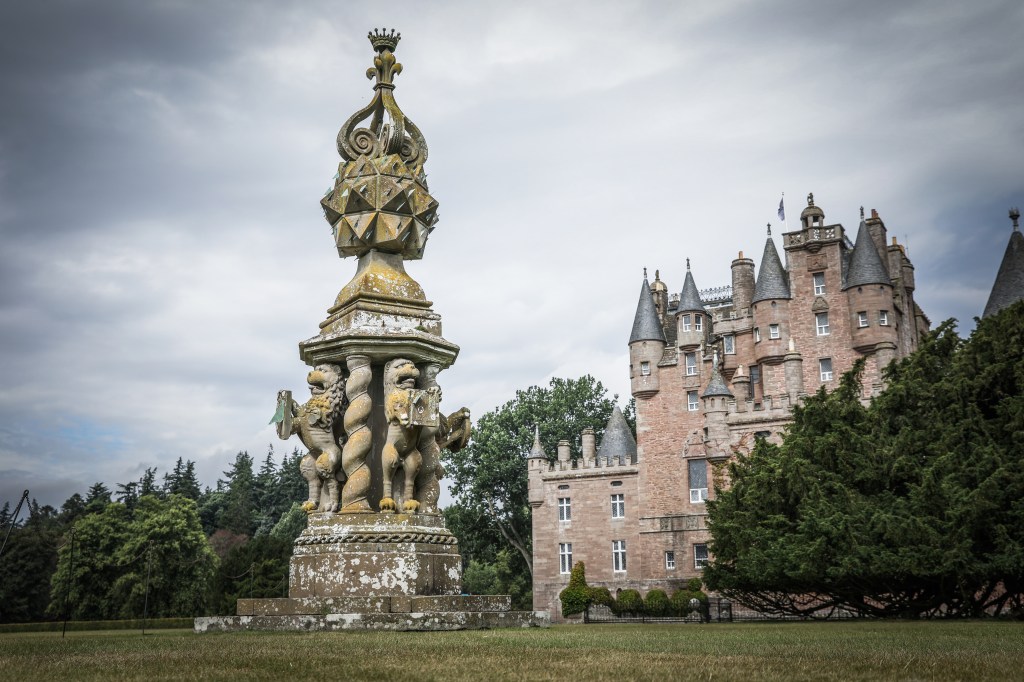
The sundial at Glamis © Strathmore Estates (Holding) Ltd.
Commissioned by Patrick, 3rd Earl, in the 1670s, the sundial at Glamis is the tallest in Scotland, standing 21 feet high, with 84 time-recording faces. The 3rd Earl confided in his Book of Record, “There is in the garden a fine dial erected”. It is a majestic masterpiece with four large lions carrying four sundials in their claws that represent the history of the Lyon family back to 1372. The lions are topped with a canopy, and above this rises a tiered base for the mathematical ‘pineapple’ with 80 individual dial faces. The finial finishes with a flourish—four beautiful curling scrolls, a lovely ‘fleur-de-lys’ or lily flower, and the tips of four petals balancing the coronet for the Earl.
It exuberantly displays the art of the designer, the skill of the stonemason, the genius of the mathematician and the pride of the earldom. The days of the year are not equal in length, although a clock pretends they are. To reconcile sundial time with clock time, some minutes must be added or subtracted. This correction factor, called the Equation of Time, is engraved around the octagonal base. The calculations may be ascribed to James Gregory, Professor of Mathematics at St Andrews University from 1669 to 1674.
The Glamis sundial was a scientific exhibition piece of its time, and visitors today can still see this spectacular structure standing proudly in the foreground of Glamis Castle.
 LES AMIS DU PATRIMOINE EUROPÉEN