Riddarholmen Church
Stockholm, Sweden
www.kungligaslotten.se

Riddarholmen Church is Stockholm’s oldest preserved building.
The oldest parts were constructed by the Franciscan order in the latter half of the 13th century.
The first tower was added by order of Johan III in the 1570s.
© De Kunglinga Slotten. Photo: Erik Lefvander
Textes : the team at the Swedish Royal Palaces.
Published on 8 April 2025.
The Riddarholmen Church is the final resting place of the Swedish kings, and is Stockholm’s only preserved medieval abbey. The church’s history dates back to 1270, when the Franciscan monastery was founded on what is now Riddarholmen, the Knight’s Island. The Franciscan order was founded in Italy in the early 1200s by Francis of Assisi and came to Sweden in the 1220s. Here, it was also called the Grey Friars, after the grey robes worn by the monks. The construction of the church itself probably began a few years later, but by 1285 we can conclude that the building was in full swing. At that time, King Magnus Birgersson, also known as Magnus Ladulås, wrote in his will that he wished to be buried in the monastery church. This was likely fulfilled. The exact location of Magnus Ladulås’s grave remains unknown. Investigations of the official grave in 2011 revealed that it contained the remains of a family from the 1400s and 1500s. The exact burial site of Magnus Birgersson is still unclear, but according to the latest theory, he lies in a newly discovered burial chamber located between the two tombs. What is certain is that the royal burial church houses the remains of Swedish monarchs from Gustav II Adolf (d. 1632) to Gustaf V (d. 1950), with Queen Christina being the only exception. It is also the church for the Knights of the Order of the Seraphim. Since 1748, the walls of Riddarholmen Church have been adorned with the coats of arms of deceased knights. Riddarholmen Church is open to visitors during the summer season from May to September.
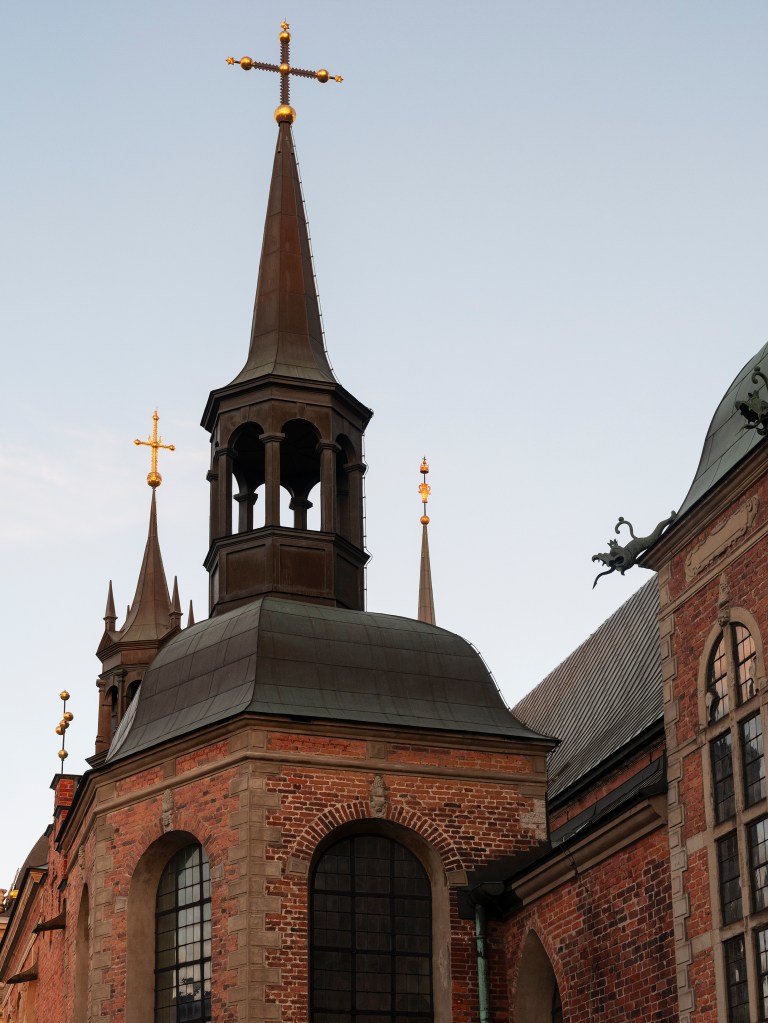
Riddarholmen Church was completed around 1300 and was almost entirely built of brick,
which was unusual in Sweden.
© De Kunglinga Slotten. Photo: Erik Lefvander
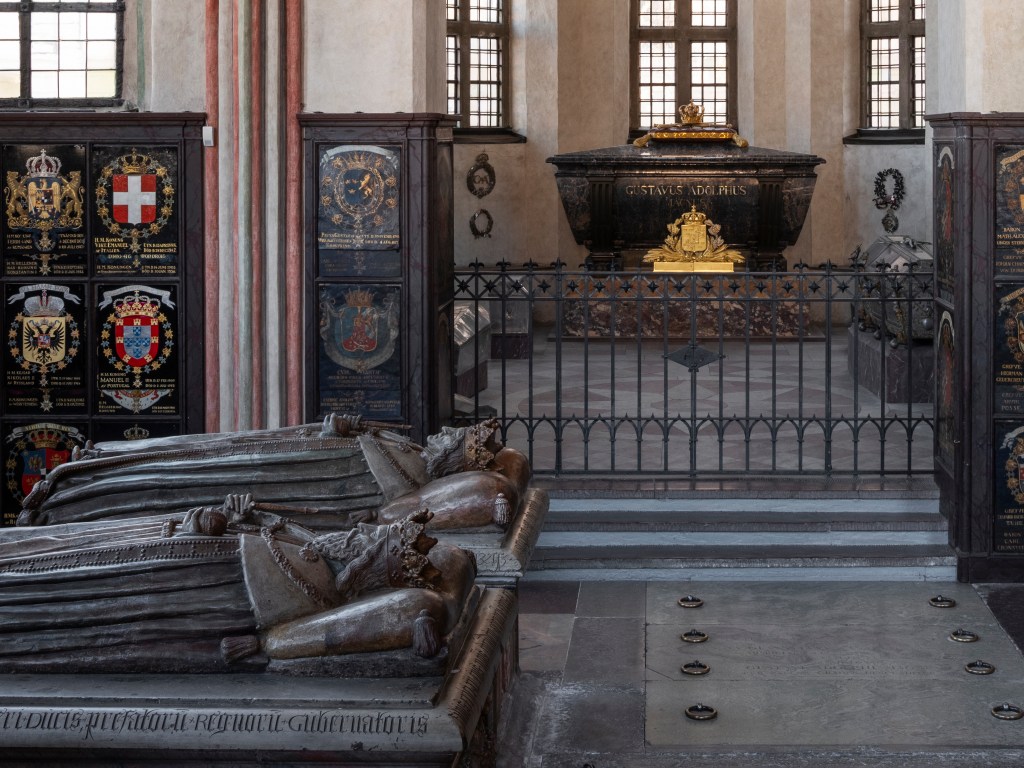
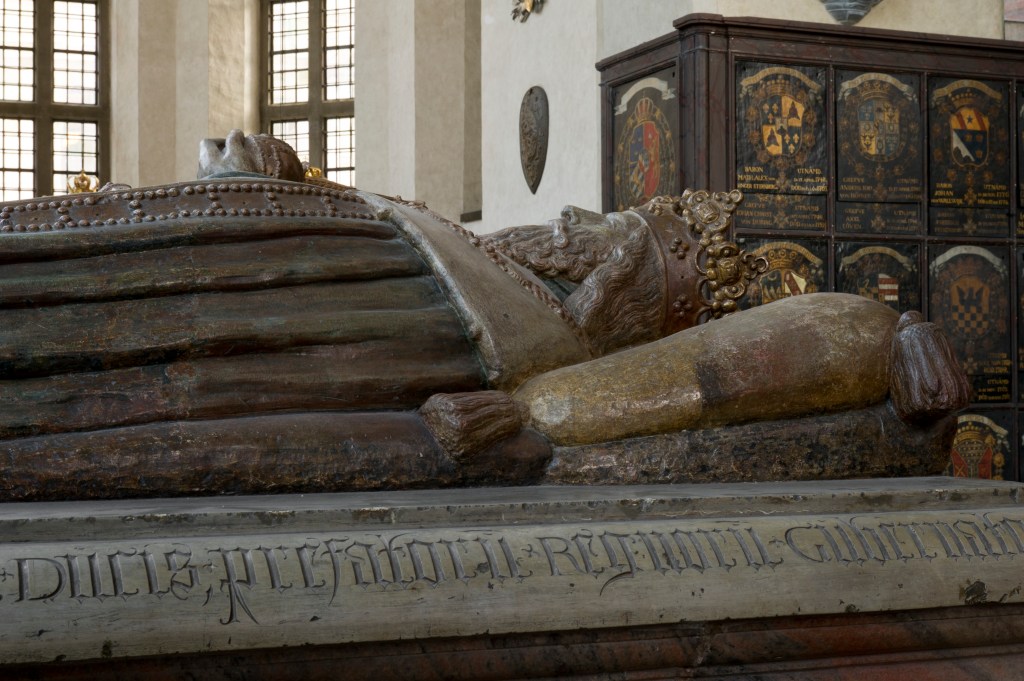
Medieval kings Magnus Ladulås and Karl Knutsson Bonde.
In the background, the sarcophagus of Gustav II Adolf.
© De Kunglinga Slotten. Photo: Erik Lefvander
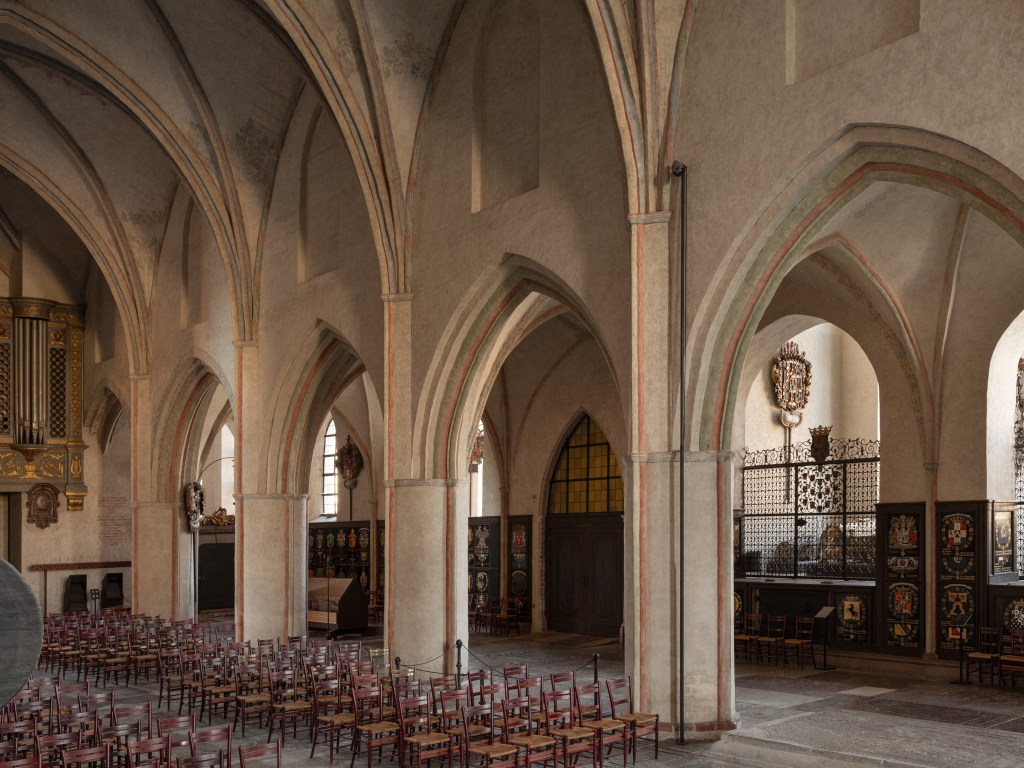
The cross vaults.
© De Kunglinga Slotten. Photo: Erik Lefvander

The first tower was destroyed in a fire in 1835. Erik Gustaf Göthe created the current tower.
On the suggestion of the Swedish-English engineer Samuel Owen,
the spire was made of cast iron, a Swedish export material.
In 2025, a renovation of the cast iron spire will begin.
© De Kunglinga Slotten. Photo: Erik Lefvander
A SELECTION OF TREASURES
The Royal Graves
The official grave of Magnus Ladulås
© De Kunglinga Slotten. Photo: Alexis Daflos
After the Reformation Parliament in Västerås in 1527, when Sweden broke with the Roman Catholic Church, the Franciscan monks were forced to leave the monastery, and the monastery buildings were either demolished or converted. The church, however, survived, and at the front of the choir still rest Magnus Ladulås (possibly) and Karl Knutsson Bonde under their tombs, created by the Dutchman Lucas van der Werdt in 1574 on the orders of Johan III. A new chapter in the history of Riddarholmen Church began when Gustav II Adolf, before heading to the battlefields on the continent in 1629, commanded that a burial chapel be built for him on the south side of the church – what is now known as the Gustavian Chapel. Just three years later, in 1632, Gustav II Adolf fell at the Battle of Lützen and was laid to rest here. This was followed by the Carolinian Chapel, which includes the grave of Karl XII, and the Bernadotte Chapel, with Karl XIV Johan’s magnificent sarcophagus as the focal point. The sarcophagus is made of granite from Älvdalen. Gustaf V was the last to be laid to rest in Riddarholmen Church in 1950.
Here you can find a list of all the royal graves.
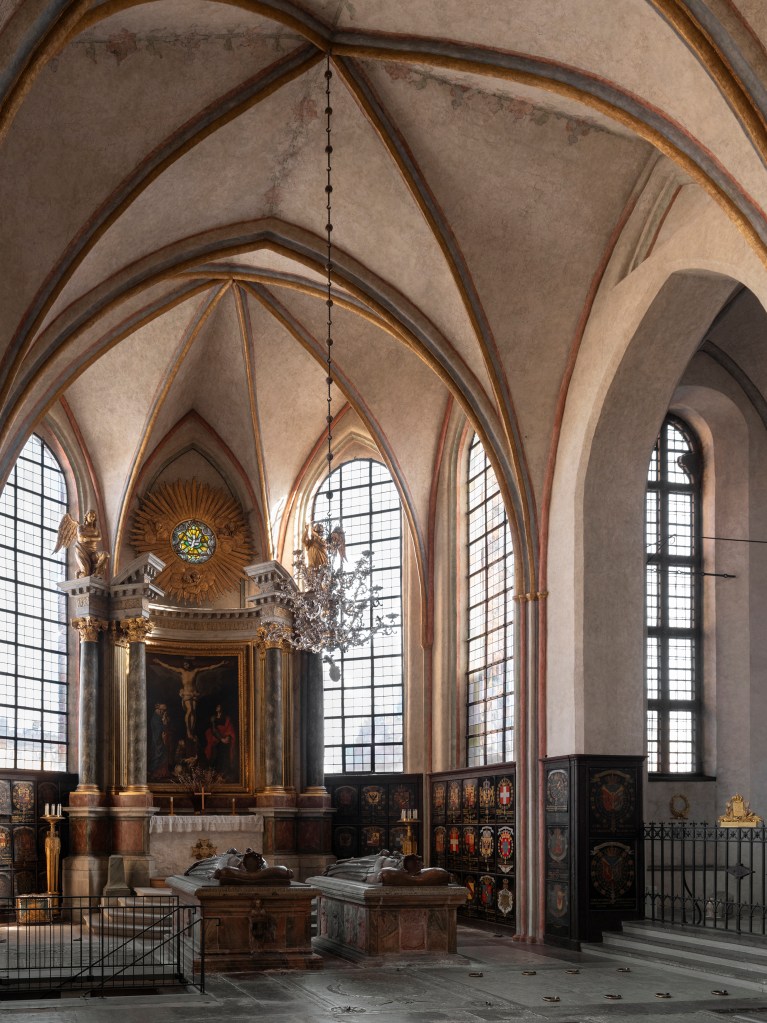
In the high choir, the tombs commissioned by Johan III for the first two kings buried in the church, Magnus Ladulås and Karl Knutsson Bonde.
© De Kunglinga Slotten. Photo: Erik Lefvander
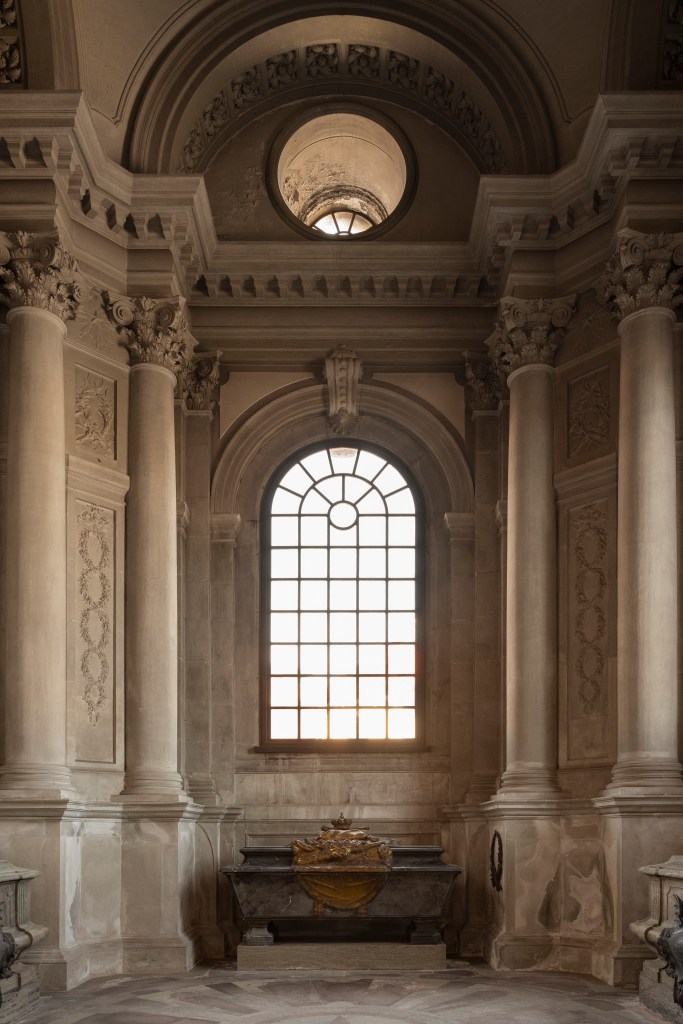
The grave of Karl XII in the Carolinian Chapel
© De Kunglinga Slotten. Photo: Erik Lefvander
The Coats of Arms
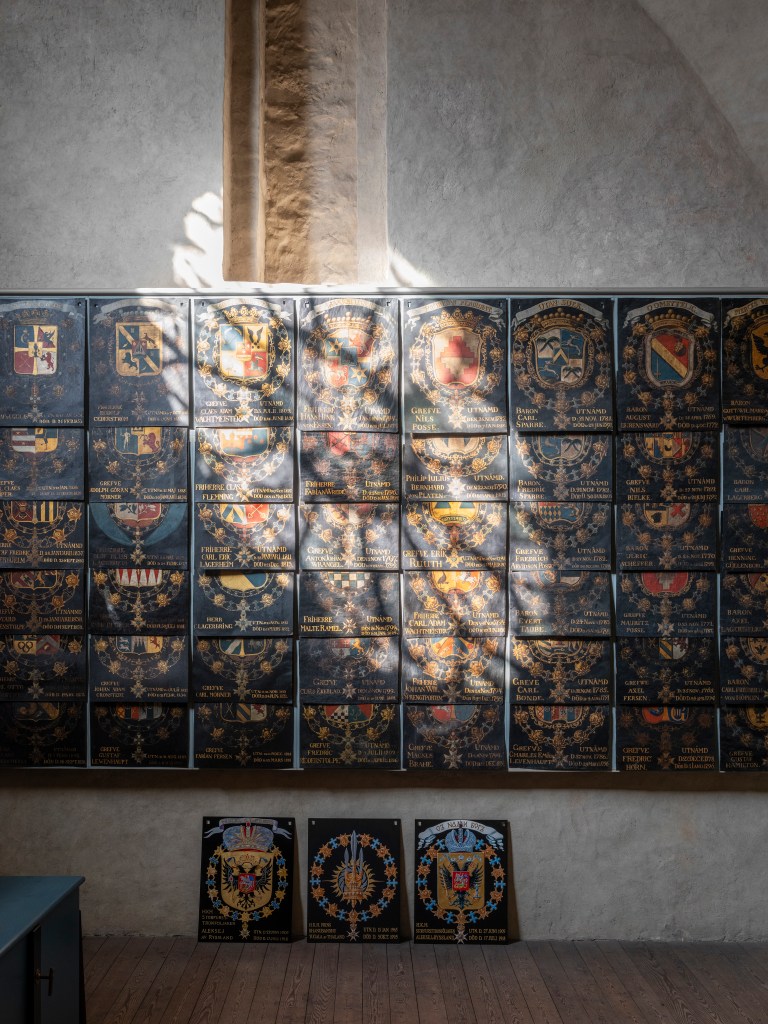
The church houses approximately 850 shields.
© De Kunglinga Slotten. Photo: Erik Lefvander
The royal burial church on Riddarholmen is also an order church. Upon the death of a Knight of the Order of the Seraphim, they are honoured with a Seraphim ringing, and their coat of arms is brought to Riddarholmen Church. The Order of the Seraphim is Sweden’s foremost order and has one class, Knight or Member (for women). It is now only awarded to members of the Swedish Royal Family and to foreign heads of state or equivalent persons in connection with state visits. Since 1748, the walls of Riddarholmen Church have been adorned with the coats of arms of the Knights of the Order of the Seraphim. When a Seraphim Knight dies, the coat of arms is updated with the date of death before being brought to Riddarholmen Church. On the day of a Seraphim Knight’s funeral, the church bells ring, a so-called Seraphim ringing. Since the church has not been a parish church for over 200 years, these ringings are one of the few occasions when the church bells ring.
The Grave of Christ
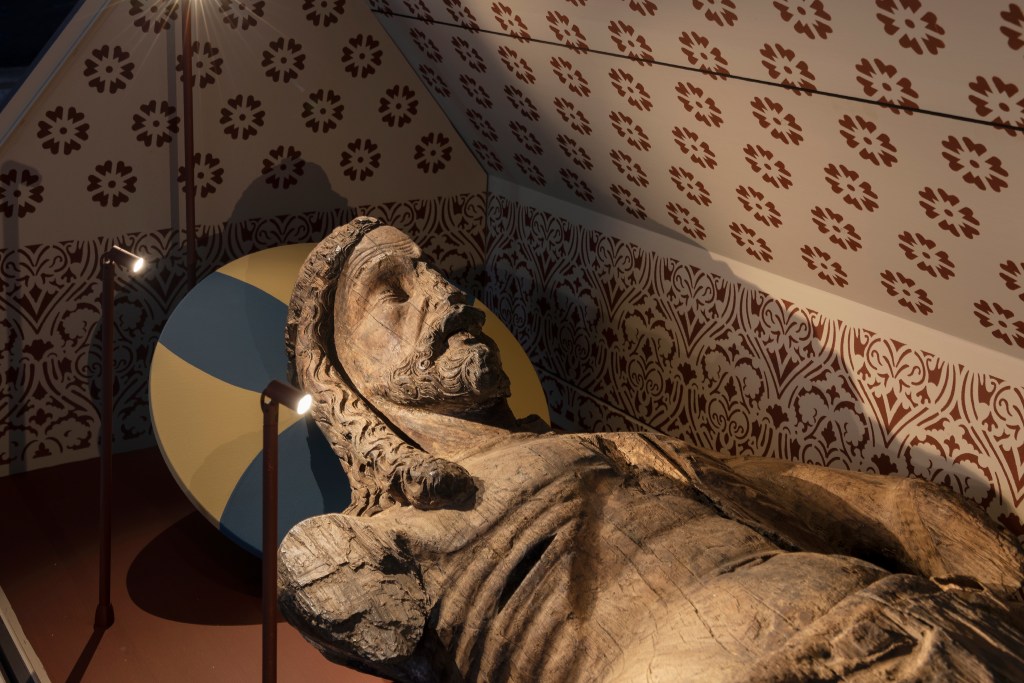
The Christ sculpture © De Kunglinga Slotten. Photo: Sanna Argus Tirén
The latest addition to Riddarholmen Church is also one of the church’s oldest objects – a wooden sculpture of Christ from around 1400. During the Middle Ages, it was used in Passion plays during Easter. The old wooden sculpture of Christ came to Riddarholmen Church during the Middle Ages. In the 1700s, it was moved, faced various fates, and returned to the church again in the early 1800s. At that time, there was no place for the sculpture, so it was placed in the attic and more or less forgotten. Now, the over 600-year-old and 187 cm long sculpture of solid oak has been conserved, given a new coffin, and is once again in its original place in the church’s northern side aisle.
 LES AMIS DU PATRIMOINE EUROPÉEN