
Westminster Abbey
London, United Kingdom
www.westminster-abbey.org
🇫🇷 🇬🇧

West front of Westminster Abbey © Dean and Chapter of Westminster, 2024.
Text: Westminster Abbey
An architectural masterpiece of the 13th to 16th centuries, Westminster Abbey also presents a unique pageant of British history – the shrine of St Edward the Confessor, the tombs of kings and queens, and countless memorials to the famous and the great. It has been the setting for every Coronation since 1066 and for numerous other royal occasions, including sixteen royal weddings. Today it is still a church dedicated to regular worship and to the celebration of great events in the life of the nation. Neither a cathedral nor a parish church, Westminster Abbey (or the Collegiate Church of St Peter, Westminster to give it its correct title) is a « Royal Peculiar » under the jurisdiction of a Dean and Chapter, subject only to the Sovereign and not to any archbishop or bishop. Westminster Abbey is the result of a process of development across the centuries, which represents the response of a monastery and later a post-Reformation church to the stimulus and challenge of its environment.
In the 1040s King Edward (later St Edward the Confessor) established his royal palace by the banks of the river Thames on land known as Thorney Island. Close by was a small Benedictine monastery founded under the patronage of King Edgar and St Dunstan around 960A.D. This monastery Edward chose to re-endow and greatly enlarge, building a large stone church in honour of St Peter the Apostle. This church became known as the « west minster » to distinguish it from St Paul’s Cathedral (the east minster) in the City of London. Unfortunately, when the new church was consecrated on 28th December 1065 the King was too ill to attend and died a few days later. His mortal remains were entombed in front of the High Altar.
Edward’s Abbey survived for two centuries until the middle of the 13th century when King Henry III decided to rebuild it in the new Gothic style of architecture. It was a great age for cathedrals: in France it saw the construction of Amiens, Evreux and Chartres and in England Canterbury, Winchester and Salisbury, to mention a few. Under the decree of the King of England, Westminster Abbey was designed to be not only a great monastery and place of worship, but also a place for the coronation and burial of monarchs. This church was consecrated on 13th October 1269. Unfortunately the king died before the nave could be completed so the older structure stood attached to the Gothic building for many years.
A remarkable new addition to the Abbey was the glorious Lady chapel built by King Henry VII, first of the Tudor monarchs, which now bears his name. This has a spectacular fan-vaulted roof and the craftsmanship of Italian sculptor Pietro Torrigiano can be seen in Henry’s fine tomb. The chapel was consecrated on 19th February 1516. Two centuries later a further addition was made to the Abbey when the western towers (left unfinished from medieval times) were completed in 1745, to a design by Nicholas Hawksmoor.
History did not cease with the dissolution of the medieval monastery on 16th January 1540. The same year Henry VIII erected Westminster into a cathedral church with a bishop (Thomas Thirlby), a dean and twelve prebendaries (now known as Canons). The bishopric was surrendered on 29th March 1550 and the diocese was re-united with London, Westminster being made by Act of Parliament a cathedral church in the diocese of London. Mary I restored the Benedictine monastery in 1556 under Abbot John Feckenham. But on the accession of Elizabeth I the religious houses revived by Mary were given by Parliament to the Crown and the Abbot and monks were removed in July 1559. Queen Elizabeth I, buried in the north aisle of Henry VII’s chapel, refounded the Abbey by a charter dated 21 May 1560 as a Collegiate Church exempt from the jurisdiction of archbishops and bishops and with the Sovereign as its Visitor. Its Royal Peculiar status from 1534 was re-affirmed by the Queen and In place of the monastic community a collegiate body of a dean and prebendaries, minor canons and a lay staff was established and charged with the task of continuing the tradition of daily worship (for which a musical foundation of choristers, singing men and organist was provided) and with the education of forty Scholars who formed the nucleus of what is now Westminster School (one of the country’s leading independent schools) [see the Treasure of Libraries # 04]. In addition the Dean and Chapter were responsible for much of the civil government of Westminster, a role which was only fully relinquished in the early 20th century.
There are around 3,300 burials in the church and cloisters and many more memorials. The Abbey also contains over 600 monuments, and wall tablets – the most important collection of monumental sculpture anywhere in the country. Notable among the burials is the Unknown Warrior, whose grave, close to the west door, has become a place of pilgrimage. Heads of State who are visiting the country invariably come to lay a wreath at this grave.
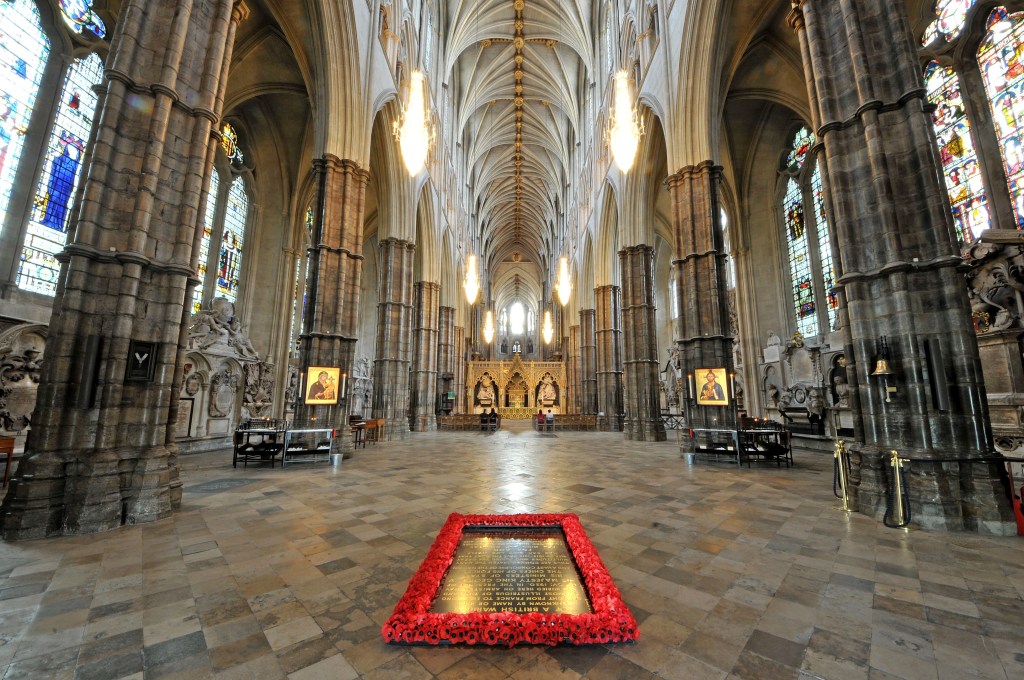
The Nave and the Grave of the Unknow Warrior
© Dean and Chapter of Westminster, 2024.
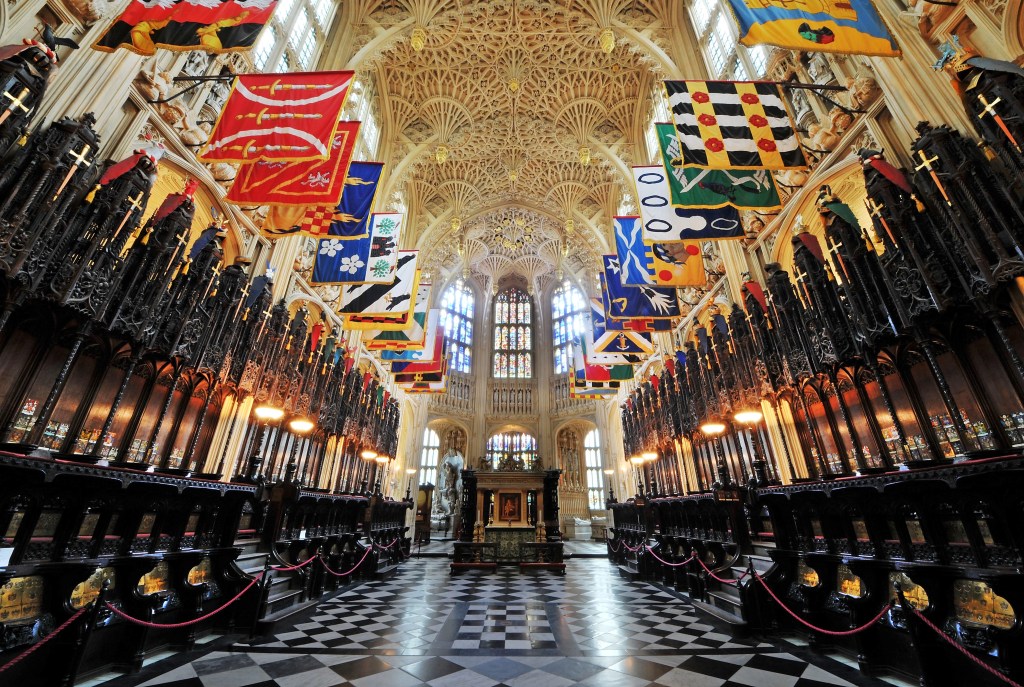
Henry VII’s Chapel © Dean and Chapter of Westminster, 2024.
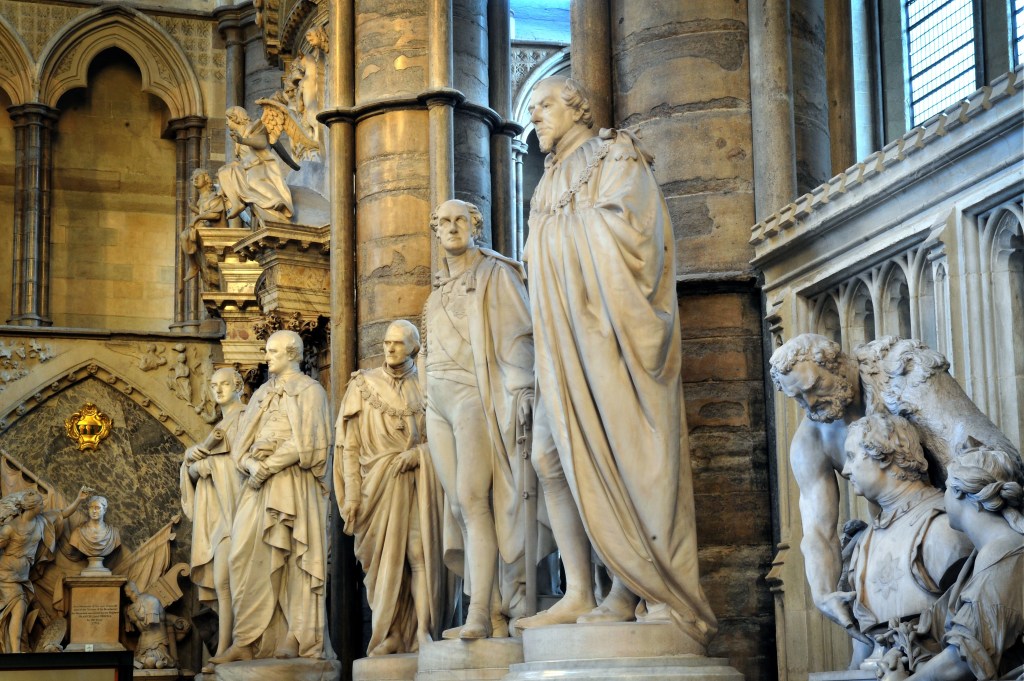
Monuments in the North Transept © Dean and Chapter of Westminster, 2024.
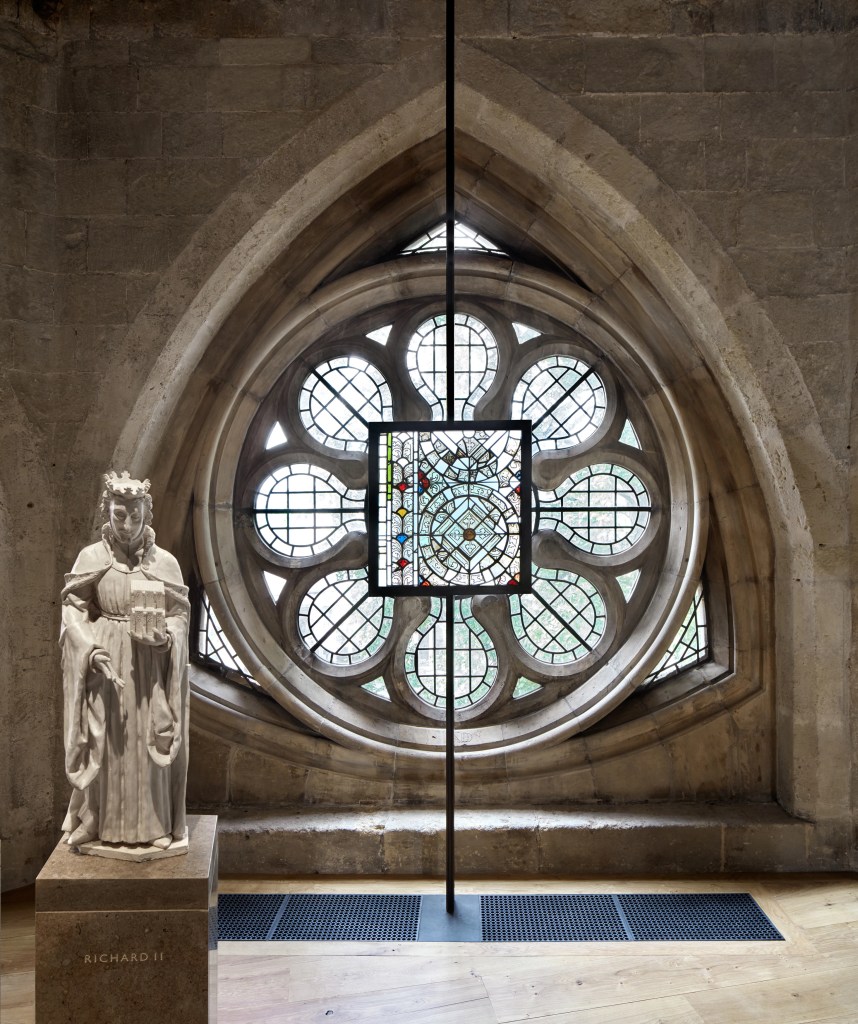
The Queen’s Diamond Jubilee Galleries © Dean and Chapter of Westminster, 2024.
Three Treasures from Westminster Abbey
The Cosmati Pavement

The Cosmati Pavement © Dean and Chapter of Westminster, 2024.
The great pavement in front of the High Altar of Westminster Abbey is a unique and remarkable object. The complexity and subtlety of the design and workmanship can be seen nowhere else on this scale.
It was laid down in 1268 by order of Henry III who had started re-building Edward the Confessor’s Abbey in the new Gothic style in 1245. The workmen came from Rome, with a man called Odoricus at their head. The pavement belongs to a type of inlaid stone decoration known as Cosmati work, after one of the families of craftsmen who specialized in it and the technique is called opus sectile, ‘cut work’. This differs from ancient Roman and earlier medieval mosaic work which consists of square stones of equal size.
The great pavement is 24 feet 10 inches (7 metres 58 centimetres) square, with dimensions calculated in Roman feet and consists of geometrical patterns built up from pieces of stone of different colours and sizes cut into a variety of shapes: triangles, squares, circles, rectangles and many others. The central roundel is made of onyx and the pavement also includes purple porphyry, green serpentine and yellow limestone. Also part of the original material are pieces of opaque coloured glass – red, turquoise, cobalt blue and bluish white. It lies on a bed of dark limestone known as Purbeck marble. This is a major departure from Italian methods, since at home the workmen used white marble as a base. The use of glass in a pavement also goes against Italian practice.
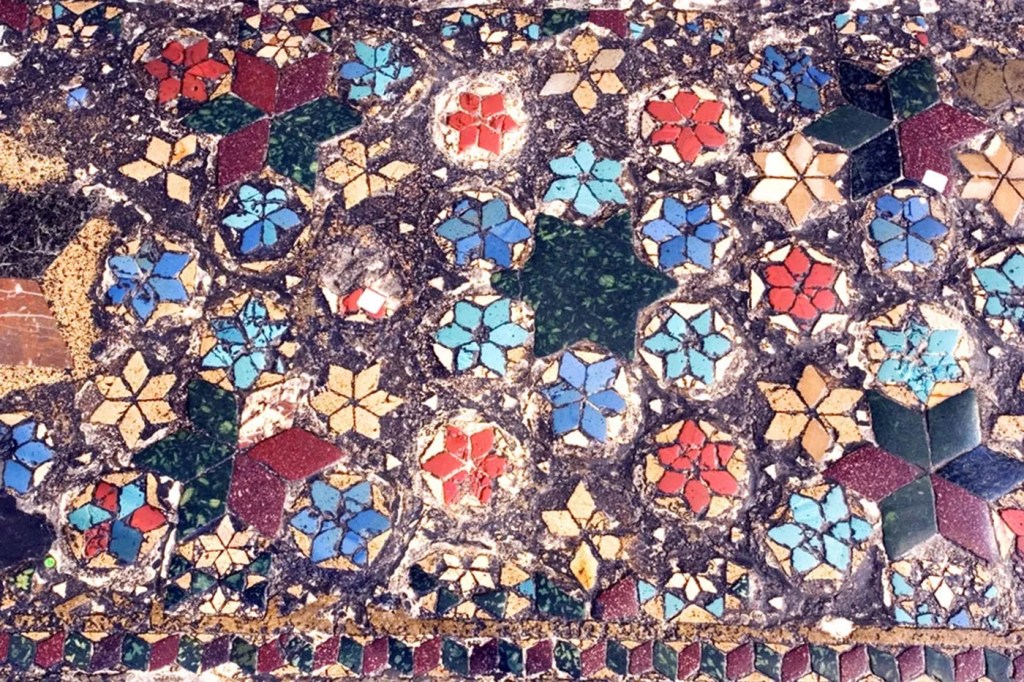
The Cosmati Pavement © Dean and Chapter of Westminster, 2024.
The Coronation Chair
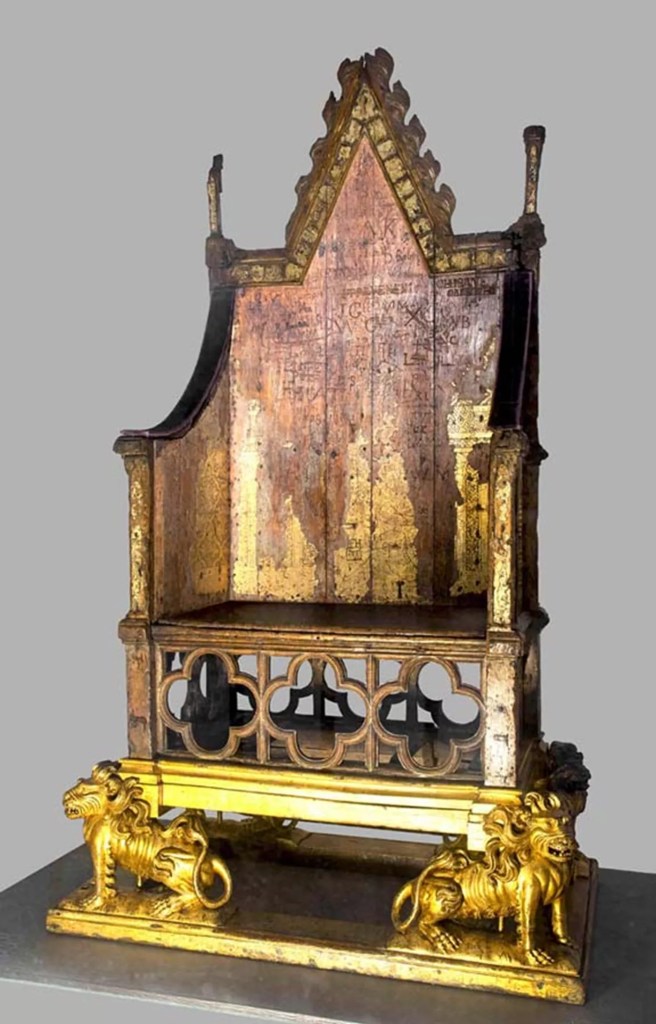
The Coronation Chair in 2012 © Dean and Chapter of Westminster, 2024.
The Coronation Chair in St George’s Chapel is one of the most precious and famous pieces of furniture in the world. It has been the centrepiece of coronations for over 700 years when it is placed in the centre of the Abbey, in front of the High Altar.
The Coronation Chair was made by order of Edward I to enclose the famous Stone of Scone, which he brought from Scotland to the Abbey in 1296, where he placed it in the care of the Abbot of Westminster. The King had a magnificent oaken chair made to contain the Stone in 1300-1301, painted by Master Walter and decorated with patterns of birds, foliage and animals on a gilt ground (the first idea was for a bronze chair to be made but that was deemed too expensive). The figure of a king, either Edward the Confessor or Edward I, his feet resting on a lion, was painted on the back. The four gilt lions below were made in 1727 to replace the originals, which were themselves not added to the Chair until the early 16th century. The Stone was originally totally enclosed under the seat but over the centuries the wooden decoration had been torn away from the front.
At coronations, the Chair – height 2.05m (6 feet 9 inches) – with the Stone stands facing the High Altar. The Chair has been in use at the coronation ceremony since 1308 although opinion is divided as to when it was actually used for the crowning, but this was certainly the case from 1399 when Henry IV was crowned in the Chair. For the Coronation of King Charles III on 6th May 2023 the Chair was placed on the central roundel of the 13th century Cosmati pavement. There have been thirty nine coronation ceremonies for reigning monarchs held at the Abbey. William III and Mary were crowned in one ceremony, as joint monarchs in 1689. A special chair was made for Mary, as William used the ancient chair. Mary’s chair is on display in the Queen’s Diamond Jubilee Galleries at the Abbey.
Most of the graffiti on the back part of the Chair is the result of Westminster schoolboys and visitors carving their names in the 18th and 19th centuries. One of the tourists carved « P. Abbott slept in this chair 5-6 July 1800 » on the seat. A bomb attack in 1914, thought to be organised by the Suffragettes, even knocked a small corner off it.
See the Coronation Chair on the Abbey YouTube Channel.
Britain’s oldest door
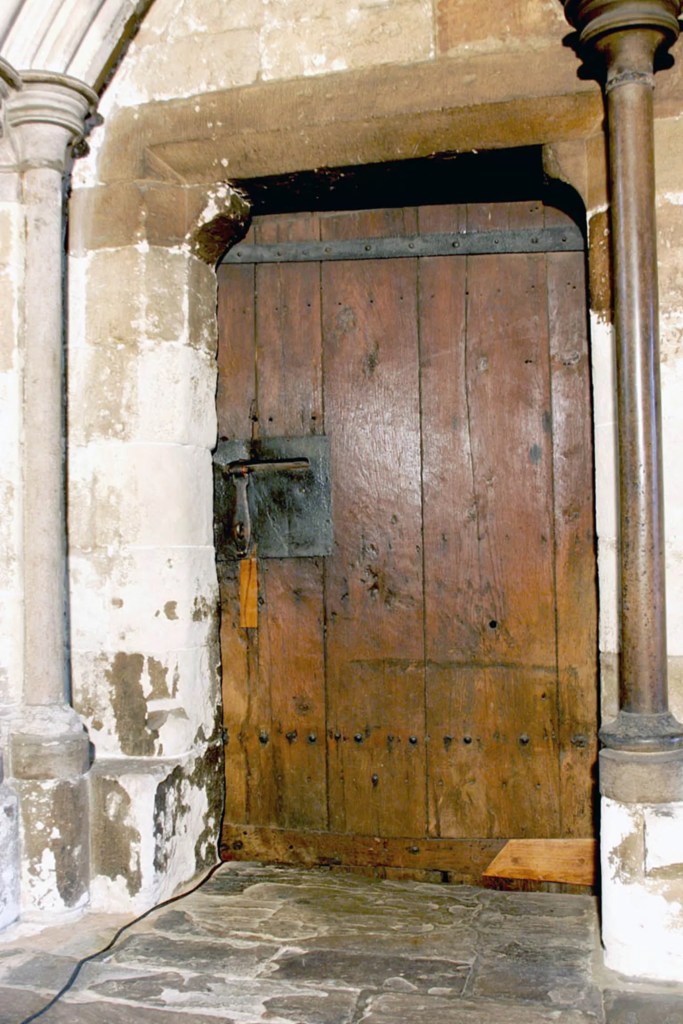
Britain’s oldest door © Dean and Chapter of Westminster, 2024.
Britain’s oldest door can be found in Westminster Abbey, in the passage leading to the Chapter House. The door was dated for the first time in 2005 by the process known as dendrochronology. A detailed study of the wooden door showed that the wood was felled after 1032 AD and that the door was constructed sometime in the 1050s. This was during the reign of King Edward the Confessor, who built the Norman Abbey which was consecrated in 1065. That makes it not only the oldest in the UK but also the only one assignable to the Anglo Saxon period. The ring-pattern of the timber indicates that the tree grew in eastern England, most probably coming from the extensive woodland owned by the Abbey in this area, and possibly from Essex. The boards are from a single tree and rings on them show growth during the years from AD 924 to 1030.
After the planks were fitted together probably both faces were covered with cow hide, added to provide a smooth surface for decoration (no trace of painting remains). In the 19th century the fragments of cow hide were first noted and a legend grew up that this skin was human. It was supposed that someone had been caught committing sacrilege or robbery in the church and had been flayed and his skin nailed to this door as a deterrent to others.
In addition to these three Treasures, please have a look at the other masterpieces of Westminster Abbey, including hundreds of memorials and burials, at www.westminster-abbey.org.
 LES AMIS DU PATRIMOINE EUROPÉEN