
Dynastic Jewels
The Al Thani Collection / Hôtel de la Marine, Paris
10 December 2025 – 6 April 2026
thealthanicollection.com
🇫🇷 🇬🇧
PRESENTATION
Dynastic Jewels
[From the press kit]
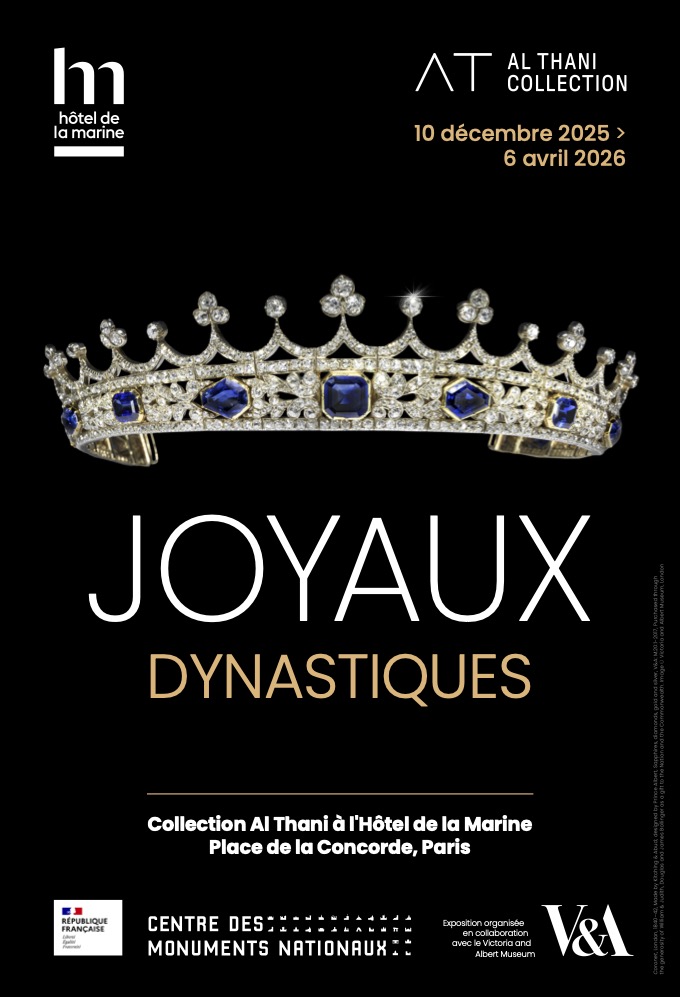
From 10 December 2025 to 6 April 2026, The Al Thani Collection at the Hôtel de la Marine, Paris hosts Dynastic Jewels, the third in a trilogy of exhibitions held in collaboration with the Victoria and Albert Museum, London. Following shows dedicated to Medieval and Renaissance works of art, this exhibition brings together rare, important and historic jewels from the collections of both the V&A Museum and The Al Thani Collection, many of which are on display in France for the first time.
Highlighting the significance of jewellery as an enduring expression of power and status, while emphasising its sentimental value and role as a mark of royal favour, the exhibition presents pieces associated with the reign and legend of some of the most notable figures in European history including Empresses Catherine the Great, Joséphine Bonaparte, Marie-Louise and Queen Victoria. From legendary gemstones and historic tiaras to spectacular brooches, diadems and necklaces, it presents resplendent pieces intended to be worn in the opulent settings of Europe’s royal courts, where they could articulate the status, heritage and authority of their owners.
The exhibition is complemented by loans from other renowned institutions including the Royal Collection, thanks to the generosity of His Majesty King Charles III, Historic Royal Palaces thanks to the generosity of His Grace the Duke of Fife, Musée national du château de Compiègne, Domaine national du château de Fontainebleau, Muséum national d’Histoire naturelle, musée de Minéralogie Mines Paris – PSL, and the heritage collections of Cartier, Chaumet, Mellerio and Van Cleef & Arpels.
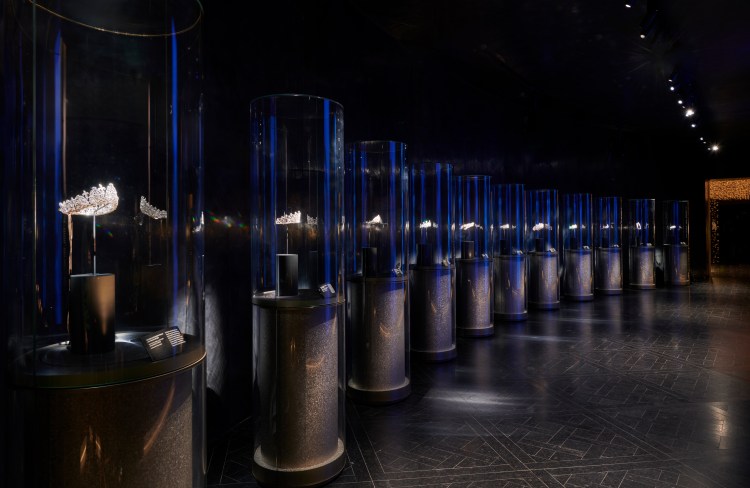
Dynastic Jewels Exhibition at the Al Thani Collection.
© The Al Thani Collection. Photos by Marc Domage.
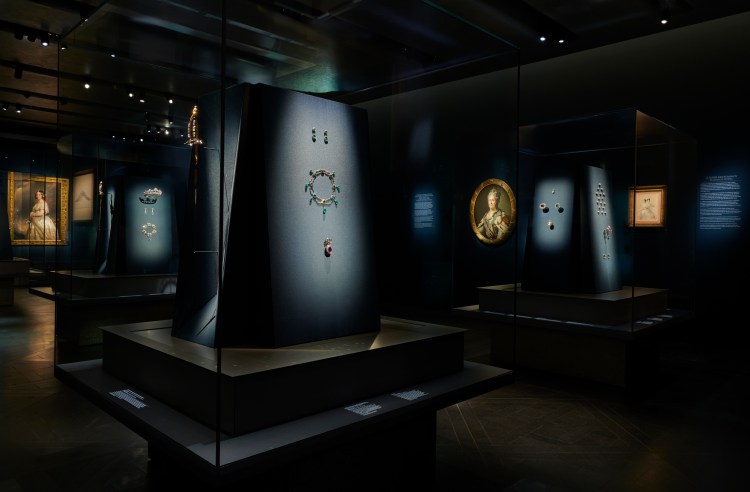
Dynastic Jewels Exhibition at the Al Thani Collection.
© The Al Thani Collection. Photos by Marc Domage.
A SELECTION OF JEWELS
by Emma Edwards, project curator at the Victoria and Albert Museum,
curator of the exhibition.
The Manchester Tiara
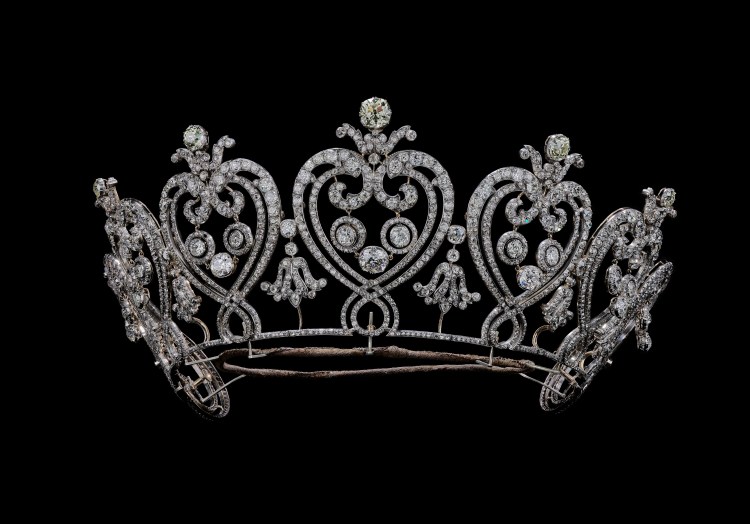
Manchester Tiara, Cartier Paris, 1903
Gold, silver, diamonds, glass paste
V&A: M.6:1-2007
Accepted by HM Government in Lieu of Inheritance Tax
and allocated to the Victoria and Albert Museum, 2007
© Victoria and Albert Museum, London
In the early 20th century, three brothers Louis, Pierre and Jacques Cartier transformed their Parisian based family company into a truly global business that reflected an epoch of glamour, travel and wealth; opening Cartier boutiques in Paris in 1899, in London in 1902 and New York in 1909. This tiara was commissioned from Cartier Paris in 1903 by the then Dowager Duchess of Manchester. Born in New York in 1853 Consuelo Yznaga was a Cuban-American who married Viscount Mandeville in 1876, becoming Duchess of Manchester in 1890. She was one of a number of exceptionally wealthy heiresses who married into the British aristocracy in the late-19th century: the newly-rich families exchanged vast dowries for connections with the European nobility in order to bolster their social standing in North American society. The tiara is designed as a series of graduated scrolls that form flaming hearts of gold and silver and all set with more than one thousand diamonds. The flaming heart motifs were inspired by the exuberant forms found in 18th-century French ironwork. The light and graceful forms that Cartier produced in jewellery at this time became known as the garland style.
The Brooch of Empress Catherine II
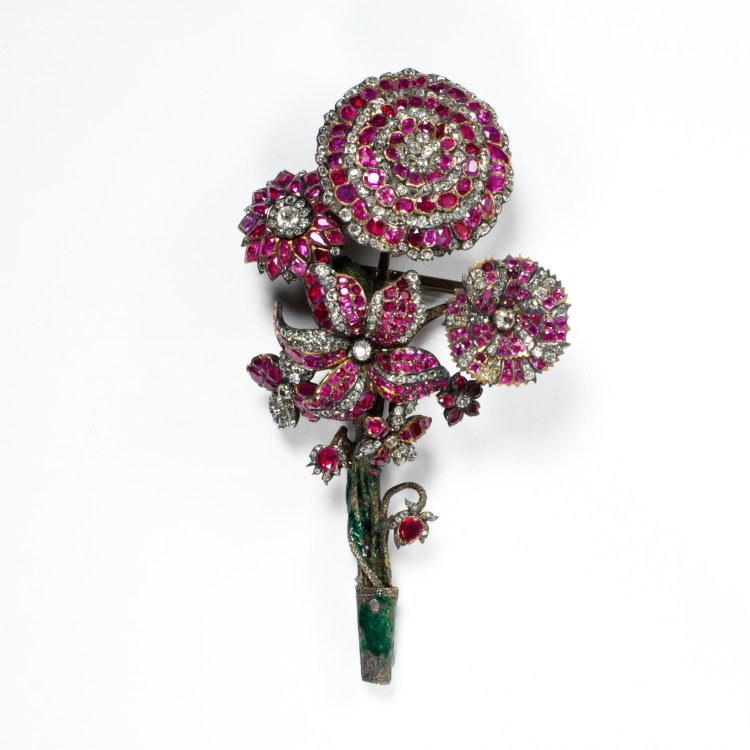
Brooch of Empress Catherine II, Russia, c. 1750-70
Rubies, diamonds, gold, silver, enamel, 12.3 × 6.7 × 3.5 cm
Victoria and Albert Museum, M.85-1951, Cory Bequest
© Victoria and Albert Museum, London
The Romanovs, who ruled Russia for three centuries until they were deposed in the Revolution of 1917, provide an example of how power was expressed through the wearing of prodigious quantities of gemstones. Each successive generation of the dynasty understood how essential magnificent jewels were to project the image of their status and power. The vast mineral resources of the Ural Mountains yielded up extraordinary gems, including remarkable diamonds. The use of diamonds is frequently associated with the ruler who, in order to define her status, set new fashions for dressing with jewellery. Catherine II, known as Catherine the Great (r. 1762–96), seized the throne from her husband, Peter III (1728–62), in an exercise of political daring that at best would have seen her exiled to a convent or more likely conveniently murdered had she not succeeded.
The Rose Brooch of Princess Mathilde Bonaparte
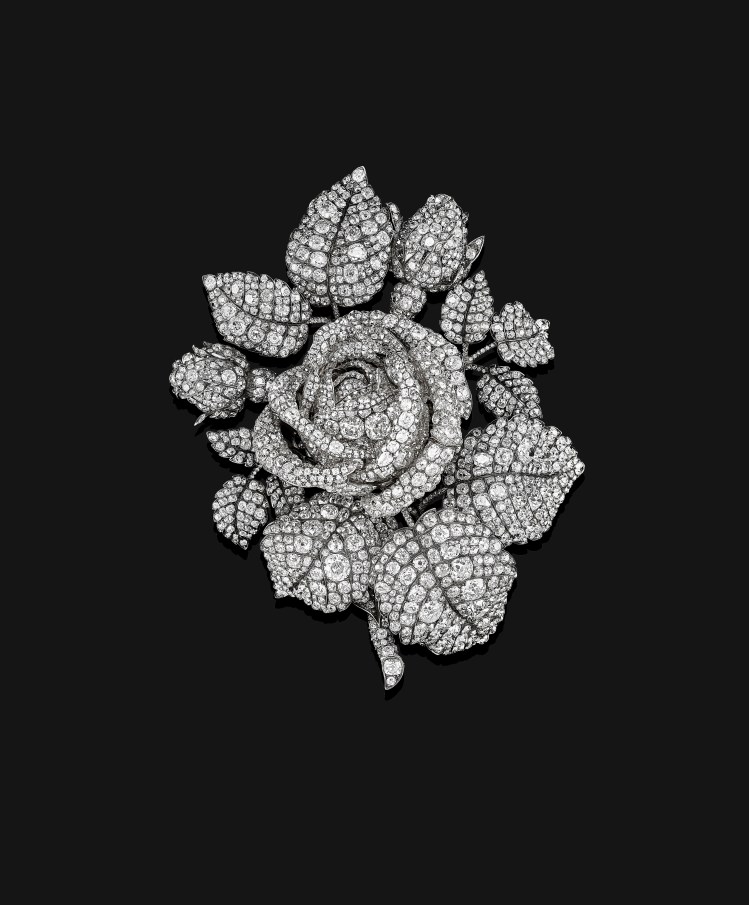
Rose Brooch of Princess Mathilde Bonaparte, Mellerio, also known as Meller, Paris, c. 1864
Diamonds, gold, silver, 14.5 × 10.8 × 5.1 cm
The Al Thani Collection, ATC452
© The Al Thani Collection, 2018. All rights reserved.
Photograph by Prudence Cuming Associates Ltd.
Princess Mathilde Bonaparte (1820-1904) was Napoleon III’s cousin, a celebrated beauty and society hostess during the French Second Empire. She presided over fashionable salons at her palace in the Rue de Courcelles, with guests that included celebrated artists and writers as well as royalty. Her splendid jewellery collection was, perhaps, second only to that of the Empress Eugénie. This diamond brooch, in the form of a large rose in full bloom was created for the princess by the Parisian jeweller Mellerio dits Meller around 1864. It is one of the most important pieces of jewellery to survive from her extraordinary collection, and one of the most dazzling of the great 19th century jewels.
 LES AMIS DU PATRIMOINE EUROPÉEN