Masterpices from Kenwood
Gainsborough’s House, Sudbury
3 May – 19 October 2025
gainsborough.org
🇫🇷 🇬🇧
PRESENTATION
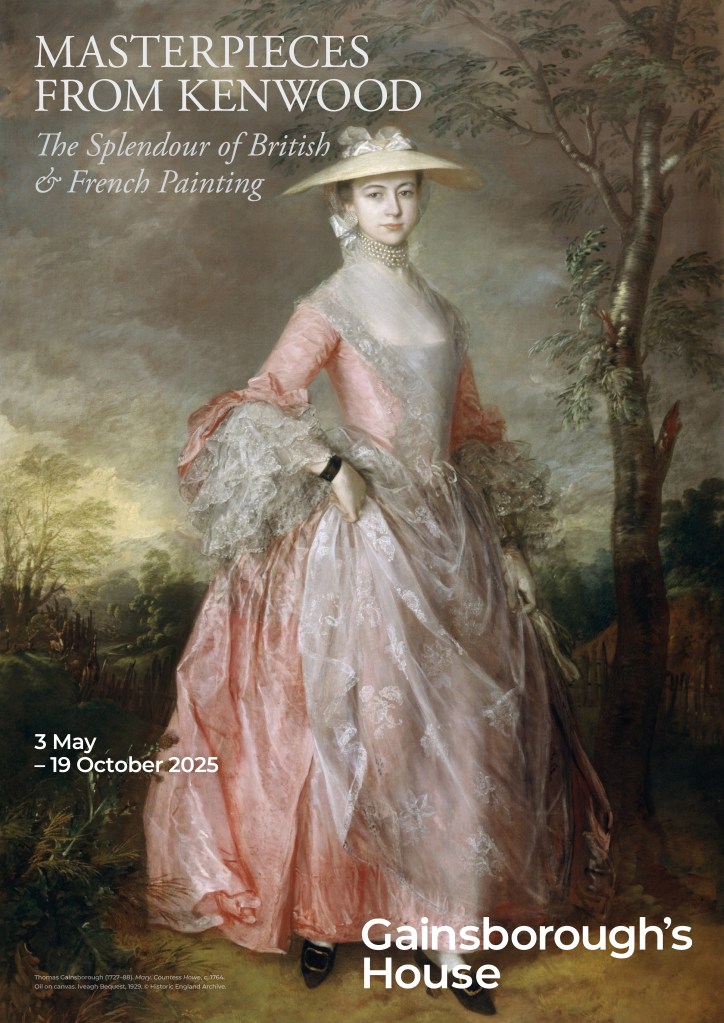
Masterpices from Kenwood:
The Splendour of British & French Painting
by Mahaut de La Motte
This exhibition showcases a selection of eighteenth and early-nineteenth century British and French paintings usually on display in the opulent Georgian interiors of Kenwood House in London, mostly collected by Edward Cecil Guinness, 1st Lord Iveagh (1847–1927) of the Guinness brewing dynasty.
Kenwood House is one of the finest historic houses in London. It has been on its current site, at the top of Hampstead Heath, since 1616, and was extended and renovated by the celebrated architect, Robert Adam, between 1764–79. Lord Iveagh bought the House and its grounds in 1925 from the 6th Earl of Mansfield. On his death in 1927, he left Kenwood to the nation, along with an impressive collection of Old Master paintings by mostly British, French, Dutch and Flemish artists (The Iveagh Bequest). In 1986 English Heritage took over responsibility for the House and its collection.
Lord Iveagh began collecting art in the 1870s to furnish houses in London, Ireland and on the Isle of Wight, but his most prolific buying years were 1887–1891, after he had floated the Guinness brewery on the open market and become the richest man in Ireland. From 1887 he bought a staggering 212 paintings from the picture dealer’s, Thomas Agnew & Sons. Iveagh was collecting at a time when the market was awash with Old Master paintings sold off by the traditional, landed aristocracy, affected by agricultural depression. Wealthy business magnates on both sides of the Atlantic notably the Rothschilds, Fricks, Vanderbilts and Huntingtons, competed to buy aristocratic heirlooms as indicators of status and to fill lavish houses.
Grand society portraits of the Georgian era (1714–1834), particularly of beautiful women, by artists such as Sir Joshua Reynolds (1723–92), Thomas Gainsborough (1727–88), George Romney (1734–1802), Thomas Lawrence (1769–1830) and Henry Raeburn (1756–1823), were regarded as a notable highpoint of British culture at the end of the nineteenth century and are well represented in the Iveagh Bequest at Kenwood.
The exhibition continues in the Sudbury Gallery on the first floor, where eighteenth-century French Rococo paintings by artists including François Boucher and Jean-Baptiste Pater, again mostly acquired by 1st Lord Iveagh, are examined alongside academic-style paintings by Angelica Kauffman and Joshua Reynolds.
A SELECTION OF WORKS OF ART
by Mahaut de La Motte,
Assistant Curator, Gainsborough’s House
Joshua Reynolds
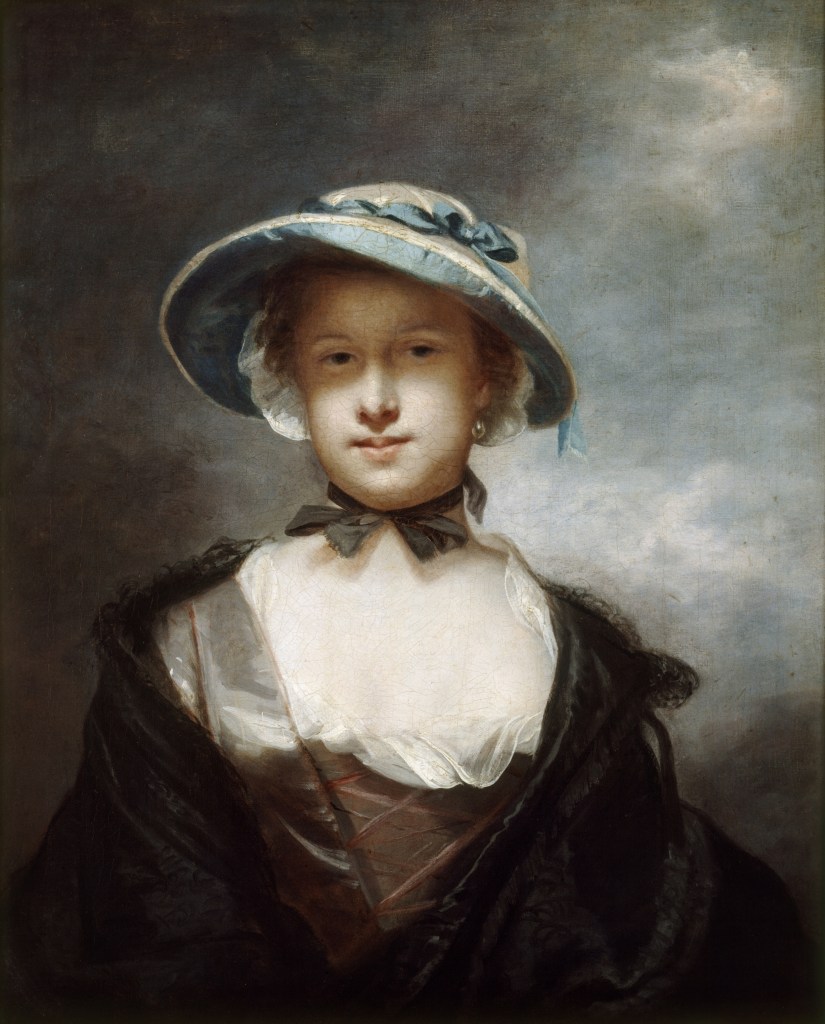
Joshua Reynolds (1723–92), Catherine Moore, 1752–56
Oil on canvas
English Heritage. Bequeathed to Kenwood by Walter Edward Guinness, 1st Baron Boyne, 1946
© English Heritage Archive
This was one of the first British portraits that Lord Iveagh acquired from the art dealership, Agnew’s, in 1887. It is a charming and sensual depiction of Catherine Moore, the future wife of the architect William Chambers. It was probably painted by Reynolds in Paris in 1752, where the couple were living before marrying in Rome the following year. Reynolds himself was on his way back to London, after two years of intense study in Italy. The use of pastel colours, soft shadows, and elements of Catherine’s dress, seem to be inspired by the work of Reynolds’s French contemporaries. For instance, the decorative cross lacing of her bodice and escaping folds of her white chemise, are suggestive of the idealised shepherdesses found in the decorative, pastoral scenes of François Boucher (1703–70) and Jean-Honoré Fragonard (1732–1806). Whilst her dress may demonstrate French influence, Catherine’s blue and ivory silk hat is distinctly English in style. She is said to have been ‘a milliner’s girl’ and so may have made it herself.
Thomas Gainsborough
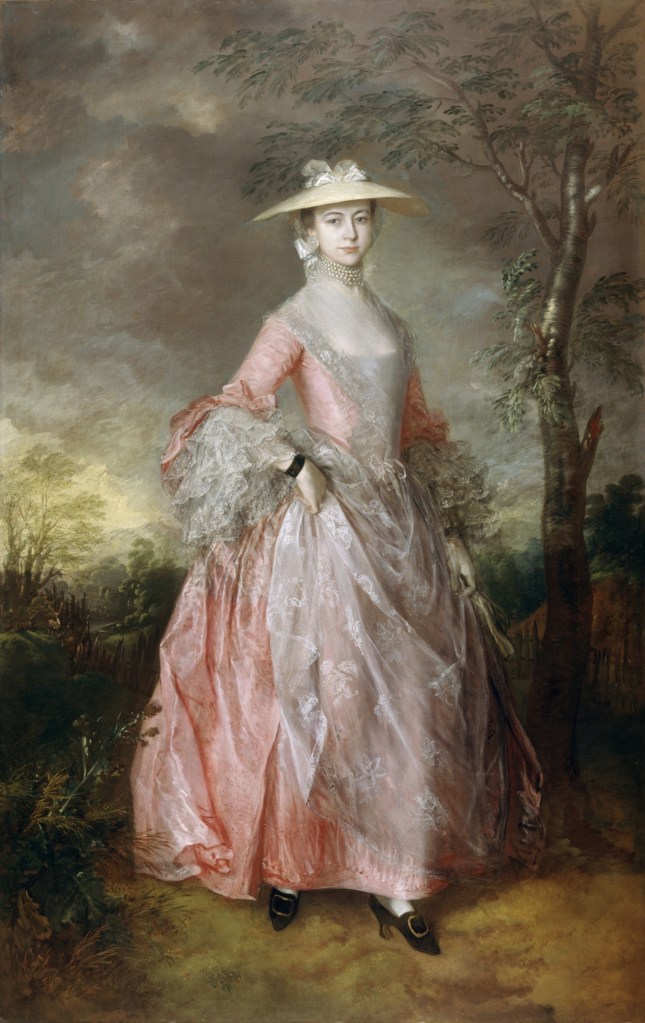
Thomas Gainsborough (1727–88), Mary, Countess Howe, c. 1764
Oil on canvas
English Heritage, The Iveagh Bequest (Kenwood, London)
© English Heritage Archive
This portrait of Mary, Countess Howe, (then Lady Howe; 1732–1800) was painted in Gainsborough’s Bath studio in the early 1760s alongside a pendant portrait of her husband. It was probably only the third full-length portrait that Gainsborough completed, and is a tour de force, expertly combining his abilities in landscape and portraiture. Lady Howe stands tall and assertively in an isolated rural landscape, the skies darkening above her as evening draws in. Her weight is on her front foot, and she simultaneously hitches up her delicate apron and perches an arm on one hip, as if poised to carry on walking. The portrait is imbued with a strong sense of both equilibrium and movement, and Gainsborough has cleverly used his colour palette to unite the composition. Notably, a warm pink hue permeates the sky, Lady Howe’s dress and her complexion. Lady Howe is dressed in the latest fashion, which includes a straw ‘chip chat’ with a razor-sharp profile that complements her steely gaze and sense of nobility. Scientific analysis and thinning paint layers have shown how Gainsborough laboured over the composition, changing various elements along the way, such as the positioning of her feet and the length of her lace sleeve ruffles. The portrait was probably painted over the course of a year due to Gainsborough’s ill health at the time, and some of the changes may have been dictated by developments in sartorial fashion.
Hyacinthe Rigaud
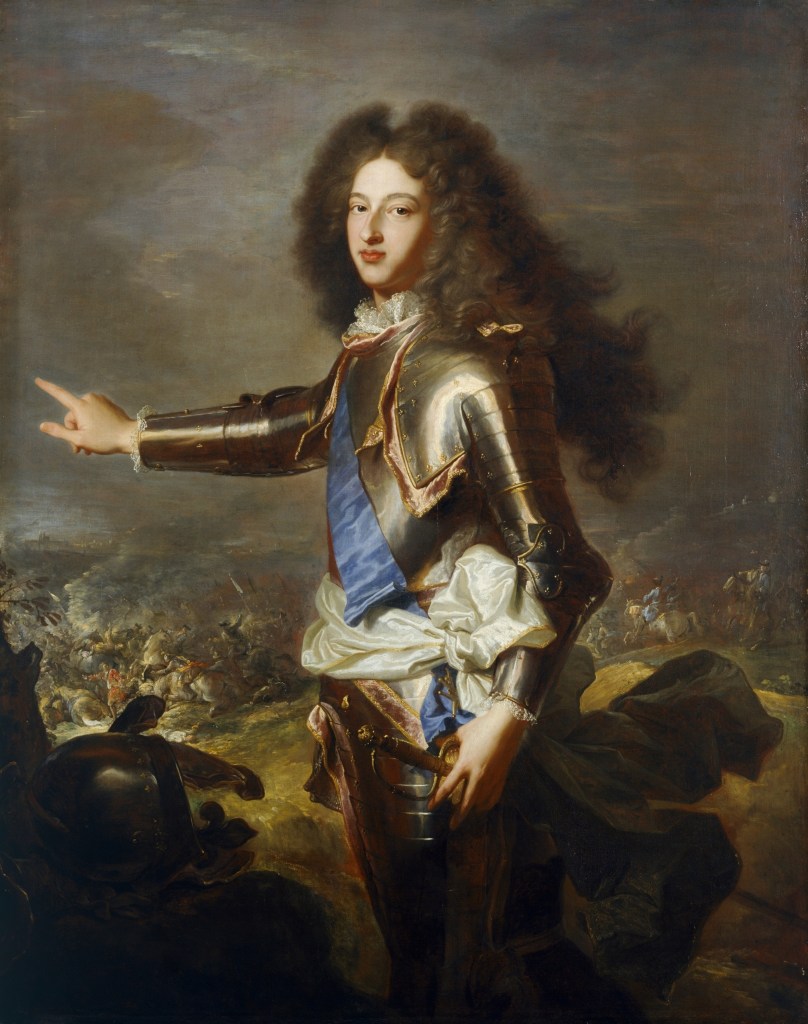
Hyacinthe Rigaud (1659–1743) and Joseph Parrocel (1646–1704)
Louis (1682–1712), Duc de Bourgogne, 1702-03
Huile sur toile
English Heritage, The Iveagh Bequest (Kenwood, Londres)
© English Heritage Archive
Rigaud was a renowned French court painter and this portrait was part of his numerous royal commissions. The sitter is the “Petit Dauphin” Louis (1682–1712), Duke of Burgundy, son of King Louis XIV’s heir apparent. His royal status is signposted by the blue sash of the chivalric Order of the Holy Ghost and the fleur-de-lys on his half armour. Although the Duke had a hunched back, Rigaud flatteringly hides this by painting his sitter from the side. His pose with the raised finger is reminiscent of Roman imagery of the adlocutio (the general’s address to the troops) and highlights the action in the background. The battlefield was painted by the war artist Joseph Parrocel who specialised in military scenes. The city is likely Nijmegen as the Duke took part in its siege in 1702. Although the French failed to take the city from the Anglo-Dutch army, the Duke, aged twenty, was commended by the King for his acts of valour in the field.
VISITOR INFORMATION
What?
Masterpices from Kenwood: The Splendour of British & French Painting
This exhibition is a collaboration between Gainsborough’s House, Sudbury, and English Heritage.
Curators: Emma Boyd, Curator, Gainsborough’s House, and Mahaut de La Motte, Assistant Curator.
Where?
Gainsborough’s House
46 Gainsborough Street
CO10 2EU Sudbury
UK
gainsborough.org
When?
From 3 May to 19 October 2025
Every day from 10am until 5pm
How much?
Price: £15
Information regarding free entrance can be found on the museum website.
 LES AMIS DU PATRIMOINE EUROPÉEN