From Exile to Avant-Garde: The Life of Princess Natalie Paley
Hillwood Estate, Museum & Gardens, Washington, DC
7 June 2025 – 4 January 2026
hillwoodmuseum.org
🇫🇷 🇬🇧

PRESENTATION
From Exile to Avant-Garde: The Life of Princess Natalie Paley
[From the Press Kit]
Natalie Paley (1905-1981) was a complex figure of the twentieth century, recognized for her contributions to fashion, film, culture, and society. A descendant of the Romanov dynasty, she rose from her family’s fabled and tragic history and left a stylish and indelible mark on the century’s culture and design. Her legacy can be seen in twentieth-century innovations from French couture collections and Parisian and Hollywood film roles to characters inspired by her personality and Surrealist portraits capturing her beauty. This special exhibition is the first to explore the exceptional glamour and enigmatic life of this legendary woman.
Born to Grand Duke Paul Alexandrovitch (1860-1919), uncle of Emperor Nicholas II of Russia, and Princess Olga Valerianovna (1865-1929), Princess Natalie Paley enjoyed an idyllic childhood in Boulogne-sur-Seine, France, just outside Paris. Her parents lived in French exile, due to their forbidden union, and they made the most of their fin de siècle surroundings, entertaining, collecting, and shopping as ultimate tastemakers. When the family’s anticipated return to Russia in 1914 led to the tragic execution of her father and brother by the Bolsheviks, Paley escaped back to France with her mother and sister. Paley reinvented herself and emerged in the 1920s as the wife of French couturier Lucien Lelong (1889-1958), becoming the focus of every fashion photographer in Paris and beyond, from Steichen and Man Ray to Horst and Hoyningen-Huene. As a confidant, visionary, and companion to artists, designers, and writers such as Jean Cocteau, Serge Lifar, Antoine de Saint-Exupéry, Fulco di Verdura, and Cecil Beaton, Paley was known for her exquisite taste, someone ethereal and glamorous who dictated her own fashion trends. She embodied the cool, discrete Hollywood allure of the 1930s, appearing in several fashionable feature films before moving to America. Her relocation heralded a new transformation: Paley married the successful New York theater producer John C. « Jack » Wilson (1889-1961) in 1937 and soon began working for the fashion designer Mainbocher. Paley and Wilson built a close community of fashion designers, editors, actors, photographers, writers and others talents from their homes in New York and Connecticut, leading to many important collaborations and cultural connections of the twentieth century.
From Exile to Avant-Garde: The Life of Princess Natalie Paley presents an array of photographs, documents, paintings, decorative arts objects, fashion, jewelry, glassware, and more. Organized into seven sections, the exhibition begins with a focus on Paley and her family in the Gilded Age Paris, exploring the artistic environment in which the young princess grew up, before highlighting her influential role in the arts as a muse of fashion creators, photographers, tastemakers, and writers. Hillwood provides the perfect setting as founder Marjorie Merriweather Post collected and preserved treasures from Paley’s imperial Russian lineage and patronized many of the same designers and photographers.
A SELECTION OF TREASURES
by Megan Martinelli,
Curator of apparel, jewelry, accessories, and textiles, Hillwood Estate, Museum & Gardens,
and Dr. Wilfried Zeisler,
Deputy Director & Chief Curator, Hillwood Estate, Museum & Gardens
Princess Olga Paley
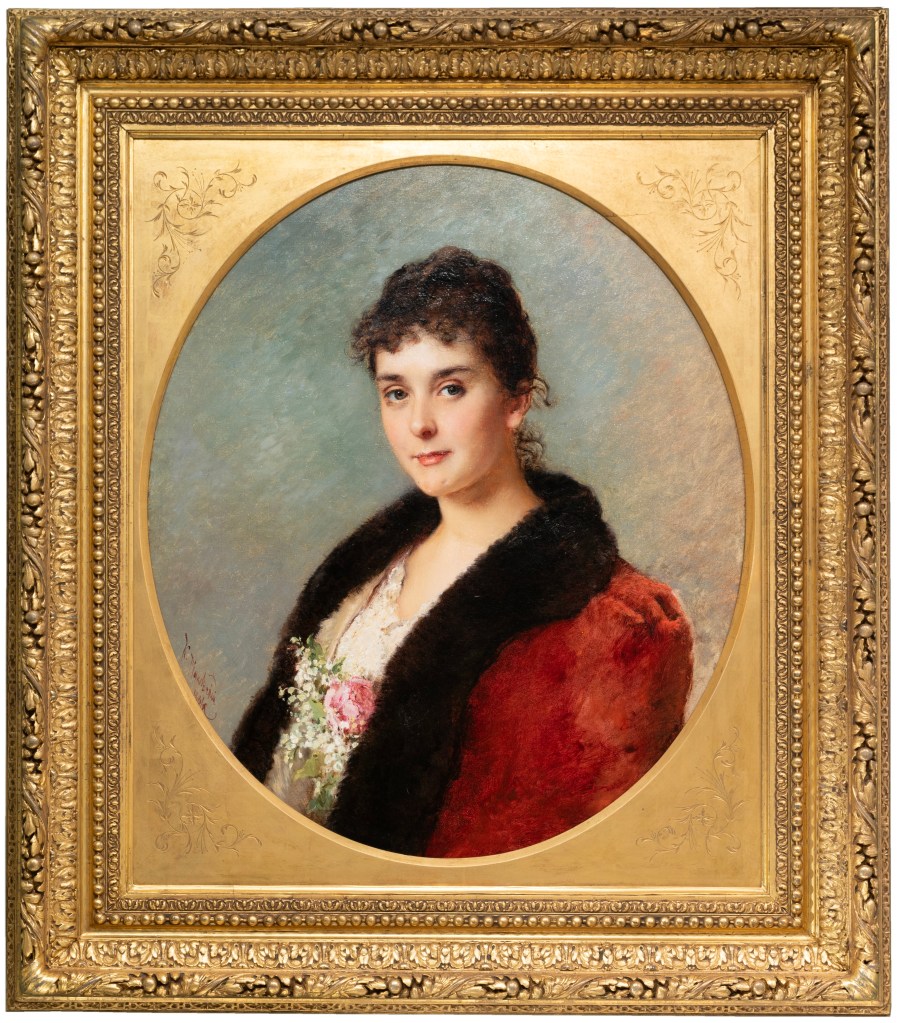
Portrait of Olga von Pistohlkors
Konstantin Makovsky, painter (Russian, 1839–1915), St. Petersburg, 1886
Oil paint, linen, wood, gesso, gilding
Museum purchase, 2022 (2022.2.1)
© Hillwood Estate, Museum & Gardens, photographed by Mark Finkenstaedt
The portrait features Olga von Pistohlkors (born Karnovich), later known as Countess Olga von Hohenfelsen (1904) and Princess Olga Paley (1915) (1865-1929), morganatic wife of Grand Duke Paul Alexandrovich of Russia (1860-1919) and mother of Princess Natalie Paley (1905-1981).
The celebrated artist Konstantin Makovsky portrayed Olga in 1886, when she was married to Erich von Pistohlkors (1853-1935), an officer in Grand Duke Paul’s regiment. Paul, who was still grieving following the death of his first wife in 1891, and Olga fell in love and began an affair in 1893; four years later, their first child, Vladimir, was born. Despite the strong opposition of the imperial family, the couple managed to marry abroad in 1902 after Olga’s divorce. Emperor Nicholas II exiled the couple and their son from Russia. In 1904, thanks to Paul’s efforts, the prince regent of Bavaria granted Olga the title of Countess Olga von Hohenfelsen. (More than a decade later, she became Princess Paley, and her children with Paul were also called Prince and Princess). Grand Duke Paul and Olga lived for about a year in Italy, France, and Germany before deciding to settle in Paris in late 1903 and leasing an apartment for themselves and their growing family. Following the birth of two daughters, Irina in 1903 and Natalie in 1905, the couple bought an elegant mansion in Boulogne, on the outskirts of Paris. Olga embraced the Parisian lifestyle, loved fashion and jewelry, collected art, and mingled with the local high society. Under her title as Countess Olga von Hohenfelsen, she appears in French author Marcel Proust’s Le Temps retrouvé, the final book in his multivolume novel now known as In Search of Lost Time, as a close friend of Madame de Guermantes. Indeed, Proust used most of Olga’s acquaintances, though calling only a few by their real names or titles, in shaping the characters for his monumental work.
Growing up, Princess Natalie absorbed her mother’s style in fashion and Parisian elegance as well as her father’s charm and sophistication. They both nurtured her taste and might have inspired her future path in the fashion industry. Treasured by Natalie, the portrait of her mother used to hang at Pebbles, her Connecticut country house.
Evening dress

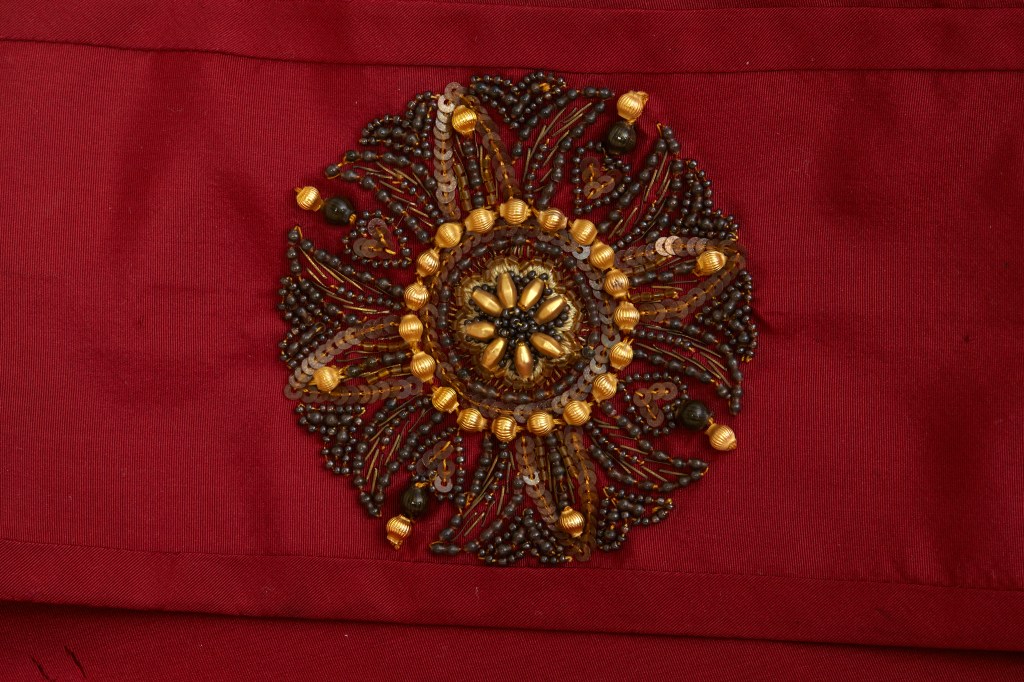
Evening dress
Mainbocher (American, 1890–1976), New York, ca. 1945
Silk taffeta, metallic wrapped thread
Gift from Jean-Noël Liaut, biographer of Natalie Paley (2024.3)
© Hillwood Estate, Museum & Gardens, photographed by Mackenzie Witter
This dress belonged to Princess Natalie Paley. Her biographer, Jean-Noël-Liaut, stated that Paley’s social connections and influences in Europe, coupled with her dazzling presence in fashion magazines, made her a “goddess of the 1930s”. Her marriage to couturier Lucien Lelong from 1927 to 1937 added another interesting credential, beneath her status as a princess and her Romanov connection. Edward Steichen protégé George Hoyningen-Huene photographed Natalie for many projects in the following decades, from her fleeting turn as a 1930s film star to her time as client manager and face of fashion house Mainbocher in New York. The American fashion designer Main Rousseau Bocher (who designed under “Mainbocher”) served in intelligence during the First World War and stayed in Paris after the war, eventually growing a successful couture firm. He fled to New York City in 1939 as the Second World War loomed. Previously connected via the Parisian fashion industry circles of the 1920s and 1930s, Natalie Paley began working for Mainbocher in the fall of 1941, managing his exclusive cadre of clients and wearing his designs, both in the fashion press and at events. Paley’s second husband since 1937 Jack Wilson noted that she was “blissfully happy… Everyone she knows from Hollywood or New York or any place… flock into Mainbocher’s all day long”, and he added that she was a “vital essential”. She accompanied Mainbocher to Paris for a visit after the war, in 1947, and continued to be affiliated with the firm through the 1950s, earning her a spot on the International Best-Dressed List from 1947 to 1954. She kept her wardrobe from this partnership, as seen by her red silk evening gown.

“Wrapped package” brooch
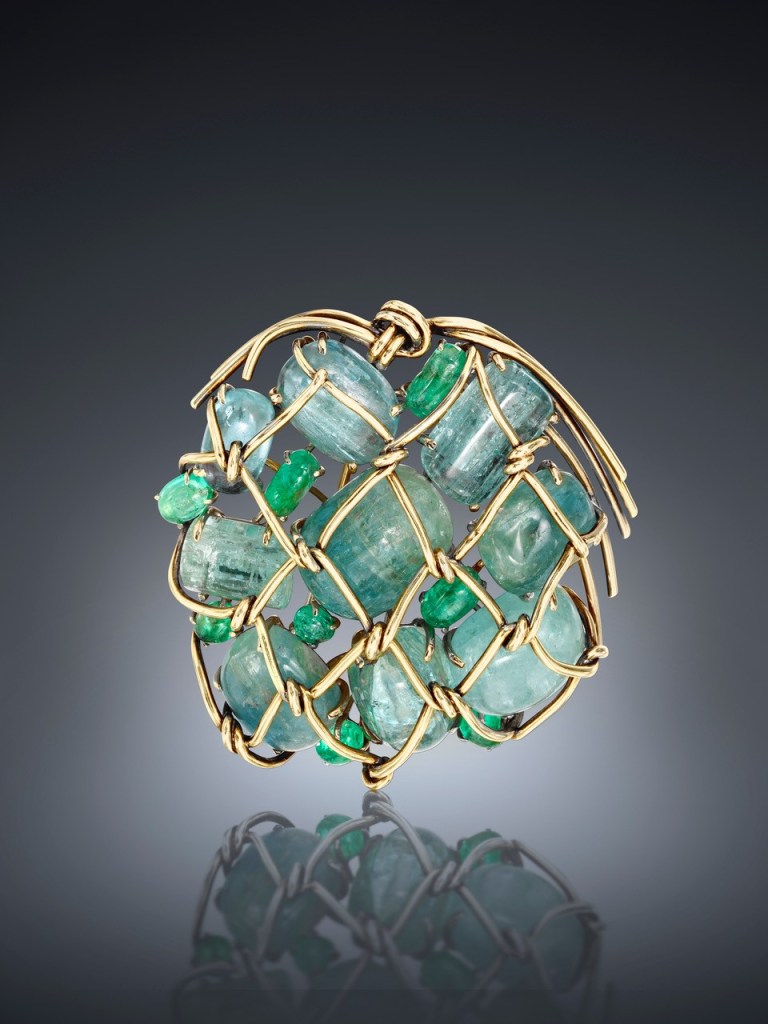
“Wrapped package” brooch
Verdura (American, 1939–present), New York, ca. 1940
Aquamarine, emerald, gold
Private collection courtesy Historical Design, Inc.
Natalie Paley was friends with many artists and creators including jewelry designer Fulco di Verdura (1899–1978), a regular guest at Pebbles, Princess Natalie and her second husband Jack Wilson’s country house. The setting was relaxed American cool—and the princess embodied it best in breezy dresses, chic sunglasses, and a hat or a brooch. Verdura was known for his use of sumptuous precious stones in imaginative settings, as seen in this “wrapped package” brooch enclosing aquamarines and emeralds in a delicate gold cage made for Natalie Paley.
PRACTICAL INFORMATIONS FOR VISITORS
What?
From Exile to Avant-Garde: The Life of Princess Natalie Paley
This special exhibition is organised by Hillwood Estate, Museum & Gardens.
Curators: Megan Martinelli, Curator of apparel, jewelry, accessories, and textiles, Hillwood Estate, Museum & Gardens, and Dr. Wilfried Zeisler, Deputy Director and Chief Curator, Hillwood Estate, Museum & Gardens.
Where?
Hillwood Estate, Museum & Gardens
4155 Linnean Avenue NW
Washington DC 20008
hillwoodmuseum.org
When?
From 7 June 2025 to 4 January 2026
From Tuesday to Sunday, 10 am to 5 pm.
Closed Monday and most holidays.
How much?
Please have a look at the suggested donations on Hillwood’s website.
 LES AMIS DU PATRIMOINE EUROPÉEN