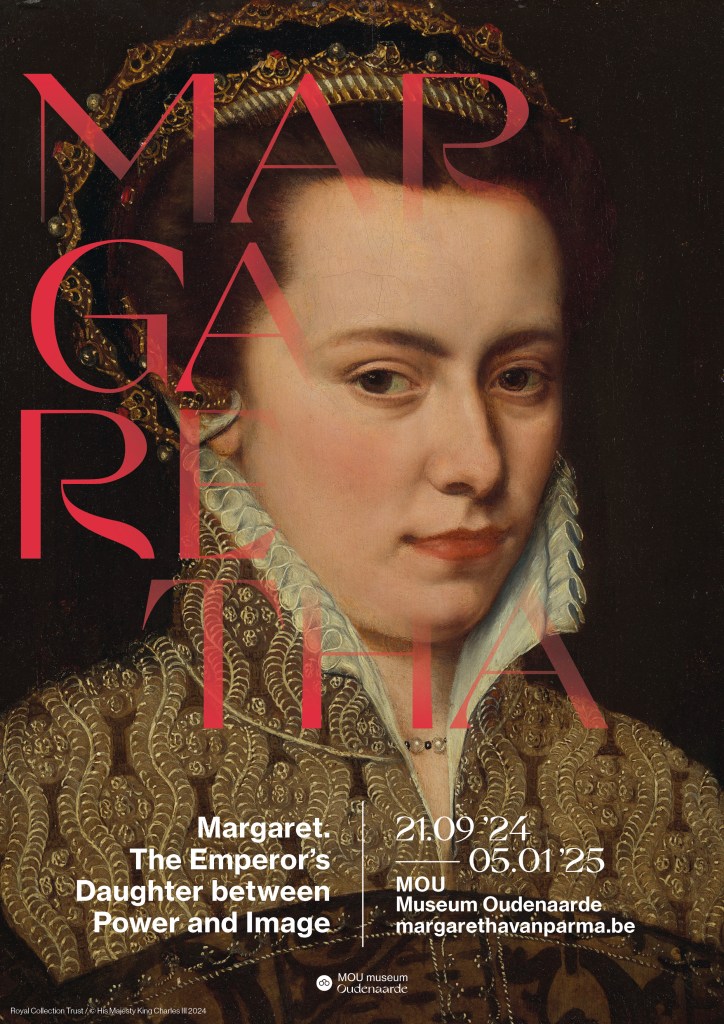
Margaret. The Emperor’s Daughter between Power and Image
MOU Museum, Oudenaarde (Belgium)
21 September 2024 – 5 January 2025
www.mou-oudenaarde.be
PRESENTATION
[from the Press Kit]
Margaret. The Emperor’s Daughter between Power and Image
Margaret of Parma was born in Oudenaarde in 1522, the illegitimate daughter of Emperor Charles and the servant Johanna Vander Gheynst. At the time, Charles V was staying at the court of Charles de Lalaing, Governor of Oudenaarde, where he met the servant.
Margaret of Parma (1522–1586) was no minor figure: she was Governor of the Netherlands during a turbulent time at the beginning of the Eighty Years’ War. She was also a society figure in Italy. Moreover, she was a true art lover and patron. It was high time this fascinating figure was given her proper place in history.
The exhibition features a wide range of objects – from the luxurious to the everyday – drawn from prestigious collections across Europe. Paintings and drawings, tapestries and miniatures, gold and silverware, stained-glass windows and other precious objects immerse you in the art and culture of the 16th century, a turning point in European history. Learn about the rituals and traditions of the time: the (falcon) hunt, feasts, etiquette and dress code, rituals, music and more. Discover the tastes of the Emperor’s daughter and join us for “the feast of the century”!
Masterpieces will be transferred from a number of European museums especially for the exhibition. These include loans from the Royal Collection Trust (UK), the Rijksmuseum (Netherlands), the Sint-Janskerk in Gouda (Netherlands), the Staatliche Museen zu Berlin (Germany), the Warsaw University Library (Poland) and the Museo e Real Bosco di Capodimonte in Naples (Italy).
A SELECTION OF WORKS OF ART
The Duchess stained glass window in Gouda

Wouter Grabeth, The Duchess stained glass window, 1562.
Portrait of Margaret of Parma
© The Sint Janskerk, Gouda
Here is a stained glass window from Saint John’s Church in Gouda. It is almost twenty meters high. It was donated to the church in 1562. The generous donor? Margaret of Parma! It is no coincidence that the window is referred to as the Duchess window.
The church in Gouda has 72 stained glass windows, the majority dating back to the 16th century. This is highly exceptional for these fragile works of art. What’s more, many of the life-size design drawings, called cartoons, have also been preserved. The maker of this stained glass window was Wouter Pietersz Crabeth, along with his brother Dirck the most famous glass artist of his time in the Netherlands.
Below, we see Margaret kneeling devoutly. She is wearing a crown. In other words: Margaret depicts herself as a monarch. In 1562, she was indeed Governor of the Netherlands. Margaret is joined by her patron saint, Margaret of Antioch, and the saint’s traditional attribute, a dragon. In the centre of the stained glass window you can see Christ washing the feet of his apostles, a scene from the New Testament. And at the top, the prophet Elijah offering a sacrifice on Mount Carmel. God and angels emerge from the smoke at the top.
A monarch who donates a stained glass window to a church is expressing her faith as well as her position as ruler. She has another ambition: to be remembered. And Margaret, the Emperor’s daughter, definitely succeeded in that.
To see the full stained glass window, click here.
The exotic animals seller
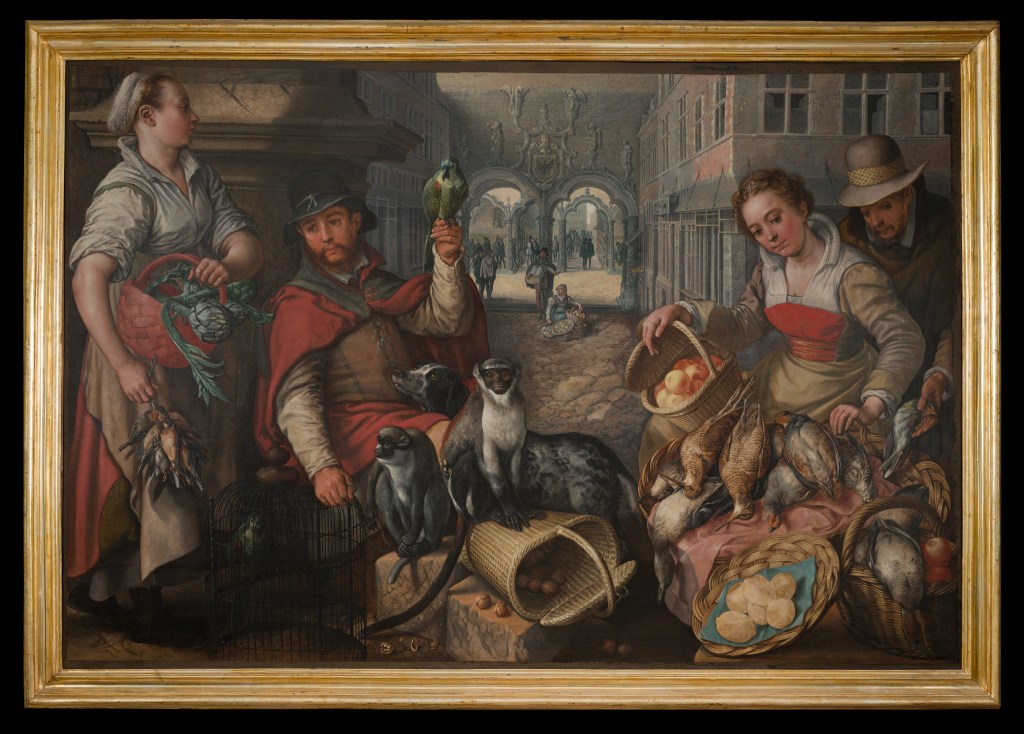
Joachim Beuckelaer, Exotic animals seller, between 1560 and 1569.
Oil on canvas, 140 x 205 cm
National Museum of Capodimonte, Naples © Museo e Real Bosco di Capodimonte
Margaret’s art collection is highly diverse: it includes exotic objects, masses of jewellery, fine art, cameos from antiquity, books and so on. We also know from the estate inventory that she owned no less than seven large paintings by the Flemish master Joachim Beuckelaer. Recently, we also discovered where the seven paintings used to hang in Margaret’s palace in Parma: in the dining room. That perfectly matches their theme: you’re looking at a market scene where all sorts of dead animals are being offered for sale. The architecture in the background is reminiscent of Antwerp in the 1560s. You can also see the House of Habsburg coat of arms.
Feel free to spend more time admiring this scene: what animals can you make out? Are they perhaps symbols, of gluttony or lust? Does the parrot mockingly represent ‘papists,’ which are Catholic priests? And is the monkey a symbol of foolishness? But then who is the fool? And what do the gestures of the man and woman, and their interaction, mean? What is really going on here? These are also questions Margaret and her guests must have pondered during their dinner conversations. Because that’s what crowded paintings like this are for: to keep the conversation going.
Alexander Farnese
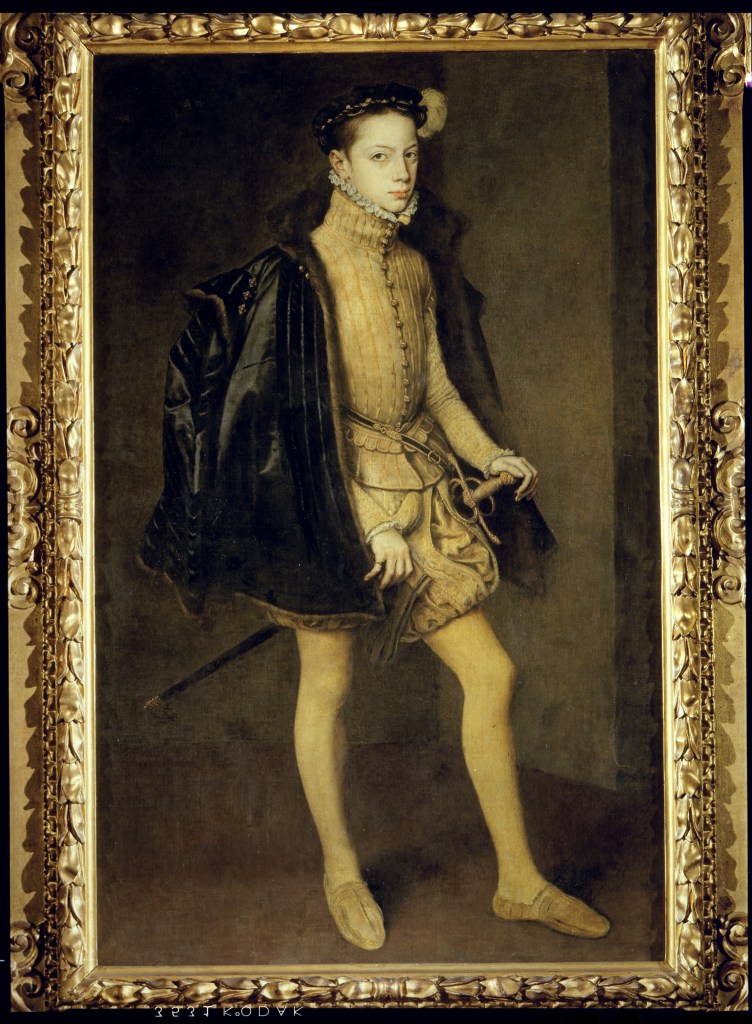
Anthonis Mor, Portrait of Alexander Farnese, 1557.
Oil on canvas, 153 x 95 cm.
National Gallery of Parma, Inv. 300.
© Galleria Nazionale di Parma.
1557. Court painter Anthonis Mor created this life-size portrait of Alexander Farnese, the sole surviving son of Margaret and her second husband, Ottavio Farnese. Mor painted it at her request. Alexander is twelve years old here.
In 1557, Margaret was living in Italy, while Alexander was raised at court in Madrid, Spain. This was imposed by King Philip II, to prevent Alexander from growing up in the sphere of influence of the powerful Farnese family. As a result, the boy’s portrait had an intense emotional value for Margaret. It hung in her personal portrait gallery. And meant that in a way, Alexander was still with her.
We fast-forward now to the year 1580. Alexander Farnese became Governor General of the Netherlands at the age of 35. An attempt to share the position with his mother Margaret failed. In the summer of 1582, Alexander succeeded in restoring Catholic rule in Oudenaarde, after several years of the Protestants being in charge. To mark the occasion, the city where his mother was born sixty years earlier, presented him with a series of tapestries about his namesake from antiquity, Alexander the Great. Four of them are now kept in the Oudenaarde Museum’s collection!
The twelve-year-old boy in this painting obviously had no idea how things would turn out.
 LES AMIS DU PATRIMOINE EUROPÉEN