
Bruno Liljefors. La Suède sauvage
Petit Palais, Paris
1st October 2024 – 16 February 2025
www.petitpalais.paris.fr
🇫🇷 🇬🇧
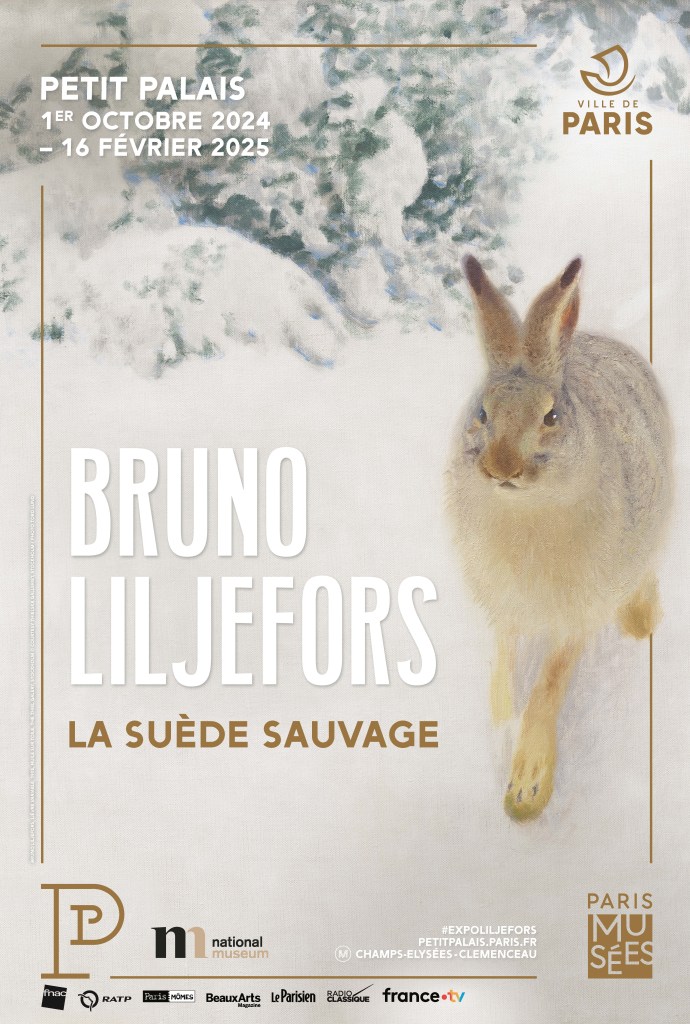
PRESENTATION
Extract from the press release
Bruno Liljefors
La Suède sauvage
After two exhibitions devoted to Swedish painters Carl Larsson (2014) and Anders Zorn (2017), the Petit Palais pays tribute to Bruno Liljefors with the last chapter of its programme focusing on the illustrious Swedish trio known as “ABC ”, a combination of the initials of their first names. Less known than his peers, Bruno Liljefors was nevertheless an important figure on the Scandinavian arts scene in the late-nineteenth century. By showing his work for the first time to the French public, the Petit Palais seeks to highlight his pictorial skill and Liljefors’ original contribution to the construction of the imaginative repertoire of Swedish nature. This unique exhibition features an ensemble of some one hundred pieces, including paintings, drawings, and photographs from the collections of Swedish museums like the Nationalmuseum of Stockholm—partner of the exhibition—the Thiel Gallery, and Gothenburg Museum, as well as numerous private collections.
Liljefors grew up in Uppsala, a town north of Stockholm, surrounded by vast expanses of wilderness. The young man practiced drawing from life from a young age and proved to be particularly gifted, especially when it came to caricatures and illustration. In 1879, he enrolled in the Royal Academy of Painting, where he met Anders Zorn who would remain a friend throughout his life. After trips to Germany and Italy, Liljefors visited Paris to complete his training. He stayed for a while in Grez-sur-Loing to the south-east of Paris, where there was a lively community of Scandinavian artists, including Carl Larsson. Unlike his painter friends, Liljefors did not stay long in France. He returned to Sweden permanently in 1884 where he devoted himself exclusively to the representation of Swedish nature and animals.
An astute observer, Liljefors captured real families of foxes lurking in the woods or hares darting through the snow, as well as ospreys perched at the top of maritime pines, eiders flying across the chilly waters of the archipelago, and grouse performing their nuptial parade in the forests. He worked in and from nature, using his skills as an acrobat and gymnast to climb trees. The painter also made use of hunting techniques such as camouflage and the construction of hideouts to observe animals without being seen. His creative process included the use of photography in the elaboration of his compositions which often present a high or even absent horizon line, thereby placing the viewer at the heart of nature. This immersion is amplified by his skill in transcribing the light and atmosphere characteristic of Scandinavian countries.
Even if he denied it, his aesthetic research was heavily influenced by Japonisme and Far Eastern art. Liljefors liked to arrange some of his paintings within large golden frames, forming compositions inspired by the Japanese technique of harimaze, where prints present several images independent of each other. These decorative ensembles, created subjectively by the artist, and associating scenes with no obvious connection between them, leave the viewer with the possibility of creating their own narrative and interpretation.
His art must also be understood in the light of the Darwinian discoveries that permeated European culture in the nineteenth century. In Liljefors’ universe, animals, plants, insects, and birds were all part of a larger whole, each with a specific role to play. At a time when the preservation of biodiversity has become a major issue, Liljefors, beyond his role as champion of Swedish nature, invites viewers to better observe the entire living world of which we are a part.
A SELECTION OF WORKS
Selected by the specialist curators of the exhibition
Sandra Buratti-Hasan, Curator at the Musée des Beaux-arts de Bordeaux, and
Carl-Johan Olsson, 19th-century Painting Curator at the Nationalmuseum of Stockholm.
Cat on a Flowery Meadow
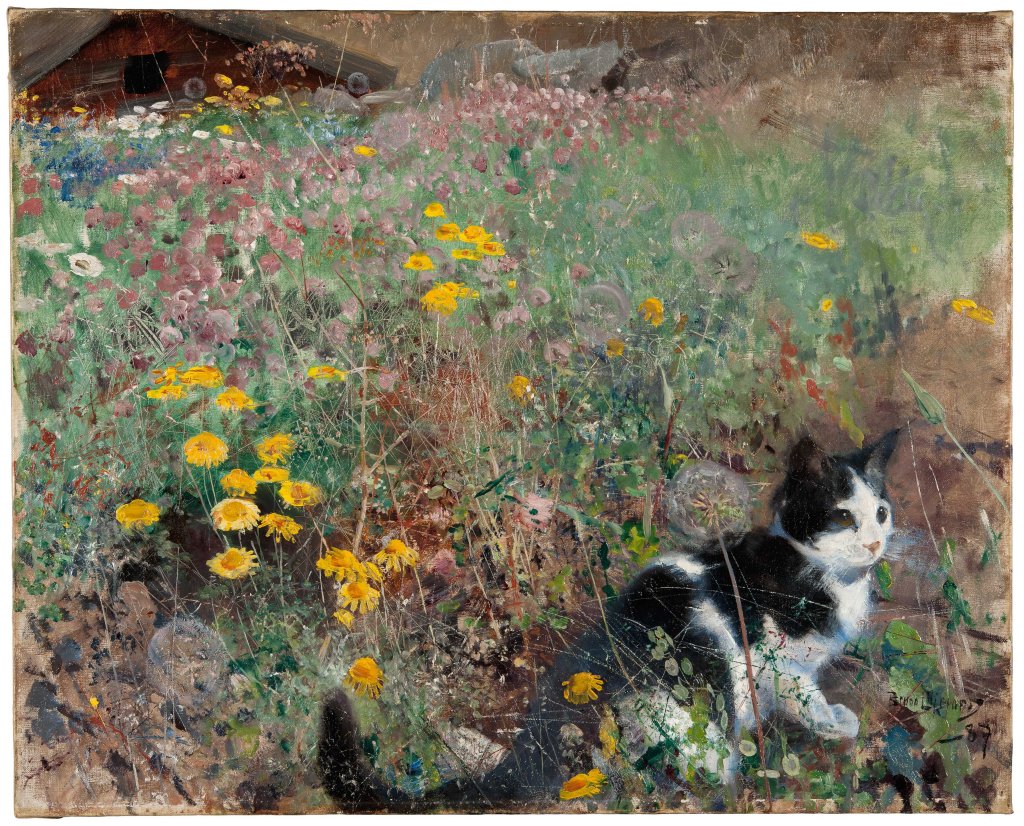
Bruno Liljefors, Cat on a Flowery Meadow , 1887.
Oil on canvas, 61×76 cm.
Nationalmuseum, Stockholm. © Stockholm, Nationalmuseum / Photo Cecilia Heisser.
The cat was a recurring source of fascination for Bruno Liljefors throughout his life. Perhaps because, although considered a domestic animal, this feline nevertheless retains its hunting instincts. Here, in the same frame, the painter combines a bird motif already found on another canvas. The birds, perched on the branch, reveal Liljefors’ talent for rendering movement and the effectiveness of his method, which relied both on close-up studies and photographic models.
Foxes
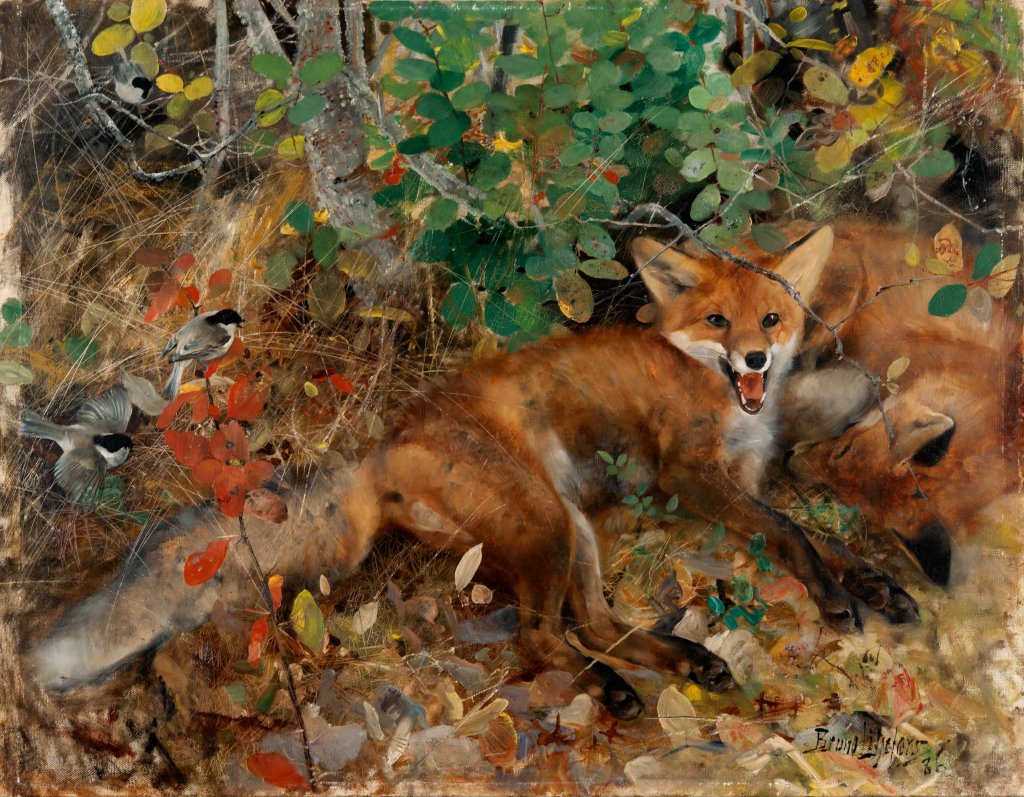
Bruno Liljefors, Foxes, 1886.
Oil on canvas, 71,5×91,8 cm.
Gothenburg Museum of Art, Gothenburg. © Gothenburg Museum of Art.
Like the cat, the fox frequently recurred in Liljefors’ painting. The artist depicted the animal in all phases of existence and in all situations. Here, we can see two resting foxes, perhaps digesting their prey. This painting is a perfect example of how Liljefors approached the combined use of paint and brush to naturally create an illusion. For example, the leaves are in fact “simple” spots of paint, and the texture of the foxes’ fur is wonderfully evoked by the traces of the paintbrush bristles.
Anna

Bruno Liljefors, Anna. The Artist’s Wife, 1885.
Oil on canvas, 95,5×79,5 cm.
Private collection, London.
Bruno Liljefors rarely focused on this genre. This work is even more surprising in that one of his most striking portraits was of his first wife, Anna. Wearing a pink dress, she appears sitting amongst the vegetation, looking outside of the frame. Her gaze is as intense as it is impenetrable, endowing the work with an enigmatic atmosphere. The naturalistic rendering of the painting evokes Les Foins (Haymaking) by French artist Jules Bastien-Lepage. The latter was much appreciated by Liljefors and the artists of his generation.
 LES AMIS DU PATRIMOINE EUROPÉEN