
Bonnard and the Nordics
Nationalmuseum, Stockholm
20 February – 18 May 2025
www.nationalmuseum.se
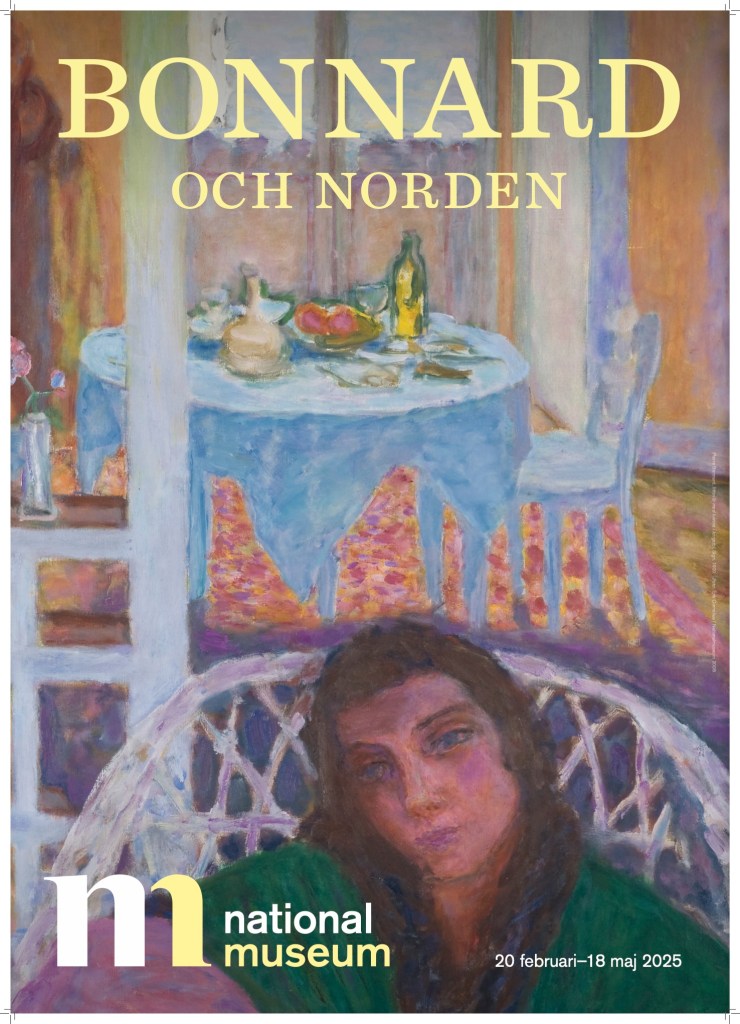
PRESENTATION
[From the Press Kit]
Published on 6th March 2025.
Pierre Bonnard was one of the twentieth century’s most influential artists. In iridescent images, the Frenchman captured the world around him: his home, family, garden, bustling streets, and the view on the ocean from his window. In recent years, crowds around the world have flocked to exhibitions of Bonnard’s paintings. Nationalmuseum’s exhibition is the first one in Sweden in more than seven decades. It also highlights Bonnard’s impact on Scandinavian art for the first time, with his work presented alongside that of select Scandinavian artists. ‘Bonnard and the Nordics’ will run from 20 February to 18 May.
The exhibition ‘Bonnard and the Nordics’ offers new perspectives on Pierre Bonnard’s life and work. Visitors get to accompany the Frenchman from his debut as a poster artist who depicted modern life in Paris in the late 1800s, to his years painting vibrant and intimate interpretations of daily life and the landscape in the southeast of France, in Normandy, and on the French Riviera, where Bonnard spent the last two decades of his life. Bonnard lived from 1867 to 1947 and is often seen as an artist who charted his own course, unaffected by the many -isms of modern art. His paintings are more than shimmering idylls, though. They also contain puzzlingly ambiguous details that can be interpreted in multiple ways against the backdrop of the era’s disquiet and war. Pierre Bonnard’s life partner Marthe makes regular appearances in the artist’s work. The exhibition introduces Marthe Bonnard as an individual and highlights her impact on Bonnard’s creative endeavours. Visitors get to admire several of her own, rare works – signed ‘Marthe Solange’.
Bonnard had a significant influence on his peers, both during his lifetime and after his death. This was the case not least in Scandinavia: in 1939, a major exhibition of Bonnard paintings opened its doors in Oslo, Gothenburg and Stockholm. It was the biggest to be held outside of France up until then. In Sweden, Bonnard became a source of inspiration for the so-called Gothenburg Colourists. Seeing Bonnard’s paintings left an impression on artists like Ragnar Sandberg, Karin Parrow and Ivan Ivarson. In Finland, Bonnard’s art played a key role for the Septem Group, of which artists like Magnus Enckell and Ellen Thesleff were part. This spring’s exhibition will also explore the unique relation between Bonnard’s psychologically multi-faceted painting and the imagery of Norwegian Edvard Munch.
Through Bonnard’s paintings, visitors get to both discover unexpected aspects of Scandinavian art and see the Frenchman himself in a new light.
A SELECTION OF WORKS OF ART
by the curators of the exhibition
Per Hedström, Head of Exhibitions, Nationalmuseum, Stockholm
and Linda Hinners, Curator of Sculpture, Nationalmuseum, Stockholm.
The Cab Horse
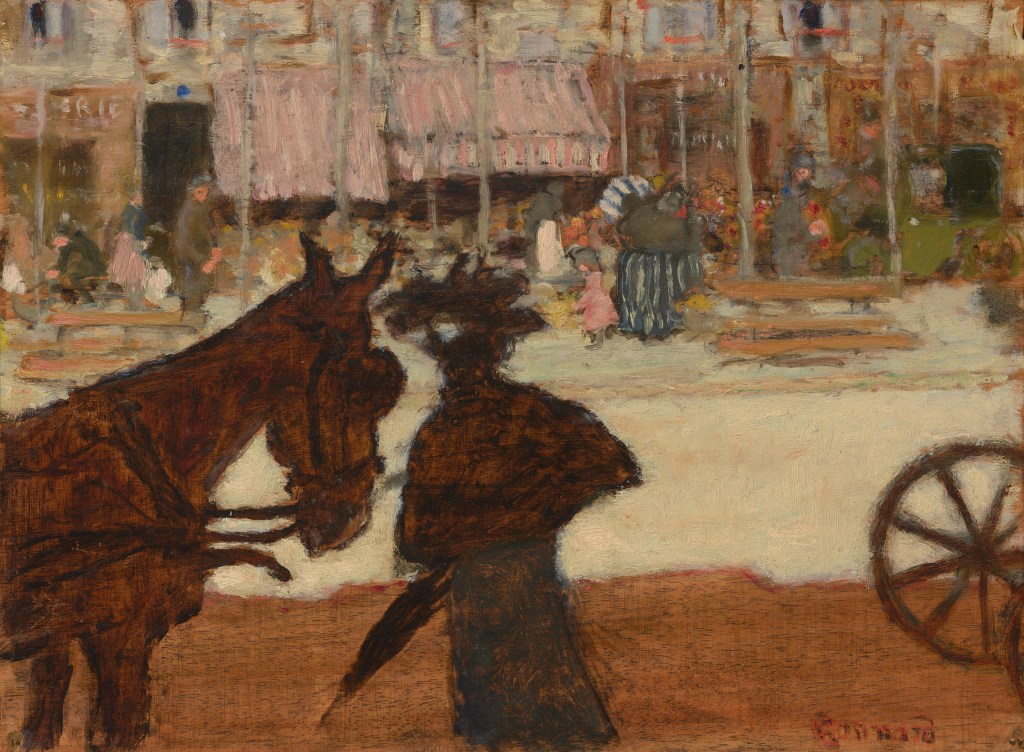
Pierre Bonnard, The Cab Horse, c. 1895.
Oil on wood, 30 x 40 cm
Ailsa Mellon Bruce Collection
Coll. National Gallery of Art, Washington. Inv. 1970.17.4
© National Gallery of Art, Washington
In the 1890s, Bonnard’s art focused on life in metropolitan Paris, where he lived in bohemian Montmartre. The painter was drawn to everyday life around him: bustling crowds in cafés or in the streets, and private social gatherings with his friends and family. This painting is a typical Bonnard street scene from that period. It’s a small work that depicts a seemingly randomly captured moment in time, almost like a snapshot photograph. At the time, Bonnard created clear contrasts between foreground and background in his work. In this case, the shapes closest to us – a horse, a woman, a carriage wheel – are just shadowy silhouettes. The crowd on the other side of the street bathes in sunlight. Such depictions of everyday life were common in Japanese art at the time, especially in the woodcuts that inspired so many of the era’s European artists. These often featured monochrome, flat surfaces – a stylistic device Bonnard implements in this painting. The Frenchman would continue to collect Japanese art throughout his life.
The Dining Room, Vernon
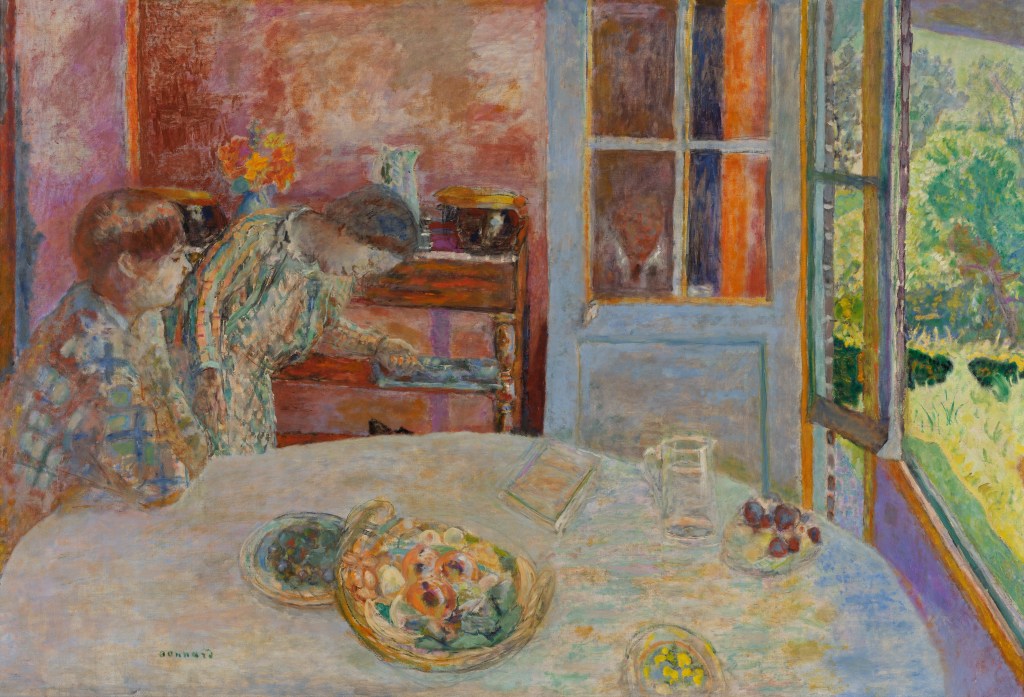
Pierre Bonnard, The Dining Room, Vernon, c. 1923-1927.
Oil on canvas, 126 x 184 cm
Coll. Ny Carlsberg Glyptothek, Copenhagen. Inv MIN 2705
© Glyptothek, Copenhagen
In the early 1920s, before they settled on the French Riviera, Pierre and Marthe Bonnard split their time between Paris, Le Cannet on the Mediterranean, and Vernon in Normandy. This is a painting of the dining room in Vernon. It’s a classic example of Bonnard’s later style. Bonnard wanted to paint what the naked eye saw, to capture the spontaneous, immediate impression of entering a room or gazing out over a landscape. He simply wanted to paint a scene, objects or people without highlighting specific elements to make them look more important than others.
The room in this work seems almost compressed and practically vibrates with colour. It features two people, a table, and a glass door open onto the garden. The painting both accentuates and erases the structure of the objects we see. The patterns on the figures’ clothes seem to blend into one another like the luminous colours in the garden outside. They say Bonnard’s work isn’t for those who’re in a hurry… It can take a while to discover every detail in his paintings. Look closely, and you’ll see the nose of a dog peeking up from behind the table, for example. In one of the door’s glass panes, there’s a faint reflection of a face. As a result, the painting is both mundane and somewhat enigmatic.
Nude in an interior
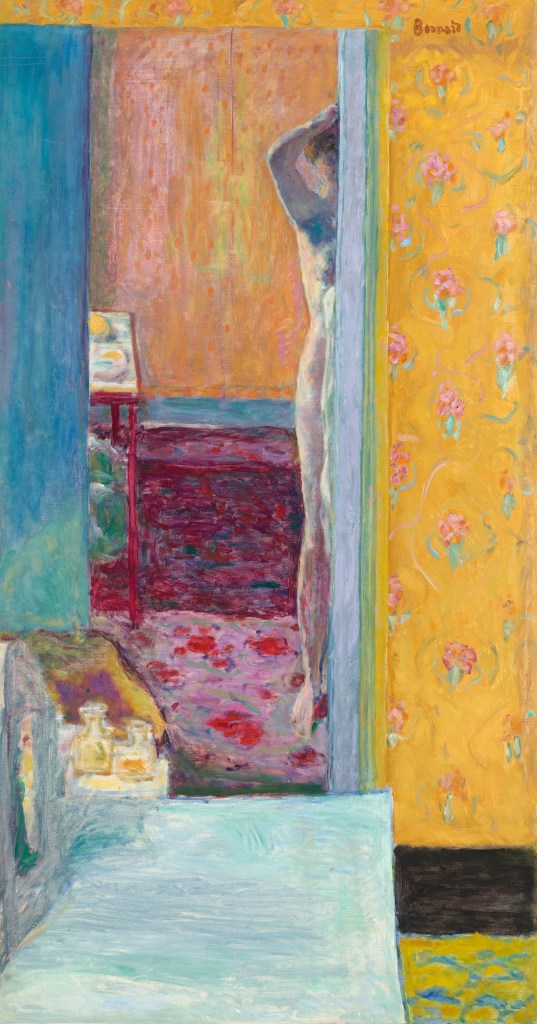
Pierre Bonnard, Nude in an interior, c. 1835.
Oil on canvas, 134 x 70,5 cm
Collection of Mr and Mrs. Paul Mellon
Coll. National Gallery of Art, Washington. Inv. 2006.128.8
© National Gallery of Art, Washington
Bonnard painted his first nudes around the turn of the century. It was a motif he would continue to explore for the rest of his life. He portrayed his models in everyday settings, while also approaching the subject in a way that was firmly rooted in art history. After all, the naked body has been a key motif in Western art ever since Classical Antiquity. Bonnard often depicted the people around him. One oft-recurring model was his life partner, Marthe. The pair met in 1893 and would remain by each other’s side for almost five decades. Over time, the Frenchman’s nudes increasingly focused on shape, colour, and the way the light was reflected in the room or on the bodies he portrayed. His compositions became ever more complex. Sometimes, Bonnard’s models are backlit or turn away, their faces half hidden. In this painting, the model’s body is partly shrouded from view by the door frame – or perhaps it is her reflection in a mirror we are looking at? In spite of the bold, welcoming colours, the work is ambiguous, not least because of the disconnect between viewer and subject.
 LES AMIS DU PATRIMOINE EUROPÉEN