Alberto Giacometti – What Meets the Eye
Statens Museum for Kunst, Copenhagen
10 February – 20 May 2024
www.smk.dk
🇫🇷 🇬🇧

Tall, slender figures with rough, organic surfaces: the Swiss artist Alberto Giacometti (1901-1966) is internationally known for his iconic representations of long-limbed human figures. They are highlights in the collections of some of the world’s leading museums, such as the Tate Modern in London, the Museum of Modern Art in New York and the Fondation Giacometti and the Centre Pompidou in Paris. In Denmark they can be found at Louisiana and in the square in front of the old town hall in Holstebro, among other places. Giacometti’s fame rests very much on his sculptures. This held true in his own day and remains so today, when he is considered one of the most important artists of the twentieth century. But the scope of his art is far wider than that.
On 10 February 2024, SMK will open the exhibition Alberto Giacometti – What Meets the Eye, which unfolds the story of Giacometti across his various art forms: sculpture, painting, printmaking and drawing. The extensive exhibition takes its point of departure in the SMK collection, which is home to several important examples of Giacometti’s works on paper. Created in collaboration with the Fondation Giacometti in Paris, the exhibition offers an extraordinary opportunity to experience some of Giacometti’s popular masterpieces like The Nose (1947), The Cage (1950-51) and The Walking Man (1960) side by side with a number of lesser-known works that have only rarely been on public display. In total, the exhibition contains around 90 works, and it takes its starting point in the 1920s and 1930s – a period that left a decisive mark on Giacometti’s art and would continue to affect his style and idiom until his death in 1966.
Giacometti moved to Paris at the age of 21, and from 1930 he became part of the Surrealist circle around the French poet and writer André Breton (1896–1966). For several years, Giacometti was inspired by the idiom used by the Surrealists to represent the subconscious and humanity’s inner life. But in 1934 his artistic practice took a significant turn. He began to work from the life again, working from models and turning to physical reality. The exhibition Alberto Giacometti – What Meets the Eye unfolds Giacometti’s years-long obsession with visual perception and his dedicated struggle to capture the world as he saw and perceived it. Heads and full-length figures were his most used subjects, and by working with scale, direction, space and distance, he strove to translate his visual sensory impressions into truthful and authentic works of art.
Philosophical questions about the human condition, including existentialist and phenomenological debates, played a central role in his art, and from 1941 he came into contact with thinkers such as Jean-Paul Sartre and Simone de Beauvoir. The exhibition and the accompanying publication delve into these relationships with leading thinkers of the time. At the same time, the exhibition unfolds the artist’s close relationship with Paris, where Giacometti lived most of his life. For example, it presents a number of lithographs from the book Paris sans fin (Paris without end), on which he worked until his death, and which describes life in the French capital.
A CURATOR’S CHOICE
by Thomas Lederballe Pedersen
senior researcher and chief curator, Statens Museum for Kunst
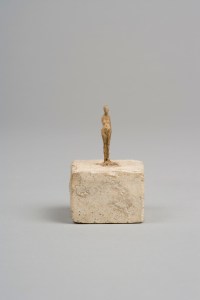
Alberto Giacometti. Very Small Figurine. 1937-1939. Plaster, 4.5 x 3 x 3.8 cm.
Fondation Giacometti © Succession Alberto Giacometti / Adagp, Paris, 2024
Among the challenges constantly faced by Alberto Giacometti in representing what he sees, he particularly struggles with achieving a size that he deems authentic – the size that would make a figure or a sitter appear ‘real’ in scale. The sculpture Very small figurine serves a prime example of this struggle. Standing at a mere five centimetres in height, it is the smallest work in the exhibition. The tiny figure is made from memory when the artist encountered his friend and lover, Isabel Rawsthorne (Nicholas), on the Boulevard Saint-Michel in Paris. Despite the diminutive scale, Giacometti managed to capture her essence, as he perceived her in that specific moment: very small and viewed from a great distance. This awareness of spatial relationships between viewer and subject permeates his lifelong exploration of the size of his figures.
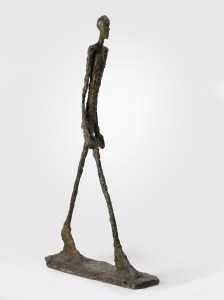
Alberto Giacometti. Walking Man II. 1960. Bronze, 190 x 112.5 x 28 cm.
Louisiana Museum of Modern Art, Humlebæk. Donation: Ny Carlsberfondet
© Succession Alberto Giacometti / Adagp, Paris, 2024
In a letter from 1948 to the gallerist Pierre Matisse, Giacometti points out that, in addition to figure and space, the third element that is fundamental to his art is movement. This is often expressed by figures that simply have one leg in front of the other, walking through eternity/frozen in eternity. Around the time that he writes to Matisse, Giacometti created a larger figure of a walking man. A decade later, he would create a variation on this theme in a figure of the same gender and size: Walking Man II. With its dynamic, progressive pose and conveying a sense of forward movement, this figure type creates space, and has been compared to a corresponding figure type in ancient Egyptian art, which the artist knew about. The sculpture’s timeless dimension gives it symbolic power, and it bear witness to the artist’s tireless quest to represent the essence of the human experience.

Alberto Giacometti. The Nose. 1947. Plaster, painted metal and corde de coton, 82.5 x 37 x 71 cm. Fondation Giacometti © Succession Alberto Giacometti / Adagp, Paris, 2024
The Nose, an equally comical and haunting sculpture, presents a skeletal figure suspended within a cage. Its most striking feature is an extraordinary long nose that protrudes through the bars. While initially appearing humorous, the inspiration for this work stems from a traumatic experience in Giacometti’s youth: the death of his older travel companion, the archivist Peter van Meurs. In his text ‘The Dream, Le Sfinx and the Death of T.’ published in 1946, Giacometti recalls this nightmarish vision of the old man’s face: ‘the nose more and more accentuated, the cheeks hollowing, the open moth almost still barely breathing.’ Giacometti’s personal experience of witnessing the appearance of death infuse this important work with psychological and existentialist depth, echoing surrealist traditions, and inviting viewers to contemplate the interplay between imagination and reality.
 LES AMIS DU PATRIMOINE EUROPÉEN