
🇫🇷 🇬🇧
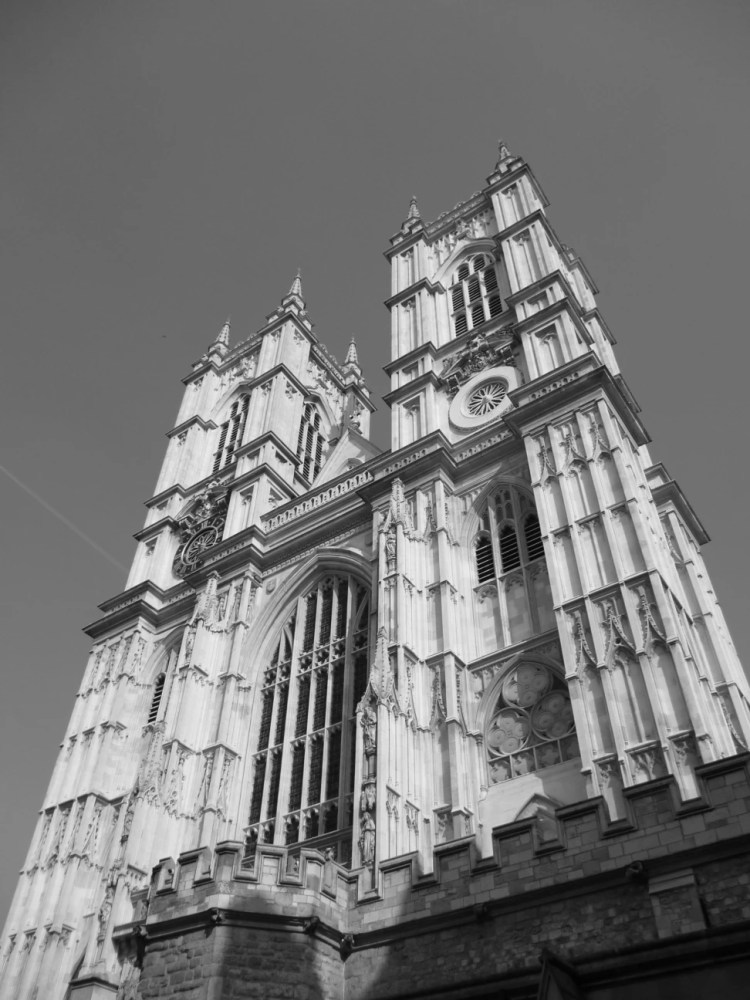
The West Front of Westminster Abbey © Thomas Ménard
Napoleon is often considered as one of Britain’s greatest enemies. As a consequence, Nelson and Wellington are amongst the greatest heroes of the British people. Both are buried in St Paul’s Cathedral, but they are remembered in Westminster Abbey. The plaques they were given as members of the Most Honourable Order of the Bath are both on display in the Lady Chapel. In addition, there is a wax effigy of Nelson in the Queen’s Diamond Jubilee Galleries.
Actually, connections with Napoleon are everywhere in this Royal church. In this “Napoleon Trail in Westminster Abbey”, you will meet about twenty people who, in one way or another, were opponents to General Bonaparte, the First Consul or Emperor Napoleon I. Most of them are officers of the Royal Navy or the British Army. Some are politicians, for example the great rivals of the time: William Pitt the Younger and Charles James Fox. Finally, there will be a few peculiar figures: a French prince, the last Queen of France and the Father of the Corsican Nation.
These people are listed alphabetically in this trail. If you are visiting Westminster Abbey, the route can change, so it was difficult to list them in another way. You will find their location on the map below. Sometimes, it is not possible to see some of the monuments or graves. Feel free to ask a member of staff if you need any help.
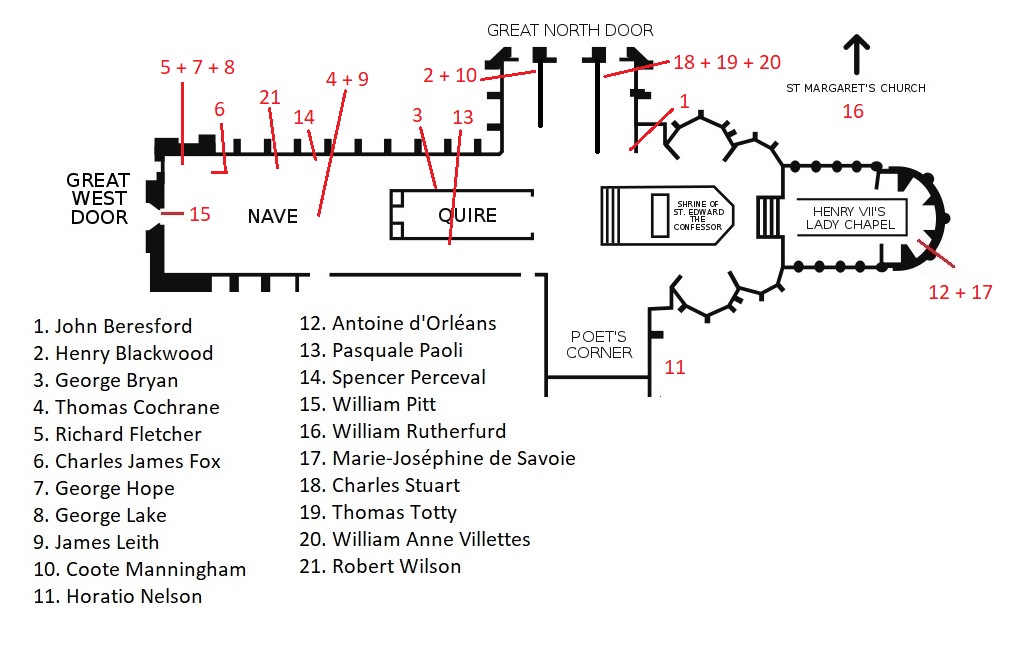
You can find the opening times, fees and other information about the Abbey on its website: www.westminster-abbey.org.
The French-speaking Cultural Foundation of London would like to thank the Dean and Chapter and the Management Team of Westminster Abbey, who supported the “Napoleon Trail” project. It has been created in the context of the commemorations surrounding the bicentenary of Napoleon’s death and the “Year Napoleon 2021”. This event is coordinated by the “Fondation Napoléon” in France and the British Napoleonic Bicentenary Trust in the UK.
Texts : Thomas Ménard + George Tanton
1. John Beresford
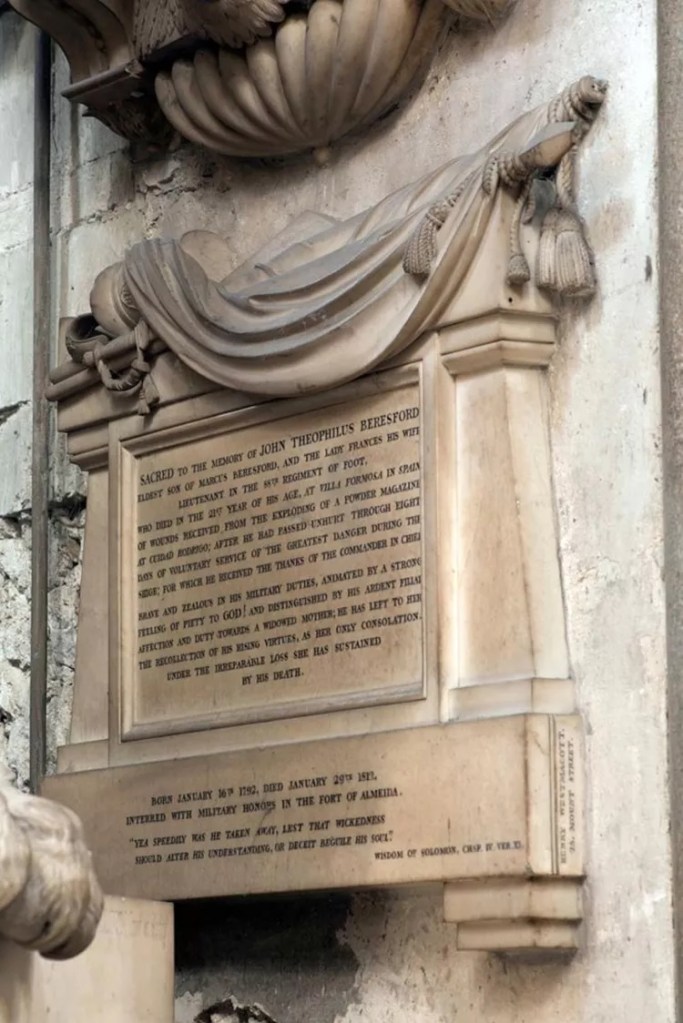
Memorial by Henry Westmacott
Image © 2021 Dean and Chapter of Westminster
John Theophilus Beresford was born on 16 January 1792. His father, Marcus Beresford, was an Irish politician, from the family of the Marquises of Waterford and the Earls of Tyrone. During the Peninsular War, he was a Lieutenant in the 88th Regiment of Foot. He died on 29 January 1812, aged 21, from wounds received from the explosion of a powder magazine, a few days earlier, during the Siege of Ciudad Rodrigo (7-20 January 1812).
This memorial is in the Chapel of St John the Evangelist, North Ambulatory and here.
2. Henry Blackwood
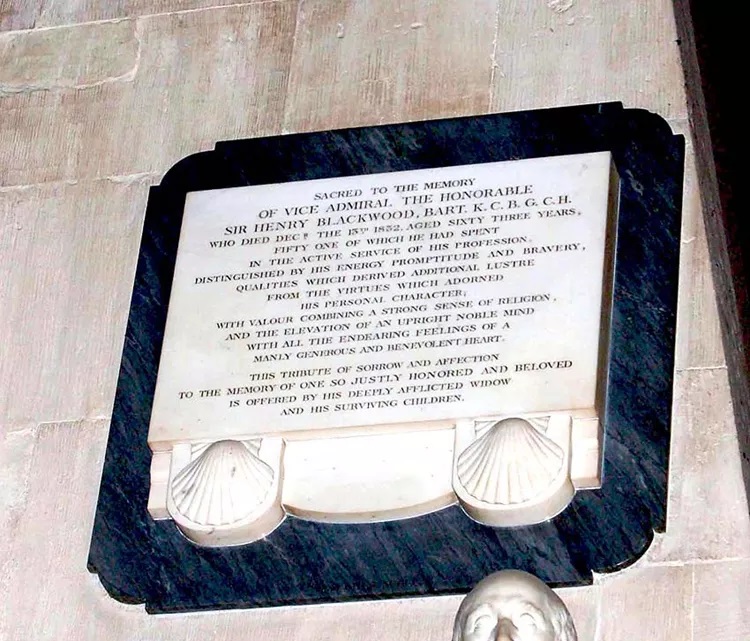
Memorial by William Behnes
Image © 2021 Dean and Chapter of Westminster
Henry Blackwood, born on 28 December 1770, was an officer of the Royal Navy. He was commanding a squadron during the Battle of Trafalgar, on 21 October 1805. Before the battle, Admiral Nelson asked Blackwood and Captain Hardy to act as witnesses, when he wrote a codicil to his will. A few months later, Henry attended Nelson’s funerals in London.
After the Napoleonic Wars, he was appointed Rear-admiral and Knight of the Order of the Bath. He retired from the Royal Navy in 1830, being a Vice-admiral and one of the Commanders-in-Chief of the Royal Navy. He died on 13 December 1832 and was buried in the family vault in Northern Ireland.
This memorial is in the North Transept and here.
3. George Bryan
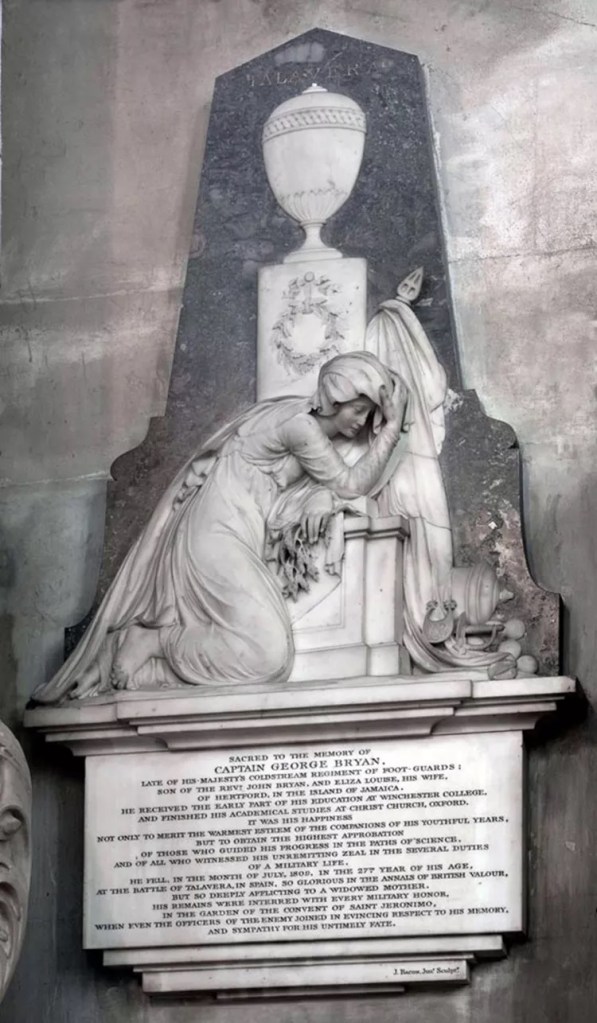
Memorial by John Bacon Jr.
Image © 2021 Dean and Chapter of Westminster
George Bryan, a former pupil at Winchester School and Christ Church, Oxford, was a Captain in the Coldstream Guards during the Peninsular War. He was killed alongside 6,000 British soldiers at the Battle of Talavera (27-28 July 1809), aged 27. He was buried near the battlefield, in the garden of the convent of St Geronimo.
After this battle, Arthur Wellesley was created Viscount Wellington of Talavera, before becoming Duke of Wellington in 1814.
This memorial is in the North Choir Aisle and here.
4. Thomas Cochrane

Image © 2021 Dean and Chapter of Westminster
The life of this Scottish sailor is really astounding. Thomas, Lord Cochrane, was the son of the 9th Earl of Dundonald. On 23 July 1893, he joined the Royal Navy, aged 17. During the Napoleonic Wars, he became one of Bonaparte’s fiercest opponents, especially during naval operations in the Mediterranean. Napoleon revered him as “The Sea Wolf” for his part in destroying and capturing French ships.
Thomas Cochrane was also involved in the Great Stock Exchange Fraud. In February 1814, rumours that Napoleon had been killed in Russia arrived in London. It leaded to a very sharp rise of the share prices on the London Stock Exchange and Cochrane earned a lot of money. It was soon assumed that it was a fraud and, on 20 June 1814, he was found guilty by the Court of King’s Bench, Guildhall. He was dismissed from the Royal Navy, expelled from the House of Commons (where he had been elected a few years earlier) and from the Order of the Bath, during a humiliating degradation ceremony at Westminster Abbey.
As a consequence, he decided to flee to South America. In the 1820’s, he successively organised and took command of the Chilean Navy and the Brazilian Navy, during their war of independence against Spain and Portugal. He was also involved in the struggle for Peruvian independence.
In 1832, he became the 10th Earl of Dundonald and was eventually forgiven by the Crown. He returned to England and reenlisted with the Royal Navy, where he became a Rear-admiral. Lord Dundonald died on 31 October 1860, aged 84. He was buried a few days later in the nave of Westminster Abbey. In 1967, he inspired Pablo Neruda for his collection of poems entitled “Lord Cochrane de Chile”.
This tombstone is in the Nave and here.
5. Richard Fletcher

Memorial by Edward Hodges Baily.
Image © 2021 Dean and Chapter of Westminster
Born in 1768, Richard Fletcher joined the Royal Artillery at 20 years old, and then the Royal Engineers on 29 June 1790. He first fought against the French in the West Indies, being involved in the capture of Martinique, Guadeloupe and St Lucia. After being wounded at St Lucia, he was appointed Chief engineer and sent back to England.
Later he served in Constantinople as an adviser to the Ottoman forces, who were fighting against General Bonaparte in Syria. He helped them in Acre and Jaffa, but he was eventually captured by the French and held prisoner in Alexandria. He was freed after the Treaty of Amiens. When the war broke out again, he served in the Baltic, at the Battle of Copenhagen.
Then he was involved in the Peninsular War, where he was General Sir Arthur Wellesley’s Chief engineer. He was present at the Battles of Talavera, Badajoz, Ciudad Rodrigo, and Vitoria on 21 June 1813. He also organised the defences at Lisbon. After being wounded several times, it was said that Wellington visited him every day to ask for advice from his most competent engineer.
Fletcher was killed at the Battle of San Sebastian, on 31 August 1813, and buried there. A few months earlier, on 14 December 1812, he had been created Baronet and thus became Sir Richard Fletcher. He was also appointed Lieutenant-colonel.
This memorial is in the Nave and here.
6. Charles James Fox
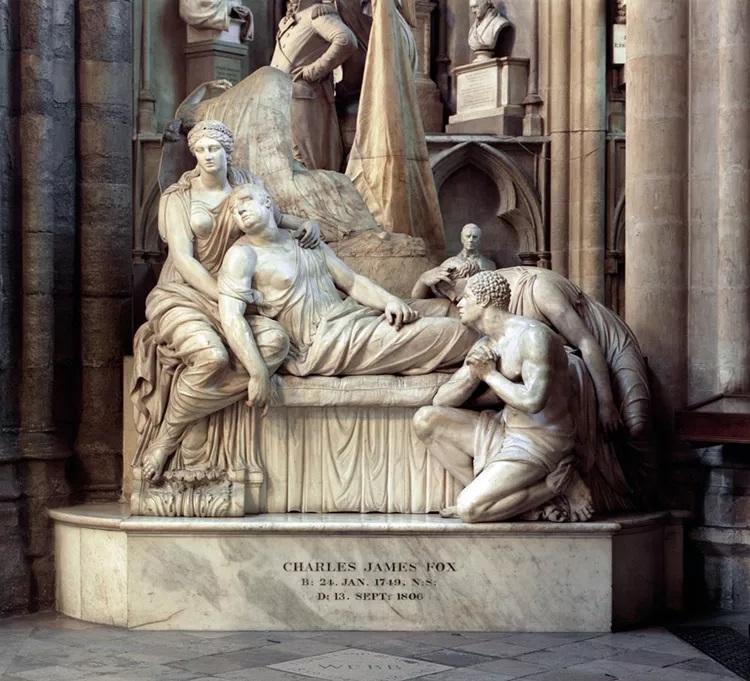
Monument by Sir Richard Westmacott.
Image © 2021 Dean and Chapter of Westminster
Charles James Fox was born in 1749. His father was the 1st Baron Holland and his mother a descendant of Charles II. He started his public life with a Grand Tour in Europe. He met Voltaire, the duc d’Orléans and Lafayette in Paris and Versailles.
He then became a MP in spite of his young age. At the House of Commons, he was known as an excellent orator and soon as one of the leaders of the Whig Party and the first opponent to William Pitt the Younger and King George III. That might be the reason why he supported the independence of the Thirteen Colonies.
Later, he supported the French Revolution, at least in its first stages. He changed his mind with the September Massacres. He welcomed Bonaparte and said about him that he surpassed Alexander and Caesar! After the Treaty of Amiens, he travelled to France, met the First Consul three times and became a foreign member of the French “Académie des inscriptions et belles-lettres”.
When the war broke out again, he kept supporting Bonaparte against the Tory government, but, after Pitt’s death, he eventually agreed to join Grenville’s “Ministry of All the Talents” as Foreign Secretary, a position he already hold several times before.
Six month later, on 13 September 1806, he died in Chiswick House, then belonging to his good friend, perhaps his mistress, Georgiana Cavendish, Duchess of Devonshire. He was buried in Westminster Abbey.
As a Francophile, he was an admirer of Napoleon I, despite that he was the greatest enemy of the British people.
This monument is in the Nave and here.
7. George Hope
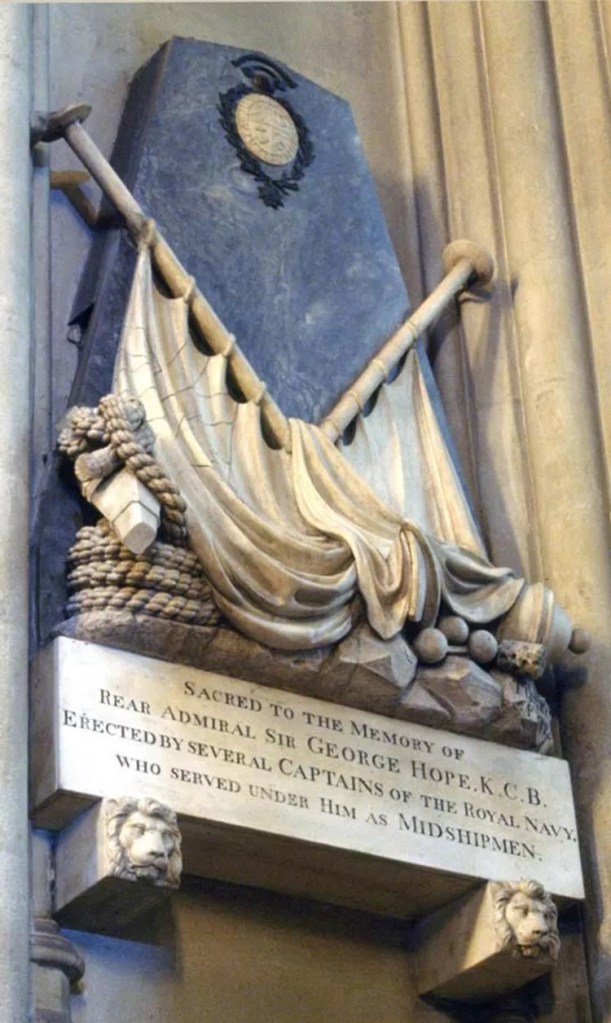
Memorial by Peter Turnerelli.
Image © 2021 Dean and Chapter of Westminster
George Johnstone Hope was the grandson of a Scottish earl. He joined the Royal Navy at 15 years old in 1782. In the 1790’s, he commanded several frigates in the Mediterranean. After the Battle of the Nile, he joined Nelson at Aboukir and was sent to Naples in order to evacuate the Royal Family, threatened by the new Parthenopean Republic. Later, he was involved in the British invasion of Egypt and in the Battle of Trafalgar on 21 October 1805. He kept serving in the Royal Navy during the end of the Napoleonic Wars. He became one of the Lords of the Admiralty and a Knight Commander of the Order of the Bath. He died in his office at the Admiralty on 2 May 1818 and was buried in Westminster Abbey.
This memorial is in the Nave and here.
8. George Lake
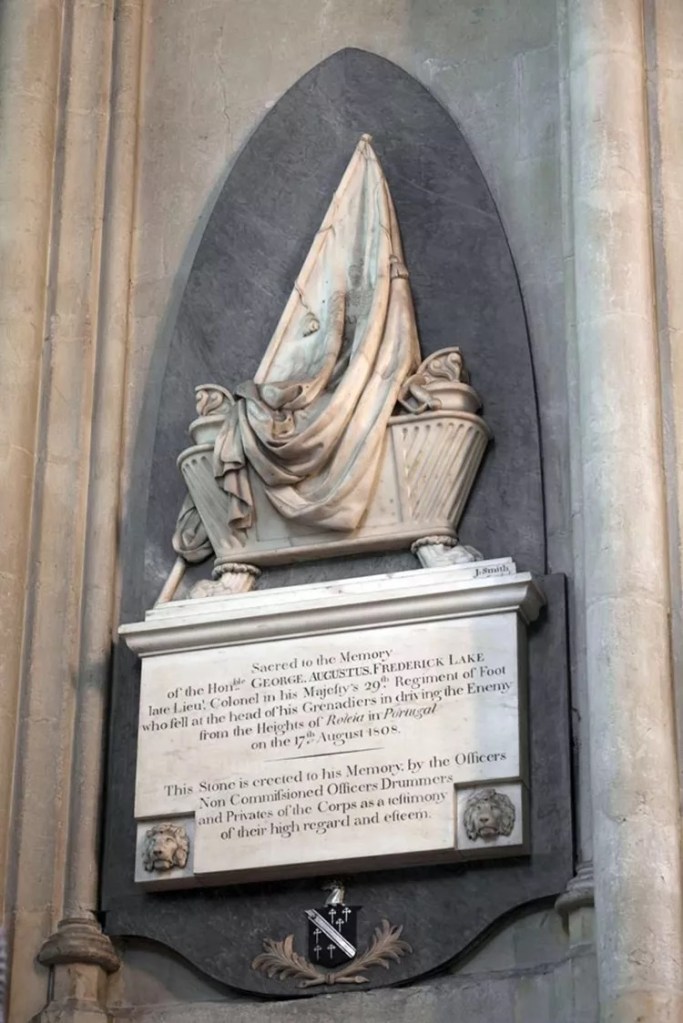
Memorial by James Smith.
Image © 2021 Dean and Chapter of Westminster
George Augustus Frederick Lake was born on 2 February 1781. His father was General Gerard Lake, 1st Viscount Lake, who served as an Equerry to the Prince of Wales, whilst he himself served as one of the Prince’s Pages of Honour. Between 1798 and 1803, he became the aide-de-camp and the military secretary to his father, who was Commander-in-Chief in Ireland and then in India. He was severely wounded at the Battle of Laswaree, after helping his father, whose horse had been shot under him.
In 1808 George was appointed Lieutenant-Colonel in the 94th Regiment of Foot and sent to the Peninsular War. On 17 August, he was killed at the Battle of Roliça, one of the early engagements with the French. He was buried there by his fellows Grenadiers Guards.
This memorial is in the Nave and here.
9. James Leith
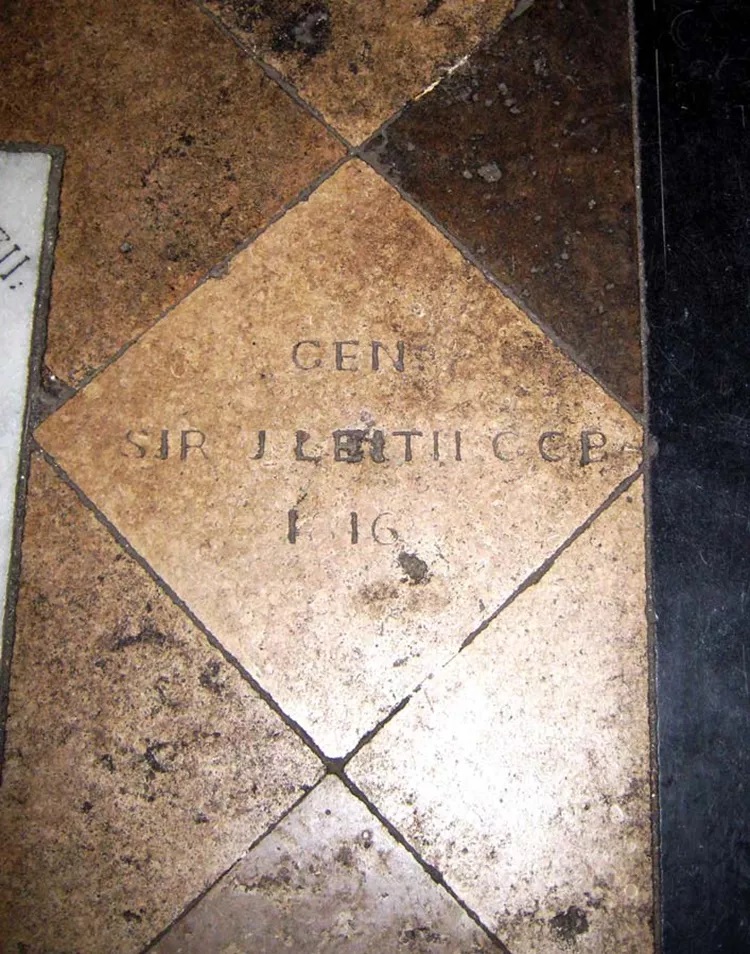
Image © 2021 Dean and Chapter of Westminster
People visiting the Abbey often miss James Leith. In spite of being one of the most senior officers of the French Revolutionary Wars and the Napoleonic Wars, he has got a very simple gravestone, instead of a glorious monument.
He was born in Scotland in 1763 and joined the Army aged 17. He soon became an officer and served as an aide-de-camp to several prominent generals. In 1793, he participated in the Siege of Toulon, as did the young Napoléon Bonaparte on the other side. Then he was sent to Gibraltar, to Ireland and finally to Spain. On 8 August 1810, his 47th birthday, Wellington appointed him as the Commander of the newly created 5th Infantry Division. He commanded it at the Battles of Bussaco, Badajoz, Salamanca and San Sebastian.
On 15 February 1814, he became the Governor and Commander-in-Chief of the Leeward Islands (West Indies). On 8 August 1815, he invaded Guadeloupe, where the French governor appointed by Louis XVIII decided to rally Napoleon after his escape from Elba. On 10 October 1816, he contracted yellow fever in Barbados and died on 16 October. Lieutenant-General Sir James Leith was buried in Westminster Abbey on 15 March 1817.
This tombestone is in the Nave and here.
10. Coote Manningham
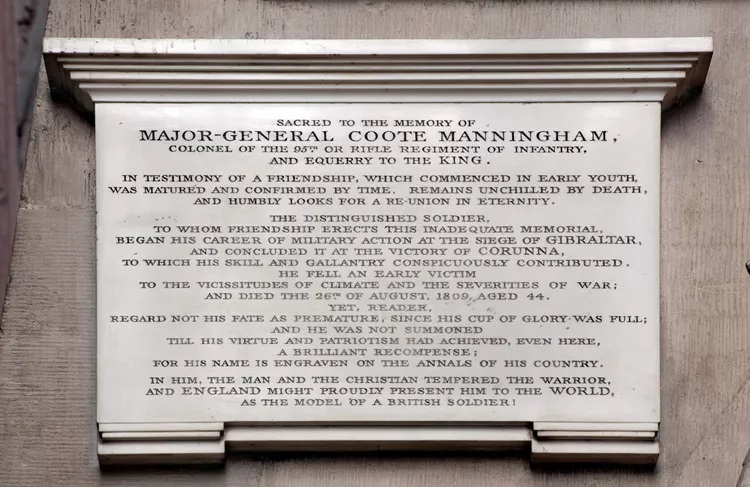
Memorial by Johan Bacon Jr.
Image © 2021 Dean and Chapter of Westminster
Coote Manningham was born around 1765. He participated in the Siege of Gibraltar, and served in Santo Domingo and then in Spain. There he was commanding the Experimental Corps of Riflemen (later 95th Rifles), a corps he had created and trained. He contracted illness during the retreat of British troops after the Battle of Coruna (16 January 1809) and died in England, a few months later, on 26 August 1809, aged 44.
This memorial is in the North Transept and here.
11. Horatio Nelson
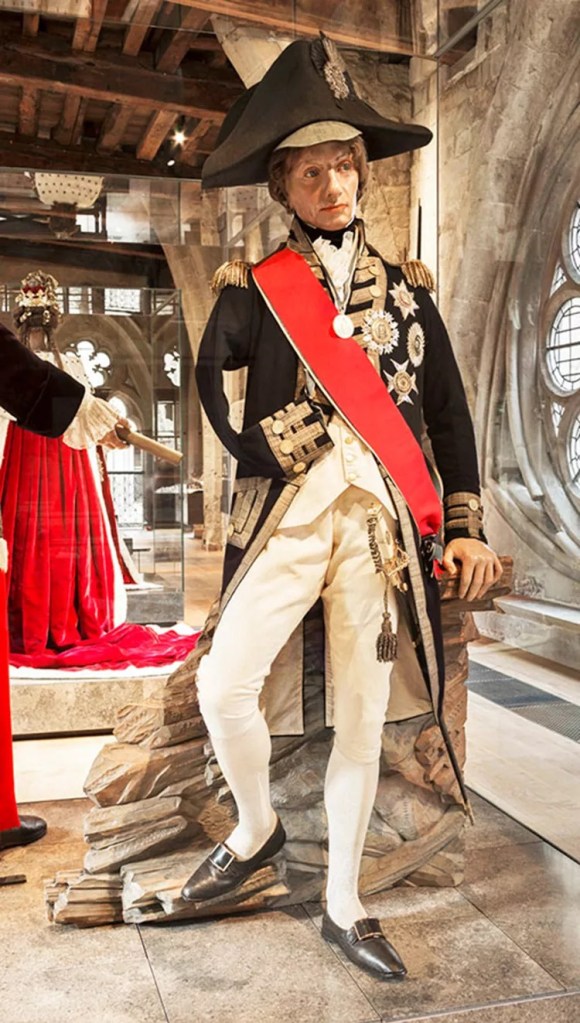
Image © 2021 Dean and Chapter of Westminster
Admiral Nelson is one of the greatest heroes of English and British history. He has a peculiar link with Westminster Abbey. As the Duke of Wellington, he is buried in St Paul’s Cathedral, so there is obviously no grave or even a memorial at the Abbey. However, there is a wax effigy displayed in the Queen’s Diamond Jubilee Galleries, an exhibition space opened in 2018 in a part of the Triforium, the first floor gallery, 20 meters above the Shrine Ambulatory.
Horatio Nelson was born on 25 September 1758 in Norfolk. He joined the Royal Navy at an early age and participated in the American Revolutionary War or, from an English point of view, the repression after the rebellion of the Thirteen Colonies. Later, he served during the French Revolutionary Wars and the Napoleonic Wars, notably in the Mediterranean. Amongst many battles, he participated in the Siege of Toulon, in the British invasion of Corsica, in the Battle of the Nile and, obviously, in the Battle of Trafalgar. During some of the first engagements, he lost an eye and an arm; during the last one, he lost his life, killed by a French bullet shot from the nearby Redoutable.
On this day, on 21 October 1805, the Vice-admiral Viscount Nelson sent his famous order through the flags of his flagship HMS Victory: “England expects that every man will do his duty”. Before the battle, he also said “Westminster Abbey, or Victory!” Nevertheless, he was buried in St Paul’s Cathedral on 9 January 1806. His funerals were probably one of the most solemn events that happened in London.
Soon, the Abbey staff ordered a wax and wooden effigy of the glorious admiral. His mistress, the scandalous Emma, Lady Hamilton, said it was more like her lover than any portrait. The effigy wears some clothes which belonged to Nelson, as his sword.
In the Lady Chapel, the plaque he received as a Knight Grand Cross of the Most Honourable Order of the Bath can be seen.
This effigy is in the Queen’s Diamond Jubilee Galleries and here.
12. Antoine d’Orléans

Monument by Sir Richard Westmacott.
Image © 2021 Dean and Chapter of Westminster
This figure is a bit peculiar amongst Napoleon’s enemies who are buried or commemorated at Westminster Abbey.
Antoine-Philippe d’Orléans, duc de Montpensier, was born on 3 July 1775 in the Palais-Royal, opposite the Louvre Palace. His father was Louis-Philippe d’Orléans, who would be known as Philippe-Egalité, and his brother another Louis-Philippe d’Orléans, later King of the French. He was baptised in the Royal Chapel at Versailles Palace on 12 May 1788. His godfather was King Louis XVI and his godmother Queen Marie-Antoinette. A year later, the French Revolution would change the Orléans family’s fate.
Even if they were members of the French Royal Family, they supported the Revolution and the project of an English-styled liberal and constitutional monarchy. As a consequence, Antoine joined the Revolutionary armies and fought against the European rulers of the First Coalition. He was aide-de-camp to his older brother, General Egalité. However, he vainly tried to persuade his father to vote against the King’s death penalty.
In 1793, all the members of the Royal Family who were still in France were arrested. Antoine was imprisoned in Fort Saint-Jean in Marseille. He was then exiled to the United States of America in 1796. In Philadelphia he joined his brother Louis-Philippe, the new Head of the cadet branch of the House of Bourbon, their father having been guillotined. In 1800, the Orléans eventually settled in Twickenham, near London. The new de jure King of France, Louis XVIII, and his brother, the comted’Artois, later King Charles X, also moved to England, while France was ruled by Napoléon.
The duc de Montpensier died on 18 May 1807, near Windsor. His brother was escorting him to a place where he could recover from the tuberculosis he caught in the French gaol. His last words were in English: “Give me your hand, I thought I was dying”. He was dying, indeed. Thanks to the British Royal Family, he got permission to be buried amongst the Kings, in the Lady Chapel of Westminster Abbey.
This monument is in the Lady Chapel and here.
13. Pasquale Paoli
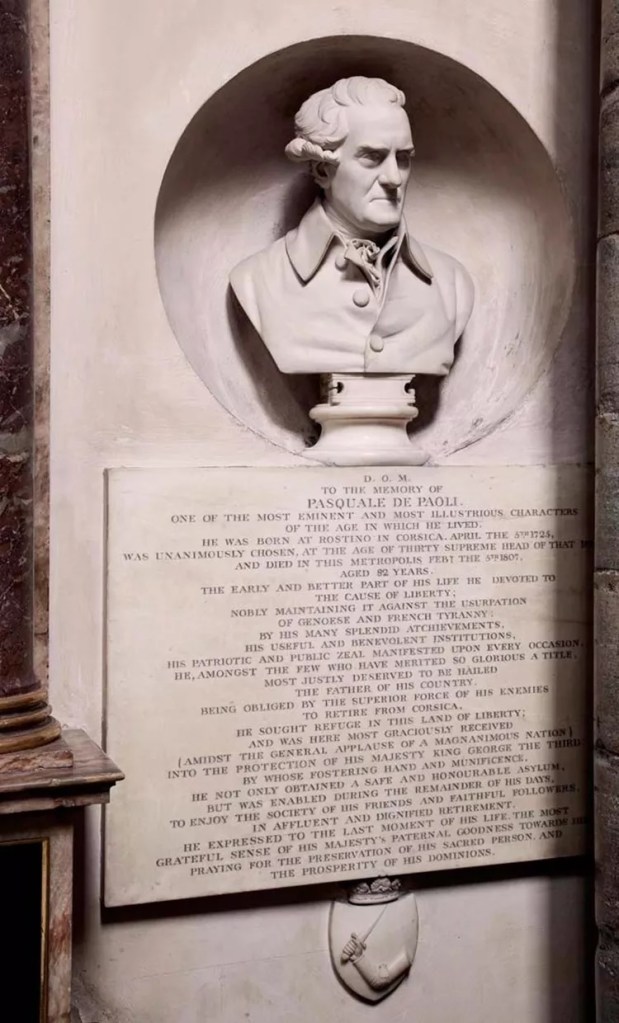
Memorial by John Flaxman.
Image © 2021 Dean and Chapter of Westminster
Considered as the Father of the Corsican Nation, Pasquale Paoli was an enemy of the Bonaparte family.
He was born on 5 April 1725 in Corsica, which was then a Genoan possession. On 17 November 1733, the attempt to arrest his father Giacinto led to the insurrection of Corsica against the Republic of Genoa. Giacinto became General of the Nation, participated in the foundation of the Kingdom of Corsica in 1736, and ruled as Regent after King Theodore left the island. When King Louis XV of France sent his armies to restore the Genoan rule, he went to Naples with Pasquale. There the young Paoli discovered the Enlightenment philosophy, particularly that of the British liberal thinkers.
Pasquale returned to Corsica and was also elected General of the Nation on 20 April 1755. After Genoa was defeated, he started ruling the new Republic and designed a Constitution, the first one to implement female suffrage. In 1769, he eventually had to exile again, when France conquered Corsica. He settled in England, where he was under the protection of King George III. He would stay there for 20 years.
In the context of the French Revolution, he was able to come back to France, where he was celebrated by Lafayette and Robespierre. Louis XVI even appointed him Commander of Corsica. First he supported the liberal Revolution but he did not accept its evolution. In Corsica, he joined the Royalists and fought against those who were supporting the Convention, mainly the Bonaparte family! Then, he participated in the foundation of the Anglo-Corsican Kingdom. He failed in getting appointed as Viceroy and decided to set sail to England for a new exile. He died there on 5 February 1807, aged 81. He was buried in St Pancras Old Church cemetery, alongside many French Emigrés. A few decades later, the remains of the “Babbu di a Patria” were transferred to Corsica, by orders of Tito Franceschini-Pietri, who was both his grand-nephew and the Private Secretary to Napoleon III, grand-nephew of Napoleon I.
This memorial is in the South Choir Aisle and here.
14. Spencer Perceval
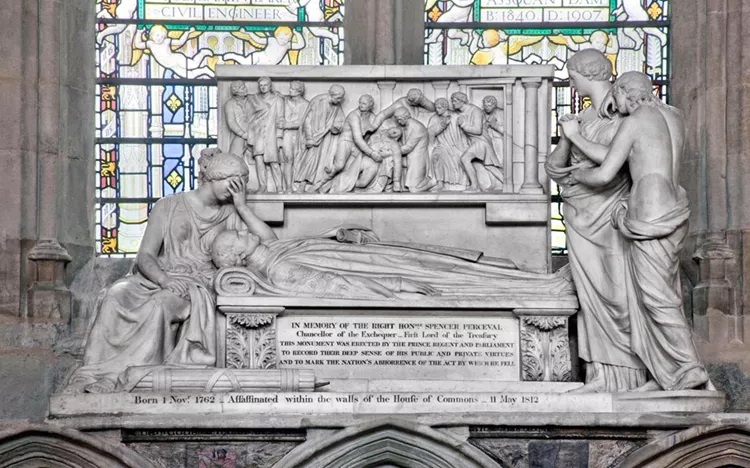
Monument by Sir Richard Westmacott.
Image © 2021 Dean and Chapter of Westminster
Spencer Perceval was born on 1 November 1762 in Mayfair, London. His father, the Earl of Egmont, was the First Lord of the Admiralty. At 33 years old, he was elected in the House of Commons, as a Tory MP. He became Chancellor of the Exchequer in 1807, and then First Lord of the Treasury in 1809. At the time, this was the official name of the Prime Minister (Today, the 10 Downing Street is still the official residence of the First Lord of the Treasury, and not the office of the Prime Minister). The main task for Perceval was to fight against Napoleon, especially in Portugal and Spain. One of his Foreign Secretaries was Richard Wellesley, the Duke of Wellington’s older brother. He also managed to find a solution for King George III’s illness and installed the Prince of Wales as Regent.
Spencer Perceval was assassinated on 11 May 1812, in the lobby of the House of Commons, within the Palace of Westminster. He is the only British Prime Minister to have been assassinated. He was buried in the family vault in Charlton and commemorated with a magnificent monument in Westminster Abbey.
This monument is in the Nave and here.
15. William Pitt le Jeune
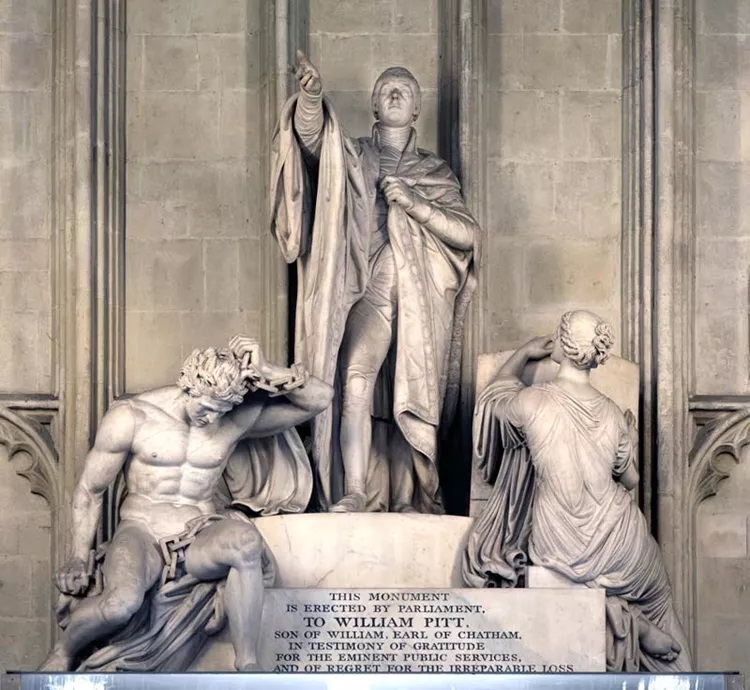
Monument by Sir Peter Westmacott.
Image © 2021 Dean and Chapter of Westminster
William Pitt the Younger comes after Spencer Perceval in this alphabetical list but he preceded him as a Prime Minister.
He was born on 28 January 1759. His maternal uncle George Grenville was Prime Minister from 1763 to 1765 and his father William Pitt, known as William Pitt the Elder, from 1766 to 1768. A few days after being appointed Prime Minister, his father eventually accepted a peerage and became the 1st Earl of Chatham. For many years, he had refused this honour and was known as the Great Commoner. When he died in 1778, his oldest son John succeeded him as the 2nd Earl of Chatham.
Five years later, in 1783, his son William, leader of the Tories, became the youngest Prime Minister in British History, at 24 years old. He held the office for 17 years and 86 days, until 1801. As a consequence, he was ruling Great Britain during the French Revolutionary Wars. He decided to join the First Coalition (1792-1797) and then the Second Coalition (1798-1802). He was in office when General Bonaparte became First Consul. He resigned on 14 March 1801 but became Prime Minister again on 10 May 1804, a few days before Napoleon was proclaimed Emperor. As did Perceval, William died in office, on 23 January 1806, but from disease. On 22 February, he was buried alongside his father in the North Transept of Westminster Abbey. He was also commemorated with an impressive monument atop the Great West Door in the Nave. His wax effigy is on display in the Queen’s Diamond Jubilee Galleries.
This monument is in the Nave and here.
16. William Rutherfurd
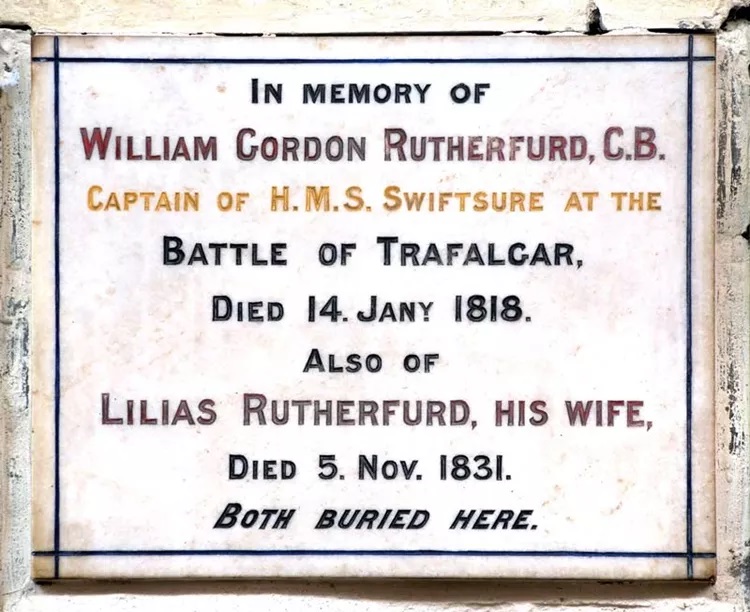
Image © 2021 Dean and Chapter of Westminster
William Gordon Rutherfurd was born in the Thirteen Colonies. His loyalist parents had to settle in Great Britain when the American War of Independence started. He studied in St Andrews and joined the Royal Navy. During the French Revolutionary Wars he mainly served in the West Indies and then in Mediterranean. On 21 October 1805, he fought in the Battle of Trafalgar, commanding the HMS Swiftsure.
After Trafalgar he was sent back to England where he was eventually put in command of the Royal Hospital for Seamen at Greenwich in 1814. He also became a member of the Order of the Bath. He died on 14 January 1818 and was buried in St Margaret’s Church, in the grounds of Westminster Abbey.
This grave is in St Margaret’s Church and here.
17. Marie-Joséphine de Savoie
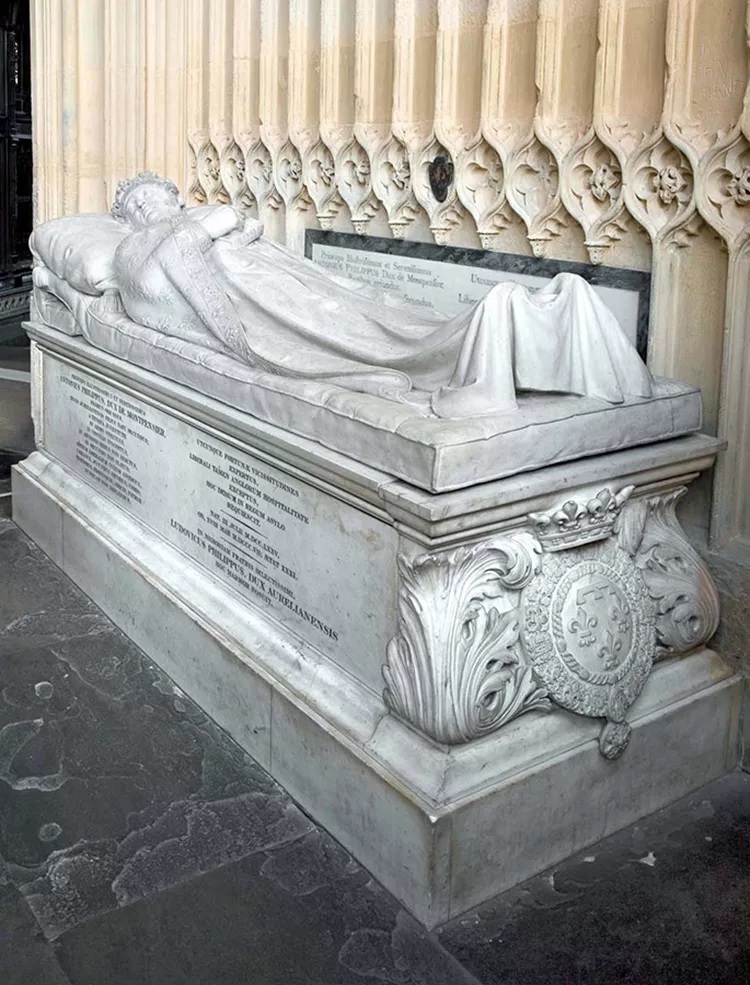
Monument by Sir Peter Westmacott.
Image © 2021 Dean and Chapter of Westminster
You might have recognised the tomb of Prince Antoine-Philippe d’Orléans, duc de Montpensier, at the back of the Lady Chapel. Actually, the last Queen of France has been buried there during a few months.
Born in Turin on 2 September 1753, Marie Joséphine was the daughter of Victor Amadeus of Savoy, King of Sardinia, and Infanta Maria Antonia of Spain.
On 14 May 1771, she was married to Louis-Stanislas-Xavier of France, comte de Provence, grandson of King Louis XV and brother to the future King Louis XVI. Two years later, her sister Marie-Thérèse married the third brother, Charles-Philippe of France, comted’Artois. In 1774, her brother-in-law became King of France and Marie Joséphine was then known as “Madame”, the second Lady at the Court of Versailles and in the Kingdom, after Queen Marie-Antoinette.
The Artois left France a few days after the Storming of the Bastille (14 July 1789) but the Provences decided to stay with the Royal Family in Paris. They eventually fled on 20 June 1791, at the same time as Louis XVI and Marie-Antoinette, but their escape was a success, unlike the tragic “Flight to Varennes”.
In the next few years, Marie-Joséphine followed her husband in Germany, Russia, Poland, etc. In 1807, they joined the Artois in England. In the meantime, Louis XVII died at the Temple prison and Provence became King Louis XVIII. Marie-Joséphine was then the exiled Queen of France. They were living in Hartwell House, Buckinghamshire, where the comte et comtesse de Lille, as they were known, recreated a kind of royal court.
She died in Hartwell House on 13 November 1810. After a solemn mass in the French church in King Street, Portman Square, she was buried in her cousin’s vault in Westminster Abbey. The following year, her remains were transferred to Cagliari Cathedral, in Sardinia.
Her husband ruled France from 1814, and then the comted’Artois from 1824, as Charles X. He had no Queen as Marie-Joséphine’s sister died in 1805. In 1830, Louis-Philippe became the King of the French and his wife the “Queen of the French”. That means Marie-Joséphine was the last “Queen of France” indeed.
Her temporary grave is in the Lady Chapel and she is evoked here.
18. Charles Stuart
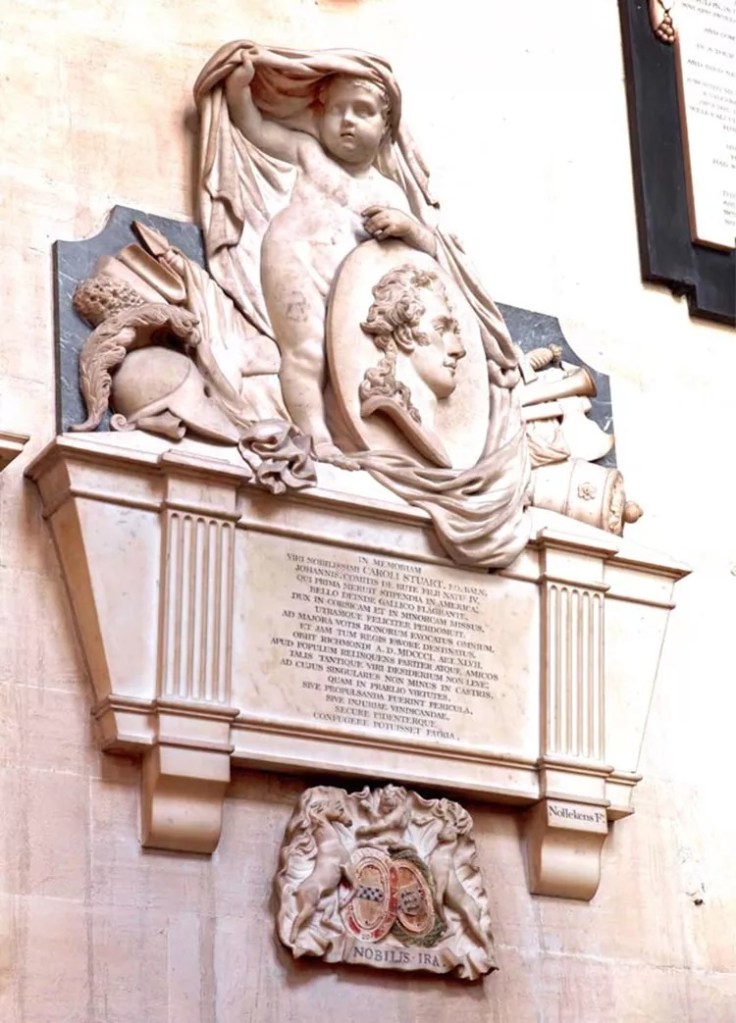
Memorial by Joseph Nollekens.
Image © 2021 Dean and Chapter of Westminster
Charles Stuart was born in January 1753 in Kenwood House, Hampstead Heath. His father was the 3rd Earl of Bute. He joined the British Army, aged 15, and eventually became a Lieutenant-General. First, he served in the American War of Independence, and then against France in the First Coalition War. He commanded the British conquest of Corsica and was a keen supporter of Pasquale Paoli. In January 1797, he was sent to protect Lisbon. The following year, he became the Governor of Minorca. He then joined Nelson in Naples and came back to England. He died in Richmond on 25 March 1801 and was buried in Petersham.
This memorial is in the St Andrew’s Chapel, North Ambulatory and here.
19. Thomas Totty
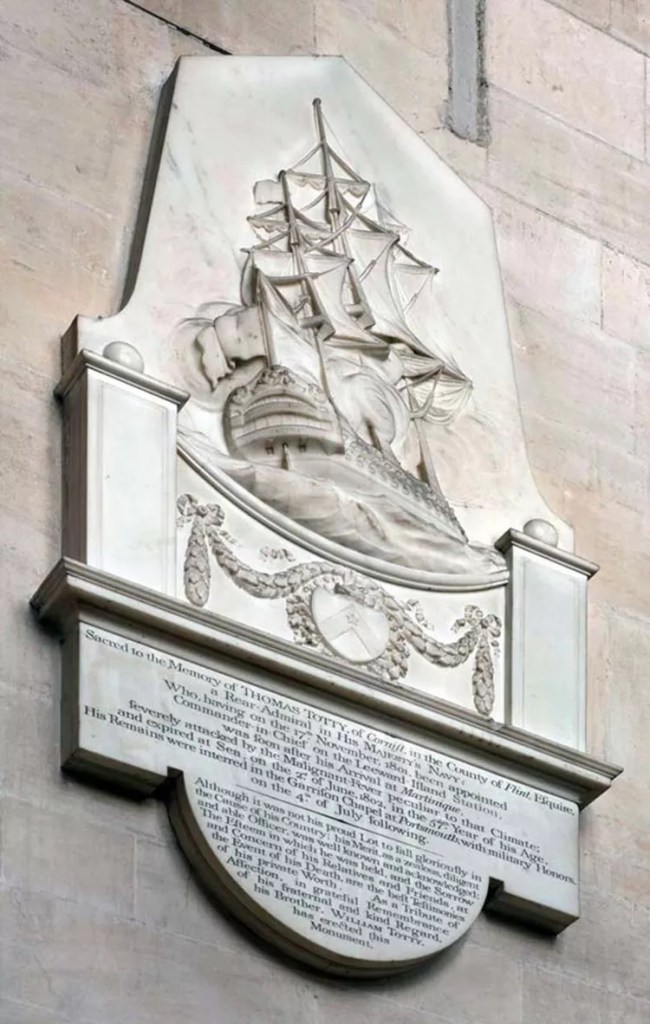
Memorial by John Bacon Junior.
Image © 2021 Dean and Chapter of Westminster
As many other sailors and soldiers in this trail, Thomas Totty, who was born in 1746, first served in the Thirteen Colonies before fighting against France in the French Revolutionary Wars and the Napoleonic Wars. He became a Rear-admiral, the Port Admiral at Chatham Dockyard and then the Commander of the Leeward Islands Station (West Indies). He caught yellow fever in Martinique and died at sea on 2 June 1802. He was buried at the Garrison Chapel in Portsmouth.
This memorial is in St Andrew’s Chapel, North Ambulatory and here.
20. William Anne Villettes
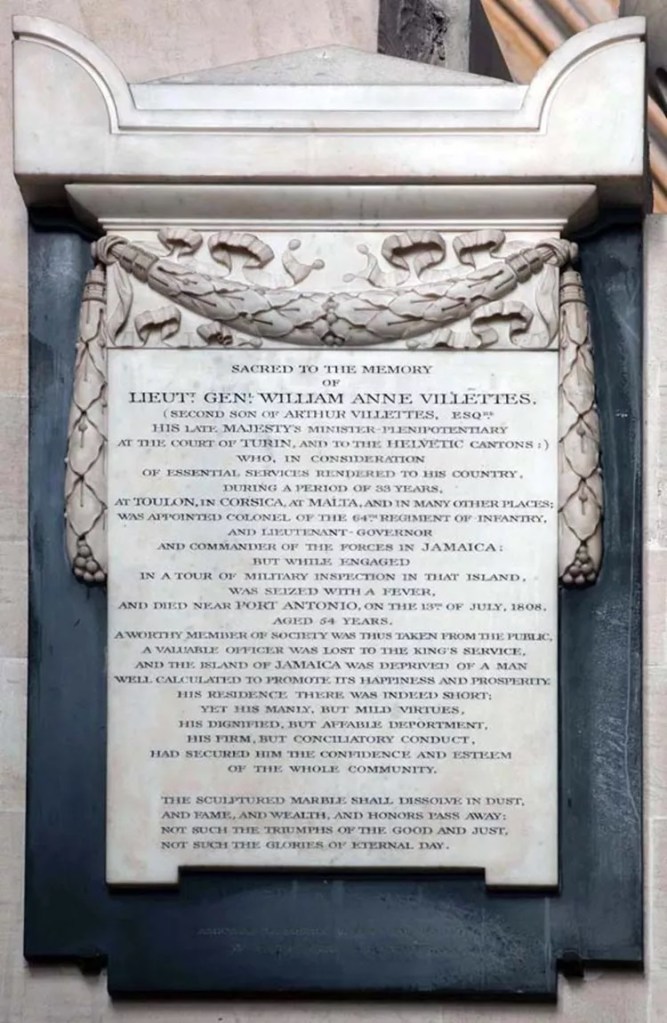
Memorial by Sir Richard Westmacott.
Image © 2021 Dean and Chapter of Westminster
William Anne Villettes was born in Bern on 14 June 1754. His father was then the British Ambassador to the Swiss Confederacy. His name sounds French as he was from a Huguenot family.
During the French Revolutionary Wars, he served mainly in the Mediterranean, in Toulon, Corsica and Malta. In 1802, he became Commander-in-chief of the British troops in the Mediterranean and rose to Lieutenant-General three years later. In 1807, he was appointed as the Commander-in-chief in Jamaica. He died there from disease, on 13 July 1808, and was buried in the West Indies.
This memorial is in St Andrew’s Chapel, North Ambulatory and here.
21. Robert Wilson
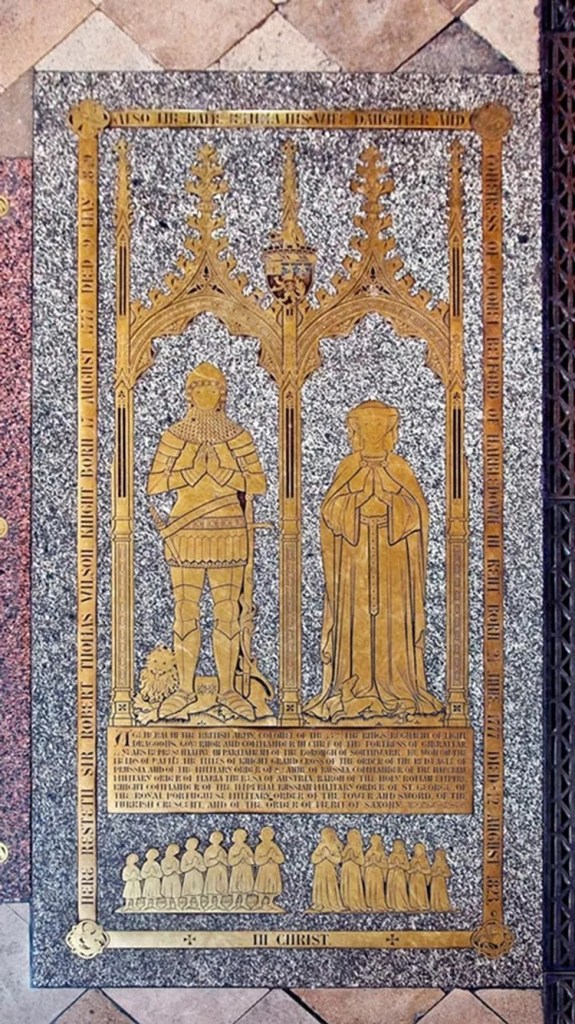
Image © 2021 Dean and Chapter of Westminster
Sir Robert Thomas Wilson is possibly one of most interesting persons amongst the people of this trail.
Born in London on 17 August 1777, he was the son of a well-known portraitist. He studied in Westminster School and became a politician (a MP from 1818 to 1831), a diplomat, an administrator (Governor of Gibraltar from 1842 to 1849) and a soldier (with the rank of General). As a soldier, he fought against Napoleon all around Europe, in Eylau and Friedland, in Spain and in Russia.
He died in London in 9 May 1849 and was buried in the Nave of Westminster Abbey. The tombstone is covered in brass. The Gothic Revival ornament shows a knight and his lady from the Middle Ages, with their thirteen children mourning at their feet.
This grave is in the Nave and here.
 LES AMIS DU PATRIMOINE EUROPÉEN