
The Appearance of Saint Francis at the Chapter Meeting in Arles, by Fra Angelico
Gemäldegalerie
Berlin, Germany
www.smb.museum
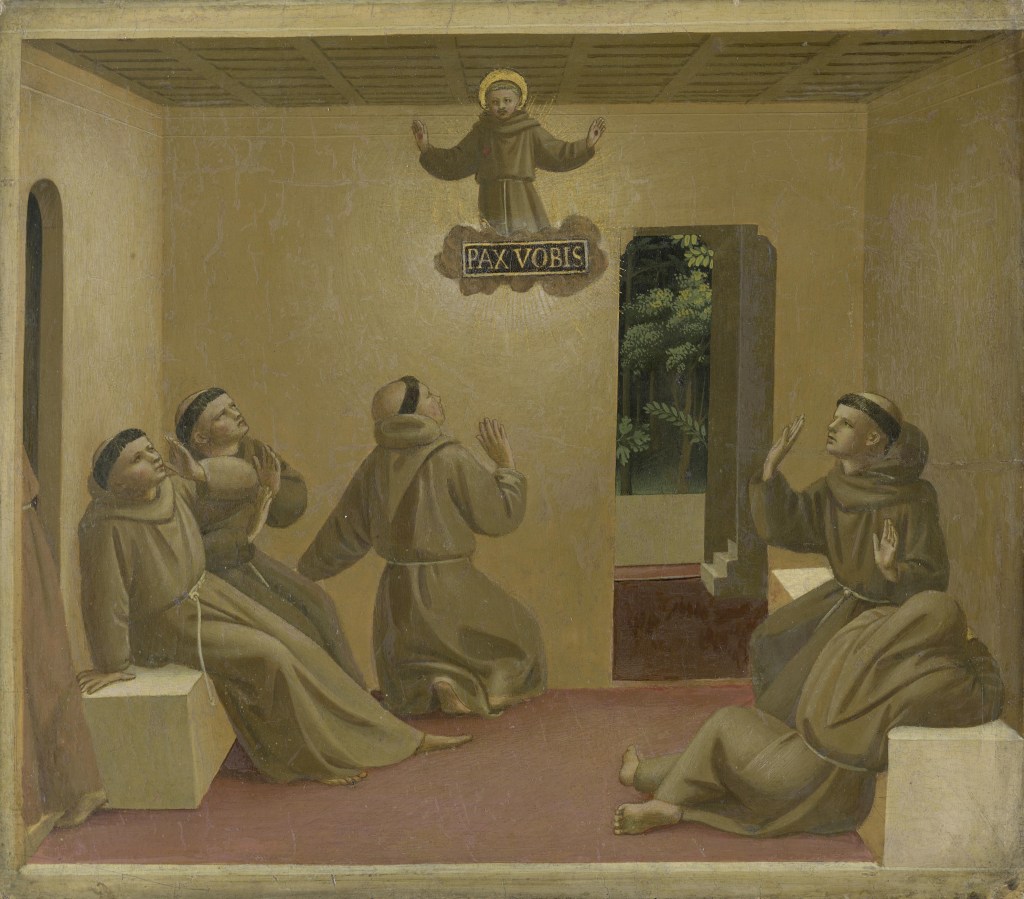
Fra Angelico, The Appearance of Saint Francis at the Chapter Meeting in Arles, c. 1429
Tempera on poplar wood, 27.5 x 31.5 cm
Staatliche Museen zu Berlin, Gemäldegalerie, cat. no. 62
© Staatliche Museen zu Berlin, Gemäldegalerie
Christoph Schmidt Public Domain Mark 1.0
Text : Neville Rowley, Curator for Early Italian Art, Gemäldegalerie, Staatliche Museen zu Berlin.
N.B.: This text is taken from the catalogue of the Donatello. Inventor of the Renaissance exhibition (Berlin, 2022).
This scene was part of the lower section (or predella) of an altarpiece painted in the late 1420s by Fra Angelico for the Compagnia di San Francesco, which met in the Basilica of Santa Croce in Florence. The main register of the altarpiece consisted of a Gothic triptych depicting the Virgin and Child surrounded by four saints; it is now kept in the Museo di San Marco in Florence (the lateral panels, badly damaged, come from the Charterhouse of Galuzzo, hence the apocryphal name of Certosa Polyptych often given to the work). The predella recounts the episodes of the life of Saint Francis, protector of the Friars Minor of Santa Croce. Three of these are now in the Gemäldegalerie in Berlin, including the Meeting between Saint Francis and Saint Dominic, a scene that probably never happened but which Fra Angelico, himself a friar of the Dominican Observance, must have seen as a necessary step for a Franciscan commission.
The Appearance of Saint Francis at the Chapter Meeting in Arles tells how, during an assembly of the Franciscan Order presided over by Saint Anthony of Padua in the Provençal city, ‘a certain Friar of approved virtue, named Monaldus, casting his eyes by Divine inspiration upon the door of the chapter-house, beheld, with his bodily eyes, the blessed Francis raised in the air, blessing the brethren, with his hands outstretched in the form of a cross’ (St Bonaventure). Following the example of Giotto, who had frescoed the scene a century earlier in the Bardi Chapel of the same Florentine church of Santa Croce, Fra Angelico does not care to follow the sacred narrative. Not just one, but no less than four friars admire with amazement the little Saint Francis floating in the air, carried by a cloud on which is inscribed the words of Christ ‘PAX VOBIS’ (peace be with you). One of the friars, in the foreground on the right, has fallen asleep on his bench, while another leaves the scene on the left (he has been sometimes identified as Saint Anthony himself).
This last detail accentuates the spatial impression of the panel, as if the scene continued beyond the painted frame. Although such ideas were already present in Giotto’s creations, it was Donatello who developed them further in his reliefs of the 1420s, and in particular in his Flagellation, formerly in Berlin and now in Moscow, which also opens up a space in depth beyond the figures. In general, the entire perspectival device as understood by Donatello in the 1420s is adapted here with great effectiveness by Fra Angelico: the painter is primarily interested in creating a space to effectively tell the sacred story. The geometric construction is still imperfect, which was already the case with the niche of Donatello’s Pazzi Madonna now in Berlin (see here). The vanishing point is located approximately where the saint miraculously appeared. The luminous sensitivity, on the other hand, fully belongs to Fra Angelico, conveying a surreal dimension to the scene. In fact, the panel can be considered one of the first nocturnes in the history of modern painting.
Bibliography
Berlin 2005
Geschichten auf Gold. Bilderzählung in der frühen italienischen Malerei, exh. cat. ed. by Stefan Weppelmann (Berlin, Gemäldegalerie), Cologne/ Berlin 2005.
Henderson, Joannides 1991
John Henderson and Paul Joannides, ‘A Franciscan Triptych by Fra Angelico’, in: Arte Cristiana, n.s., 79, 1991, pp. 3–6.
 LES AMIS DU PATRIMOINE EUROPÉEN