After the Bath – Woman Drying Herself , by Edgar Degas
The Courtauld
London, United Kingdom
www.courtauld.ac.uk
🇫🇷 🇬🇧
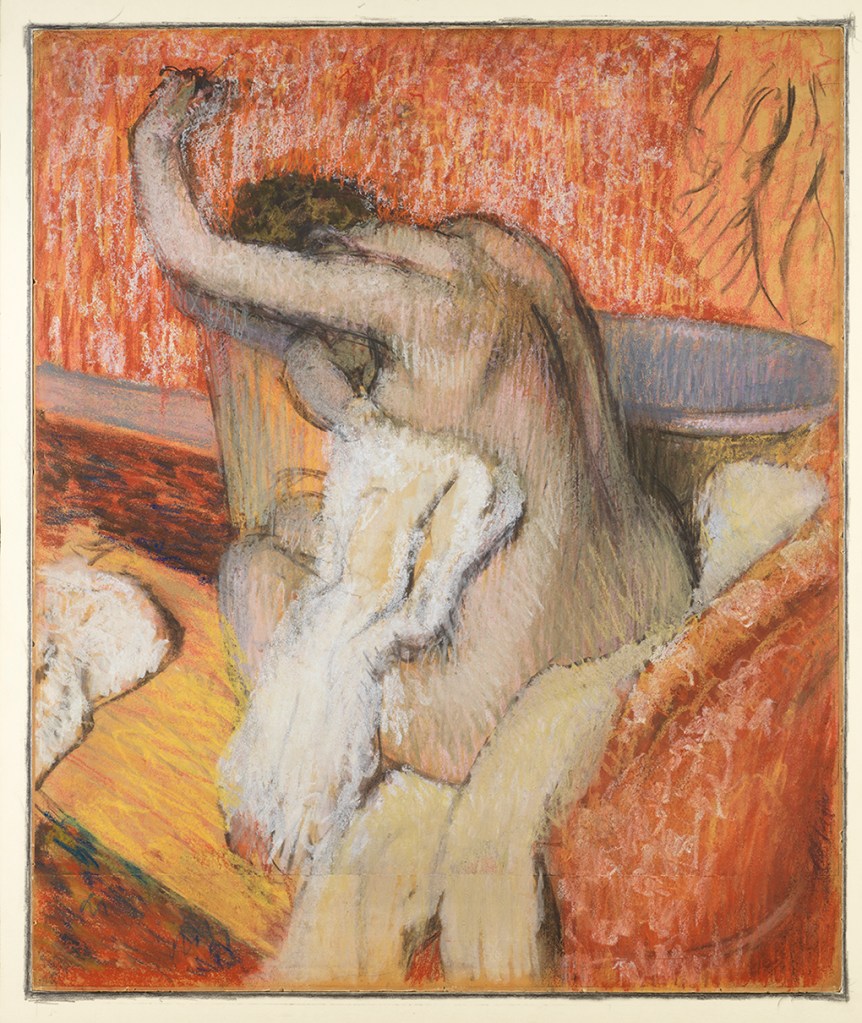
Edgar Degas (1834-1917) , After the Bath – Woman Drying Herself , c. 1895,
Charcoal and pastel on tracing paper laid down on cardboard, 67.7 x 57.8 cm, Samuel Courtauld gift, 1932
The Courtauld, London (Samuel Courtauld Trust) © The Courtauld
Text: Rachel Sloan, Assistant Curator of Works on Paper, The Courtauld
This lavish, large-scale pastel depicting a naked woman, her arm raised as she dries herself, is a symphony of rich, warm colours as well as a disconcerting and thoroughly modern representation of a female nude, captured in an awkward pose and observed in a private moment in an undistinguished contemporary interior. Such intimate scenes increasingly occupied Degas in the later decades of his career. In these close-up views of faceless, naked bodies posed in anonymous rooms, the artist aspired to represent a new type of modern female nude. Alongside its radical subject matter, After the Bath is also a brilliant example of the way Degas revolutionised the use of pastel, a medium then associated with blandly conventional subjects like aristocratic portraits and frivolous genre scenes, both by using it to create tough and uncompromising images of modern life and by blurring the distinction between line and colour, and between painting and drawing.
As is typical of Degas’s pastels, the medium is applied in distinct layers, with very little blending, over a charcoal underdrawing. Degas favoured tracing paper as it allowed him to incorporate earlier studies into his drawings; he would copy the outline of a figure from one sheet onto a new sheet of tracing paper, which he could then reverse or adapt as he wished. The figure in After the Bath most likely began life as such a tracing. However, because pastel does not adhere easily to its smooth surface, he needed to use a fixative to secure each successive layer. The result is distinct multiple layers; sometimes they allow glimpses of the charcoal drawing underneath, as in the outlines of the chair which can be seen through the woman’s robe, or the edge of her right knee, where Degas appears to have deliberately left his correction to the outline visible. Elsewhere, the colour is built up so thickly it resembles the surface of an oil painting. In a further subversion of convention, Degas chose not to smudge or blend the pastel. Not only do the colours remain distinct, so do the individual strokes. This method, unique to Degas, creates marvellous drifts of colour and unusual graphic rhythms, blurring the boundary between drawing and painting.
 LES AMIS DU PATRIMOINE EUROPÉEN