
Prevetariello in preghiera, by Antonio Mancini
Museo dell’Ottocento
Pescara, Italy
www.museodellottocento.eu
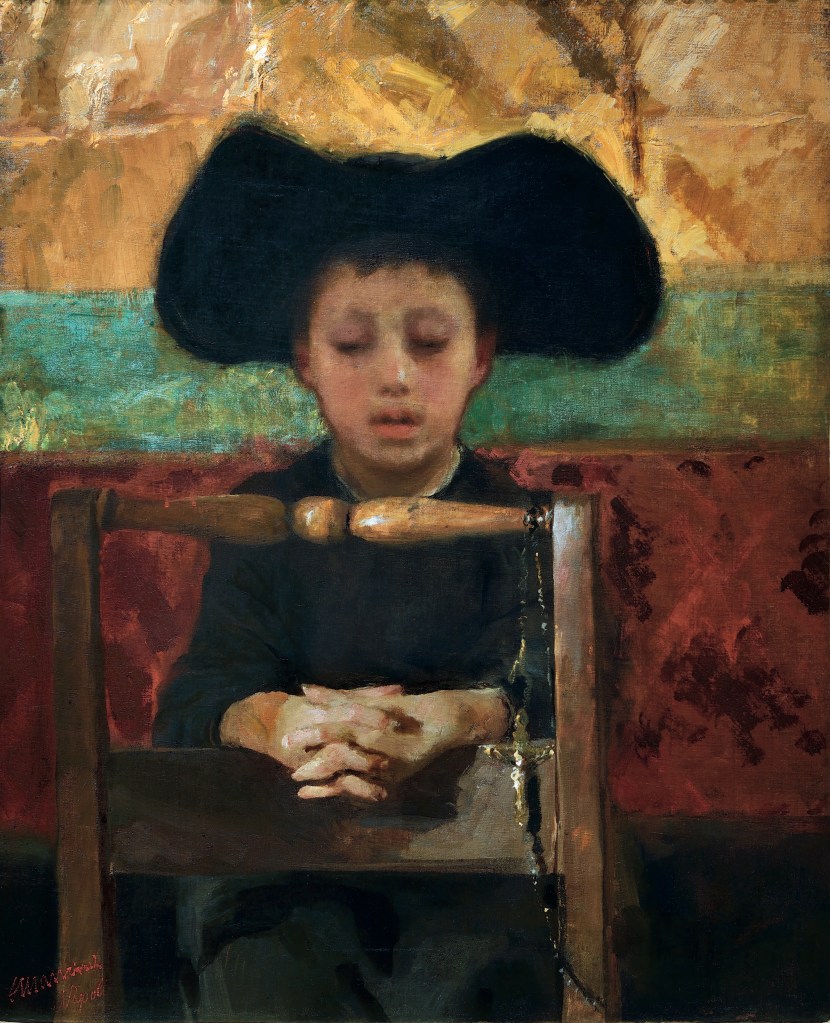
Antonio Mancini, Prevetariello in preghiera, c.1873
Oil on canva – 74 x 62 cm
Museo dell’Ottocento – Fondazione Di Persio-Pallotta, Pescara
© Fondazione Di Persio-Pallotta
Text : Manuel Carrera, Art historian, Director of the Fondazione Fausto Pirandello.
This work, exhibited at the Promotional Society event in Genoa in 1873 with the title Preghiera dei poverelli (Poor Boys’ Prayer), can be dated to the time immediately following Mancini’s stay in Venice in May of 1872, while he was still studying at the Royal Institute of Fine Arts in Naples under the tutelage of Domenico Morelli. The artist had gone to Venice to meet Count Albert Cahen, a composer and art collector who was in contact with the French Impressionists.
The meeting with Cahen in Venice also coincided with Mancini’s discovery of the great Venetian painting tradition, from Titian to Tintoretto. From that moment on, his palate took on a wealth of warm colours. The study of Titian’s painting was a sort of inner watershed in Mancini’s training, and he went from using the dramatic contrasts and dark tones reminiscent of Caravaggio to using bright sensual colours.
The iconography of the devout boy with a rosary and chair in the foreground is also found in another painting titled Il Rosario (private collection), in which, this time, the protagonist is a young girl with an aloof expression. Also worth remembering in the series of devout little “sugnizzi » – of which Prevetariello in preghiera is the most outstanding – is the painting of 1872 titled Il cantore sacro (The Sacred Singer), today in the De Mesdag Collection.
 LES AMIS DU PATRIMOINE EUROPÉEN