
Designs by Mr. R. Bentley for Six Poems by Mr. T. Gray
Gainsborough’s House
Sudbury, UK
gainsborough.org
🇫🇷 🇬🇧
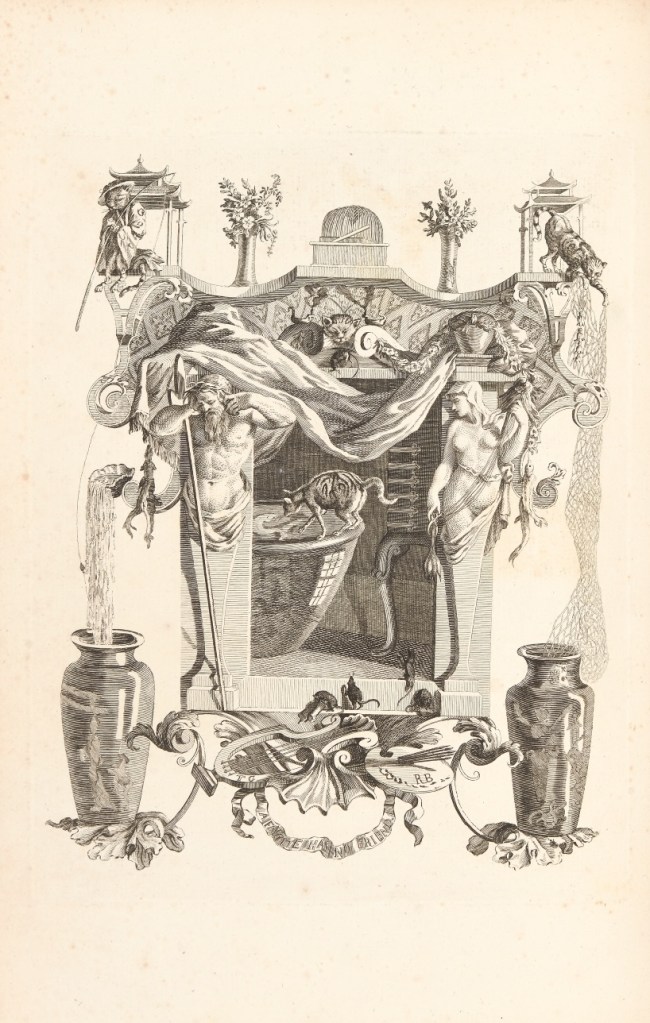
Richard Bentley, Designs by Mr. R. Bentley for Six Poems by Mr. T. Gray, 1753.
Engraving by Johann Sebastian Müller, 37.8 x 27.8 cm
Gainsborough’s House, Sudbury. 2002.050 © Gainsborough’s House.
Text : Mahaut de La Motte-Broöns, Assistant Curator, Gainsborough’s House.
Richard Bentley, son of the Cambridge theologian also named Richard Bentley and Master of Trinity College in Cambridge, is mostly known as an amateur illustrator for his drawings of the 1753 Designs by Mr. Bentley, for Six Poems by Mr. T. Gray. The work, which single-handedly made Bentley’s reputation, was a commercial success, a major inspiration for British Rococo, but a literary defeat for Gray. In the 1750s, Bentley became friend with the Whig MP and antiquarian Horace Walpole (1717-97) and worked on designs for Walpole’s Gothic-inspired refurbishing of Strawberry Hill. Among Walpole’s friends was the poet Thomas Gray (1716-71), and Walpole arranged for Bentley to illustrate poems by Gray. The illustrations were inspired by a combination of French Rococo motives, medieval Gothic elements, and chinoiserie, forming a visual identity that strongly appealed to Walpole. Three editions were printed in 1753 due to the success of the volume. They contain 25 illustrations: a large title-page vignette, six full-page frontispieces for each poem, large headpieces and tailpieces, and initial letters. Gray appreciated the illustrations on their own right but felt that they distracted from the content of the book, his poems. As he wrote to his publisher, Robert Dodsley, his verses were ‘subordinate, & explanatory to the Drawings’. Before allowing the publication to go forward, he refused to have his portrait included in the frontispiece. He insisted that Bentley’s name was to be placed before his own on the title page. The half-title was also rejected after the success of the first edition. The two other 1753 editions bear ‘Designs, &c’, referring only to the illustrations. Its most famous poem and illustration are the “Ode. On the Death of a Favourite Cat, Drowned in a Tub of Gold Fishes”. It recalled the tragic end of Selima, Walpole’ cat, that fell in a Chinese jar while trying to catch a fish.
 LES AMIS DU PATRIMOINE EUROPÉEN