
Mrs Mary Cobbold and Miss Cobbold
Gainsborough’s House
Sudbury, UK
gainsborough.org
🇫🇷 🇬🇧
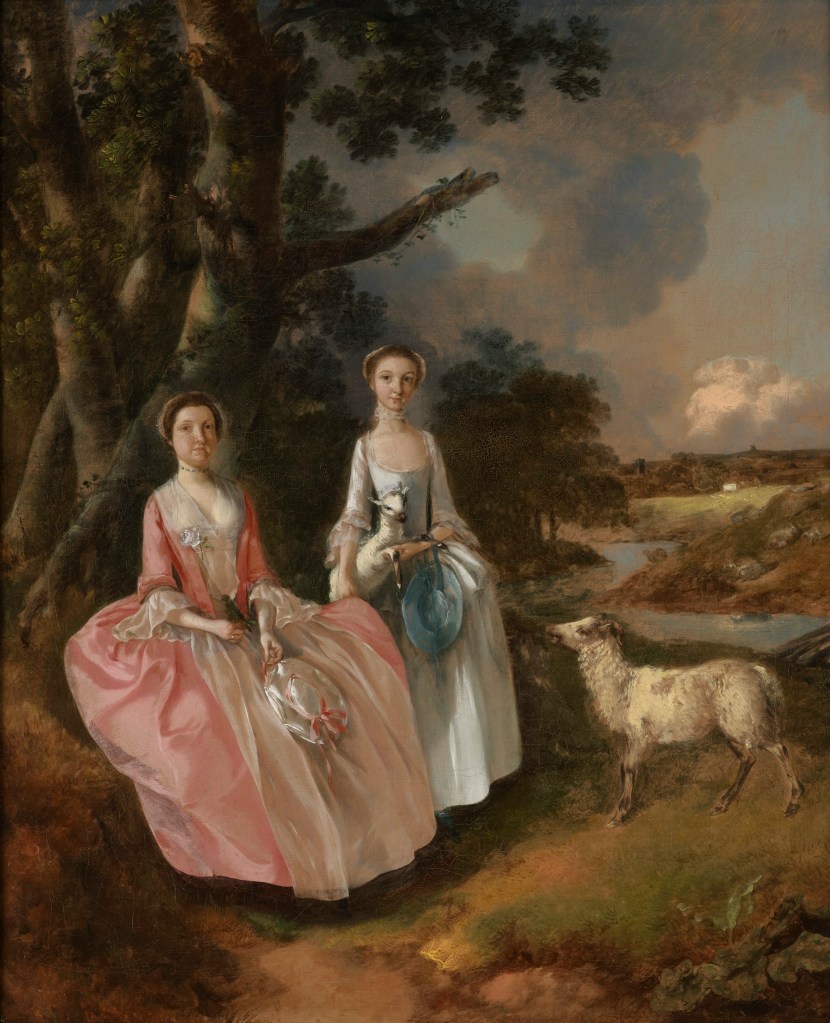
Thomas Gainsborough, Mrs Mary Cobbold and Miss Cobbold, with a Lamb and Ewe, Circa 1752–54.
Oil on canvas, 75.5 x 61.3 cm
Gainsborough’s House, Sudbury. 1998.075 © Gainsborough’s House.
Text : Mahaut de La Motte-Broöns, Assistant Curator, Gainsborough’s House.
After his London training and a few years in his local town, Sudbury, Gainsborough set his practice up in Ipswich. There, he benefited from a larger network of patronage. It is during the few years following his move that he received the commission for a portrait of two ladies from the Cobbold family, a dynasty of maltsters from Essex. Gainsborough also painted the famous springs of Holywells Park in Ipswich where the Cobbold moved their brewery operations in the mid-1740s. The eldest sitter may be Mary, the widow of Thomas Cobbold (1680–1752), or her daughter-in-law Sarah Cobbold (1717–77). The pictorial device of the broken branch with ivy, symbol of memory and undying affection, suggests it is a portrait of the recently widowed Mary. The younger sitter is likely Mary’s granddaughter, Sarah, born in 1744. This form of this elegant portrait is what was described in the eighteenth century as a ‘picture in little,’ but known more familiarly now as a “conversation piece”. Gainsborough learned much of this genre from mentors at this time, particularly Francis Hayman (1707/8–76). We see Gainsborough still learning his trade, seemingly imitating conversation pieces of the time with Mary holding a parakeet on her hand. He struggled with the composition as revealed by the many pentimenti in the position of the sitters, now visible with the naked eye. Gainsborough was already aware that the market was looking for portraitists despite his preference for landscapes. With a conversation piece, Gainsborough had the opportunity to combine the two genres. The ewe and its lamb recall pastoral paintings with fancy shepherd and shepherdess in idyllic landscapes, maybe inspired by his years working with the French illustrator Gravelot. Yet, Gainsborough resolutely sets the scene in a Suffolk landscape similar to the landscapes he was creating at the same time, animating the background with brick cottages, a church tower, and a tiny windmill on the horizon.
 LES AMIS DU PATRIMOINE EUROPÉEN