
Virgin and Child, by Donatello
Bode Museum
Berlin, Germany
www.smb.museum
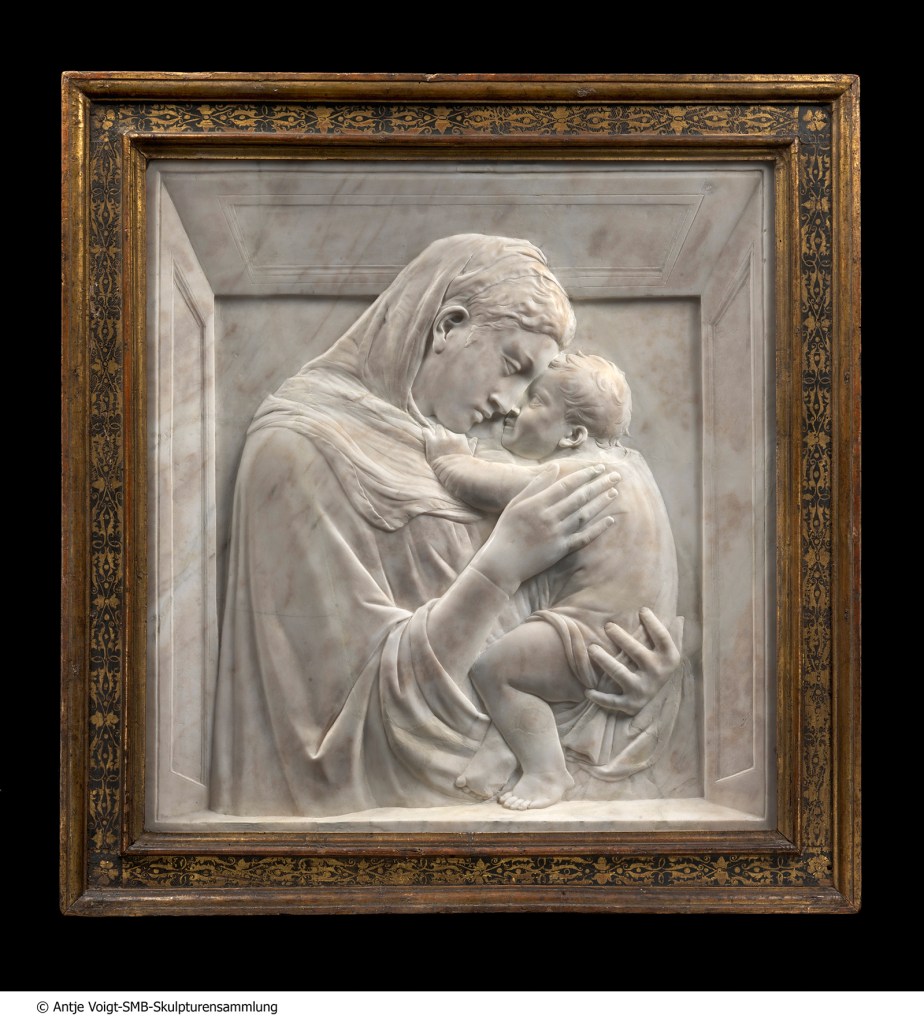
Donatello, Virgin and Child (Pazzi Madonna), c. 1422
Marble, 74,5 x 73 x 6,5 cm
Staatliche Museen zu Berlin, Skulpturensammlung (Bode-Museum), inv. no. 51
© Staatliche Museen zu Berlin, Skulpturensammlung und Museum für Byzantinische Kunst
Antje Voigt CC BY-SA 4.0.
Text : Neville Rowley, Curator for Early Italian Art, Gemäldegalerie, Staatliche Museen zu Berlin.
N.B.: This text is taken from the catalogue of the Donatello. Inventor of the Renaissance exhibition (Berlin, 2022).
This is one of the most moving interpretations of the motif of the Madonna of the whole Renaissance. Mary clasps her son tightly in her arms and places her face against his, in a gesture of great tenderness tinged with melancholy. The Virgin has a premonition that her son will die too young, in remission of the sins of humanity. The Child, for his part, still seems unaware of his fate: he smiles, showing all his new teeth and clutching his mother’s veil with great naturalness. His left foot rests against the edge of a sort of box in which the two figures are represented.
This setting is the other notable feature of the bas-relief, together with the intimate affective rapport between the figures. After the predella of Saint George for Orsanmichele this was the second time that Donatello made use of the mathematical perspective invented by his friend Filippo Brunelleschi. The vanishing lines of the edges of the niche do not converge perfectly in a single point – far from it – but the effect is very convincing: seen from a low viewpoint, the Virgin and Child seem truly three-dimensional, literally emerging from the ground of the relief. It is therefore very likely that the work was originally hung at a certain height, although the position for which it was sculpted is still debated. According to Wilhelm Bode, who bought it in 1886 on behalf of the Berlin Museums, the marble came from one of the Pazzi family’s Florentine residences (Bode 1886, p. 203). In 1677, a Florentine guide actually mentions a Madonna by Donatello in the house of Francesco Pazzi, but the description does not fully match our relief (Cinelli 1677, pp. 369–370; Catterson 2020 has questioned this provenance, as well as the authenticity of the relief, quite unconvincingly).
The ‘Greek’ profile of the Madonna is very close to two documented figures by Donatello, the Isaac in the group of Abraham and Isaac sculpted in 1421 in collaboration with Nanni di Bartolo for the Campanile in Florence (and today in the Museo dell’Opera del Duomo) and a Sibyl made in 1422 for the Porta della Mandorla of the Cathedral. From its creation, the Pazzi Madonna was admired by many Florentine and Tuscan artists (Michelozzo in his Orlandini Madonna, also in marble and now in Berlin, inv. no. 50; or Jacopo della Quercia in his Flight into Egypt for the main portal of the façade of San Petronio in Bologna). A dozen replicas produced during the 15th century remain, both in terracotta and stucco. Almost all of them do without two of the most radical innovations of this masterpiece, namely the perspective niche and the complete whiteness of the surface (on the surprising colouring of Donatello’s marble see Fehrenbach 2011, pp. 51–53). In these derivative works, only the most moving of Donatello’s inventions remains visible: the tender but tragic intimacy between two loving faces.
Bibliography
Bode 1886
Wilhelm Bode, ‘Neue Erwerbungen für die Abteilung der christlichen Plastik in den Königlichen Museen’, in: Jahrbuch der Königlich Preußischen Kunstsammlungen, 7, 1886, pp. 203–214.
Catterson 2020
Lynn Catterson, ‘Art Market, Social Network and Contamination: Bardini, Bode and the “Madonna Pazzi” Puzzle’, in: Florence, Berlin and Beyond: Late Nineteenth-Century Art Markets and Their Social Networks, ed. by Lynn Catterson, Leiden/ Boston 2020, pp. 498–552.
Cinelli 1677
Le bellezze della città di Firenze, dove a pieno di pittura, di scultura, di sacri templi, di palazzi i piu notabili artifizj e piu preziosi si contengono, scritte già da m. Francesco Bocchi ed ora da m. Giovanni Cinelli ampliate ed accresciute, Florence 1677.
Fehrenbach 2011
Frank Fehrenbach, ‘Coming Alive: Some Remarks on the Rise of “Monochrome” Sculpture in the Renaissance’, in: Source, 30, 2011, no. 3, pp. 47–55.
Janson 1957
Horst W. Janson, The Sculpture of Donatello, Incorporating the Notes and Photographs of the Late Jenö Lányi, 2 vols, Princeton 1957.
Rowley 2022
Neville Rowley, Donatello berlinese, Rome 2022.
 LES AMIS DU PATRIMOINE EUROPÉEN