Mounted jug
The Al Thani Collection
Paris, France
www.thealthanicollection.com
🇫🇷 🇬🇧
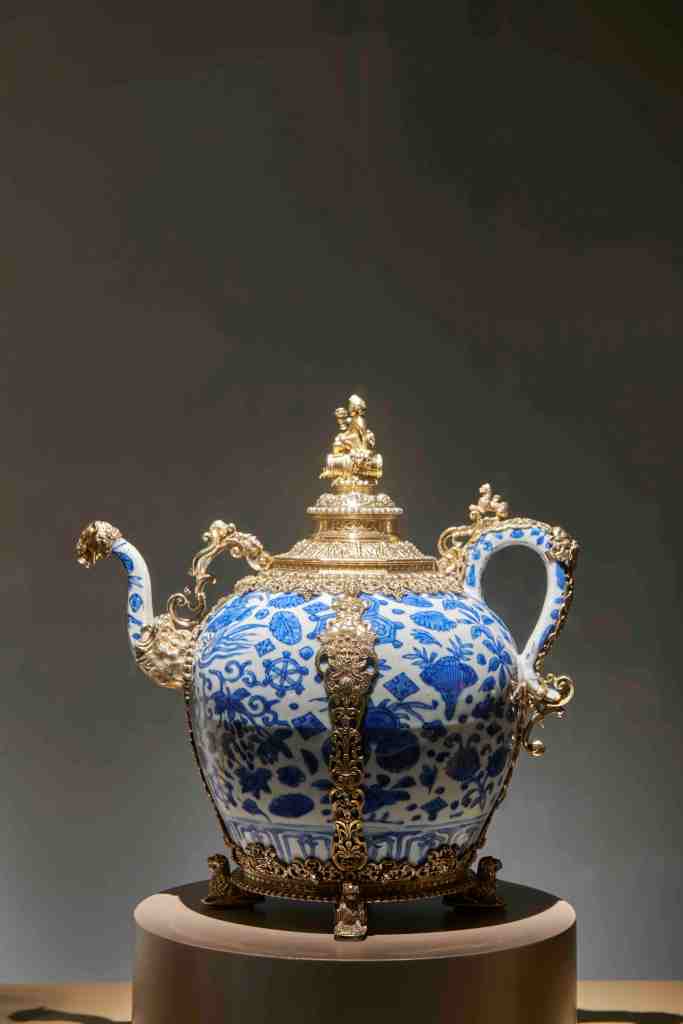
Monted jug
Porcelaine: China, Jingdezhen, Ming dynasty, Wanli era (1573-1619)
Mount: Nuremberg, 1603-08; silversmith’s hallmark: Balthasar Holweck
(active from 1602 to 1632)
White porcelaine decorated in underglaze blue, silver gilt, 30,5 x 30 x 20 cm
View of the exhibition Renaissance Treasures. The Al Thani Collection at the Hôtel de la Marine
© The Al Thani Collection 2024. All rights reserved. Photograph by Marc Domage.
Text: Julie Rohou, Heritage curator, Musée national de la Renaissance – château d’Écouen.
Translation in English: Charles Penwarden.
The first Chinese porcelain to reach Europe arrived in the early fourteenth century. It remained an extremely rare and expensive commodity on the continent until the early seventeenth century. Despite all attempts at imitation, the brilliant, translucent and resistant porcelain obtained by using kaolin remained a jealously guarded secret in the workshops of Jingdezhen, China’s main manufacturing centre in Jiangxi province. Porcelain was initially imported into Europe via the Ottoman Empire and then under the exclusive commercial monopoly established by Portugal in 1557, which was challenged by the Dutch East India Company from 1602 onwards. However, at the end of seventeenth century, porcelain remained an almost unknown commodity in the Holy Roman Empire, as can be seen from the inventories of the court of Saxony, where the Chinese porcelain given by Ferdinando I de’ Medici in 1590 is listed as “Italian tableware”. In 1604, the Portuguese ship Santa Catarina, en route from Macau to Malacca in present-day Malaysia, was captured by Dutch East India Company ships; on board was a precious cargo of Chinese luxury goods, including some sixty tons of porcelain. This enormous quantity of objects, offered for sale in Amsterdam, marked a turning point by helping to spread the taste for Chinese porcelain throughout northern Europe.
The blue and white decoration on this jug, obtained using cobalt oxide applied before the glaze, appeared in the second quarter of the fourteenth century. The motif of the eight auspicious symbols of Buddha – wheel, conch, parasol, infinite knot, lotus, pair of fish, banner and urn – which appear on the body of the jug, was first used on porcelain during the Yuan era, and then throughout the Ming period. The same lucky symbols can be found on a hexagon jug in the British Museum, which was made at the same time as this one.
Just like the ostrich eggs, coconuts, narwhal horns, exotic shells and other naturalia brought back from faraway lands by travellers, porcelain was sometimes fitted with gilded silver mounts designed both to protect it and to show it off in cabinets of curiosity. The sumptuous mounts on this wine pitcher bear the hallmark of the Nuremberg silversmith Balthasar Holweck, active from 1602, and the coat of arms of Ulrich Grundherr (1570-1654), a patrician of Nuremberg. With its herm figures, lion’s heads, foliage and palmettes, this jug illustrates the technical perfection achieved by Nuremberg goldsmiths at the beginning of the seventeenth century, as well as the constant use of forms and decorative devices inherited from the previous century. The vine-leaf decorations on the friezes and the small Bacchus on the lid suggest that this was a wine jug, although it was probably never used for this purpose.
This jug is on display from 3 October 2024 to 5 October 2025 in Gallery 4 at The Al Thani Collection at the Hôtel de la Marine as part of a display of approximately 60 works of art from the Collection celebrating the innovation, skill and craftsmanship of the Renaissance period. It was previously on display at the exhibition ‘A Taste for the Renaissance. A Dialogue between Collections’ (6 March – 30 June 2024) which showed works from the Collection alongside a selection from the Victoria and Albert Museum, London. The Al Thani Collection at the Hôtel de la Marine is also hosting a temporary exhibition from 3 October 2024 to 5 October 2025 in Gallery 3 titled ‘Colour Speaks all Languages’. More details here: www.thealthanicollection.com.
 LES AMIS DU PATRIMOINE EUROPÉEN