Bishop’s bowl
The David Collection
Copenhagen, Denmark
www.davidmus.dk
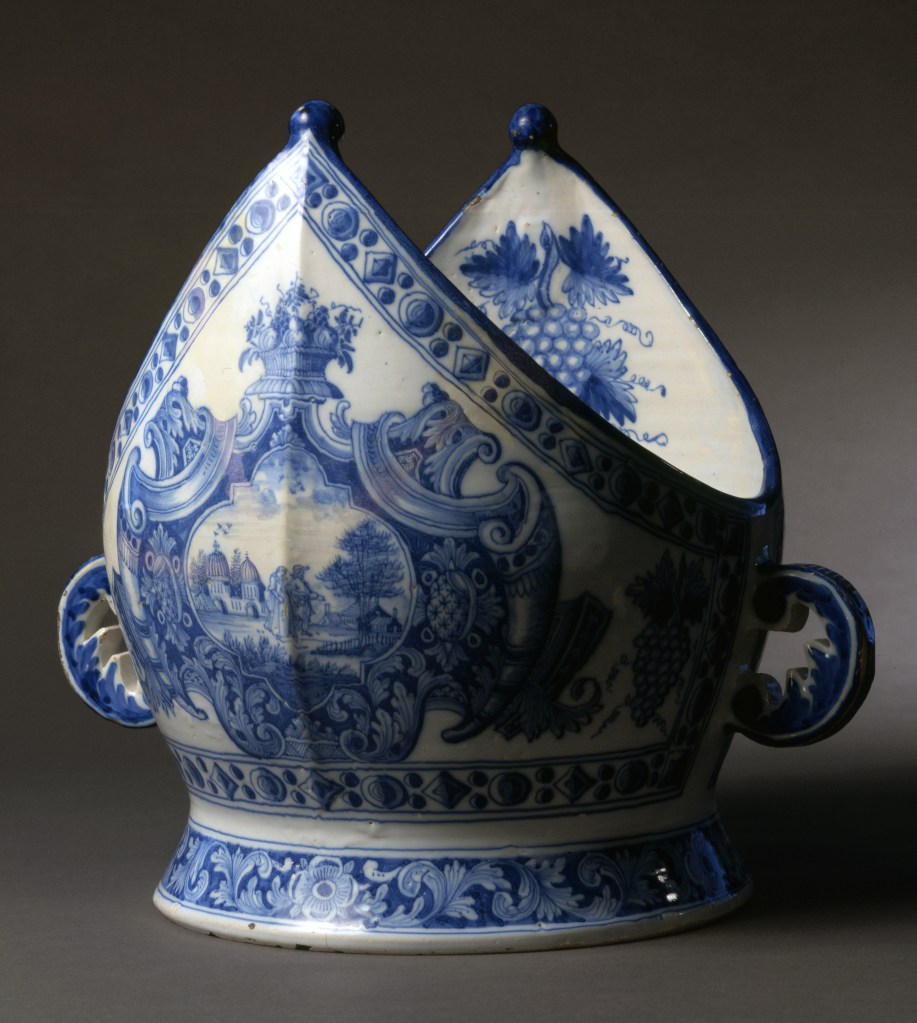
Bishop’s bowl of faience
Store Kongensgade, c. 1740, H: 31,5 cm
The David Collection, Inventory number NF 45
© The David Collection, Copenhagen, photo Pernille Klemp
Text: Anette Lindbøg Karlsen, Curator, The David Collection.
The factory in Store Kongensgade in Copenhagen (1724-1771) was the first in Scandinavia built to manufacture blue-and-white faience. Under the leadership of German-born Johann Ernst Pfau (1727-1749), the factory produced faience in the late-Baroque style, whose form and decoration were related to contemporary French and German products.
The factory made tableware as well as various other types of utility items such as vases, inkwells and similar writing paraphernalia, sconces, wall tiles and more. Among the factory’s most refined and exclusive products were the so-called bishop’s bowls, a prominent innovation at the time which would strengthen the factory’s status at a Nordic and international level alike. The distinctive shape and decoration of the bishop’s bowls mean that to this day, they are still highlighted as the very best items produced at the Store Kongensgade factory.
The shape of the bishop’s bowls is directly based on that of a mitre: the headdress worn by the Pope, bishops and some abbots during important masses and ecclesiastical services. Such bowls were created to hold punch, a fact directly referenced in their name: one of the drinks popular at the time of their invention was known as ‘a bishop’. This was a relatively light punch made of red wine, sugar and bitter oranges and could reportedly be served cold or hot.
Several bishop’s bowls have survived to the present day. Some variety can be observed in their proportions: the two symmetrically arranged, upright halves are quite low in some specimens, while others are taller and more tapered, reaching upwards. The decorative painted designs always vary from one piece to the next, meaning that most bishop’s bowls can be classified as unique.
The bishop’s bowl in The David Collection was created during Johann Ernst Pfau’s time as head of the factory. Typical of his designs are bands featuring a so-called jewel border: this band is defined by double lines at the top and bottom, in between which are stylised gemstones and beads or pearls. The bowl is further decorated with two large decorative cartouches enclosing a landscape with figures. The outwardly sloping base features an acanthus design, while the inside of the bishop’s bowl is decorated with vine leaves, bunches of grapes and a fruit basket. Finally, the bowl is equipped with two handles of a serrated foliate design.
 LES AMIS DU PATRIMOINE EUROPÉEN