
Winston Churchill. The Painter.
Wallace Collection, London
23 May – 29 November 2026
www.wallacecollection.org
🇫🇷 🇬🇧
PRESENTATION
Winston Churchill. The Painter.
[From the Press Kit]
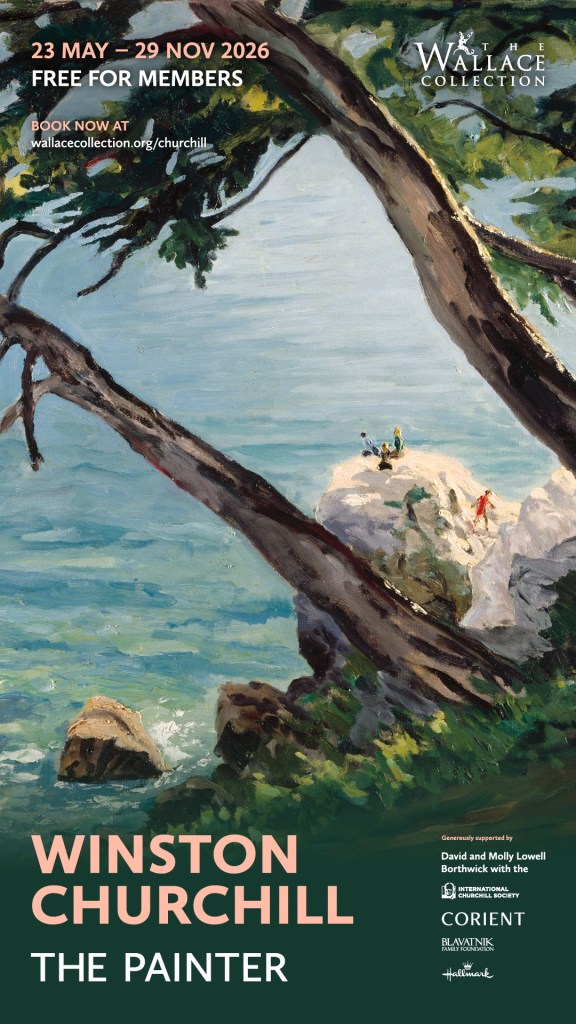
The Wallace Collection presents a major retrospective of Sir Winston Churchill’s (1874-1965) paintings – the first substantial UK exhibition devoted to his art since his death. Bringing together more than 50 works – around half from private collections that are rarely accessible to the public – this exhibition will shed new light on a world-famous figure who was defined by politics but sustained by a lifelong passion for painting.
Churchill began painting in 1915, at a moment of personal and national crisis. What started as a private refuge after the Dardanelles catastrophe of World War I, became a lasting creative discipline. Over the next five decades he produced more than five hundred canvases, painting wherever he travelled: in England, France, Italy and, most famously, under the intense light of Marrakech.
Following a chronological approach, Winston Churchill: The Painter traces Churchill’s artistic journey from tentative beginnings to bold, late works, revealing a painter of surprising range. Visitors will encounter sombre wartime scenes and radiant Mediterranean harbours, alongside tightly observed still-lifes and the luminous Moroccan cityscapes he painted as diplomatic gifts.
Churchill’s own paintings will be complemented by a small group of works by his artistic mentors and friends, including Sir John Lavery (1856-1941) and Sir William Nicholson (1872-1949), which will help visitors to explore his artistic development and influences. Alongside these works, the exhibition will unfold the key thematic threads that shaped Churchill’s creative life, including the influence of Walter Sickert (1860-1942) who encouraged Churchill to experiment with novel techniques.
A SELECTION OF WORKS OF ART
by the Curators of the Exhibition
Dr Lucy Davis, Curator of Paintings, The Wallace Collection,
and Dr Xavier Bray, Director, The Wallace Collection.
The Beach at Walmer
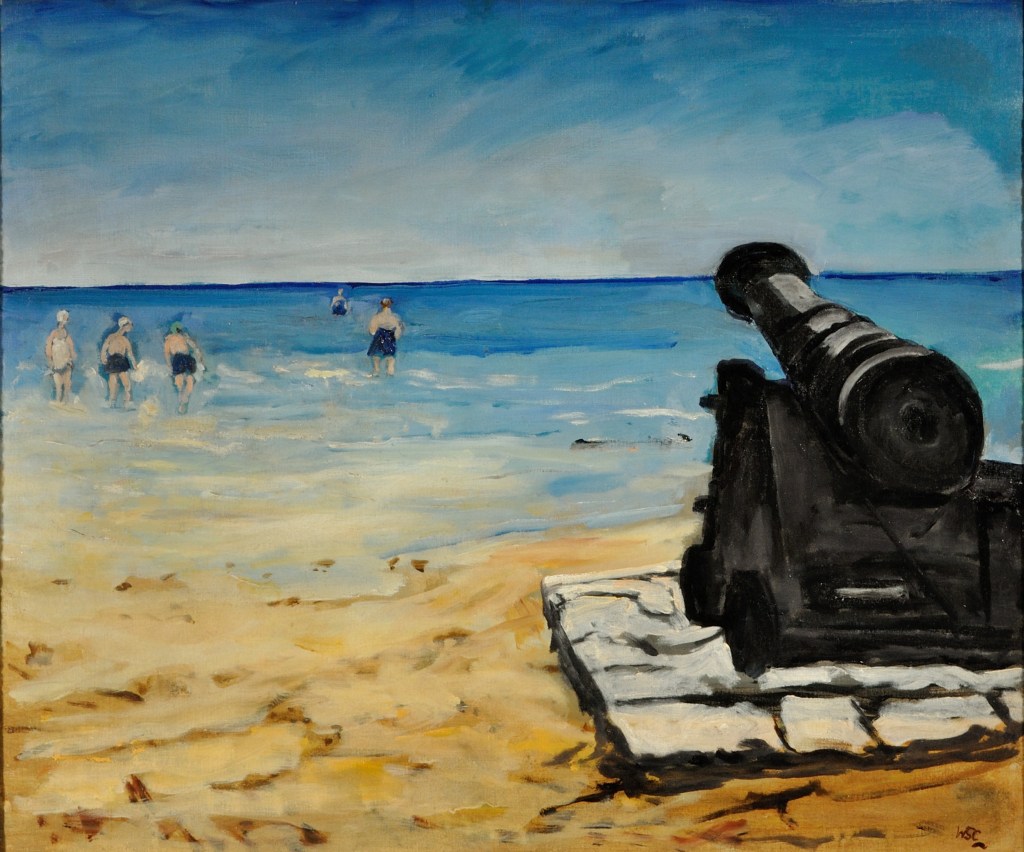
Sir Winston Churchill, The Beach at Walmer C316, 1938.
America’s National Churchill Museum at Westminster College, Fulton, Missouri.
© Churchill Heritage Ltd. Image courtesy Churchill Heritage Ltd.
Walmer is on the south east coast of England, where the Churchill family spent their holidays in 1938 and who are portrayed here. To the right is Winston Churchill himself – seen from behind, slightly away from the rest of the group, looking out to sea. This painting demonstrates Churchill’s love of colour. He said: ‘I must say I like bright colours […] I cannot pretend to feel impartial about the colours. I rejoice with the brilliant ones, and am genuinely sorry for the poor browns.’ Rich golds and browns fleck the sandy beach and the bright sky of a summer’s day composed of Churchill’s favourite colour, cerulean blue. Looming into this idyllic seascape, however, is the large cannon in the foreground, dating from the Napoleonic wars. Given the time in which Churchill was painting, it’s hard not to read a deeper meaning into the presence of the cannon. Does it reflect Churchill raising the alarm about the threat posted by Nazi Germany in the years before World War II? When Churchill offered any of his paintings to his chief military advisor, General Lord Hastings Ismay, Ismay chose this one, stating that ‘it was Winston, standing guard on the coast while England played.’
Sunset at Cannes Harbour
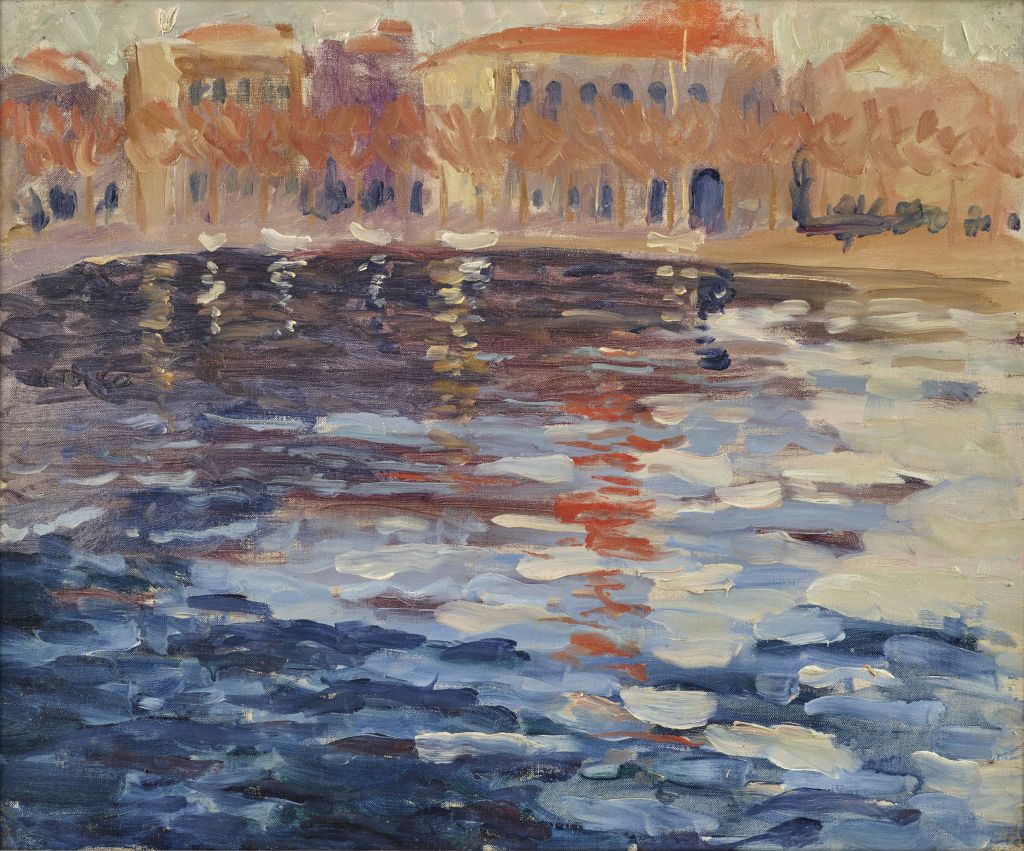
Sir Winston Churchill, Cannes Harbour at Sunset C311, 1930s.
Churchill Chattels Trust.
© Churchill Heritage Ltd. Image courtesy Churchill Heritage Ltd.
Sunset at Cannes Harbour, like many of Churchill’s paintings, demonstrate his deep interest in depicting light and reflections. The harbour at Cannes inspired some of Churchill’s best works, where the bright colours and reflections in the water allowed him to explore the techniques he admired in the Impressonists and Post-Impressionists. Here Churchill uses larger swathes of colour to depict the varied reflections of the setting sun to create a mosaic effect. Churchill devoted most of the composition not to the buildings but to the surface of the water, which he observed at different times of day as the light changed. This was a familiar site for him, and a favourite destination for painting excursions, while staying with friends such as actress Maxine Elliott at the Château de l’Horizon. Churchill’s appreciation for France can be seen in many of his other paintings, including those of Normandy, the Riviera (from Cannes to Cap d’Ail, amongst other sites) and the Atlantic (Saint-Jean-de-Luz).
Tower of the Koutoubia Mosque
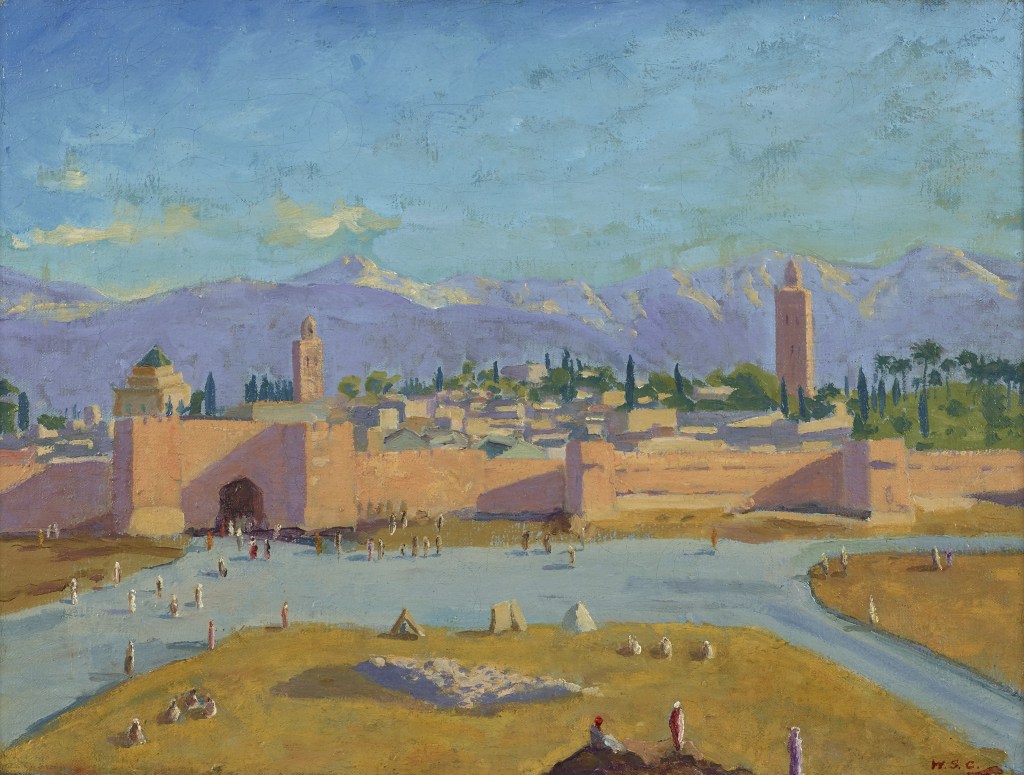
Sir Winston Churchill, The Tower of the Koutoubia Mosque C381, 1943.
Private Collection.
© Churchill Heritage Ltd. Image courtesy Churchill Heritage Ltd
The Tower of the Koutoubia Mosque is the only painting Churchill attempted during World War II. The fact that it was intended as a gift to the American president, Franklin D. Roosevelt, makes it even more significant and symbolic. The view is of the Koutoubia Mosque in Marrakech, with the majestic backdrop of the Atlas Mountains behind. At the end of the Casablanca Conference in January 1943, Churchill persuaded Roosevelt to travel with him to Marrakech, telling him ‘You cannot go all this way to North Africa without seeing Marrakech […] I must be with you when you see the sunset on the snows of the Atlas Mountains.’ The two leaders watched the sunset from the top of a tall tower, an occasion that must have strengthened their friendship and inspired Churchill to capture it the following morning in paint. He sent the painting to Roosevelt as a gift. Roosevelt was not the only president to receive a view of Morocco as a gift, however. Also included in the exhibition is the painting Valley of the Ourika and Atlas Mountains (C431) that Churchill presented to Dwight D. Eisenhower as a gesture of thanks for his role in masterminding the World Tour of Churchill’s paintings, held in 1958.
 LES AMIS DU PATRIMOINE EUROPÉEN