Articles of apprenticeship for Gainsborough Dupont
Gainsborough’s House
Sudbury, UK
gainsborough.org
🇫🇷 🇬🇧
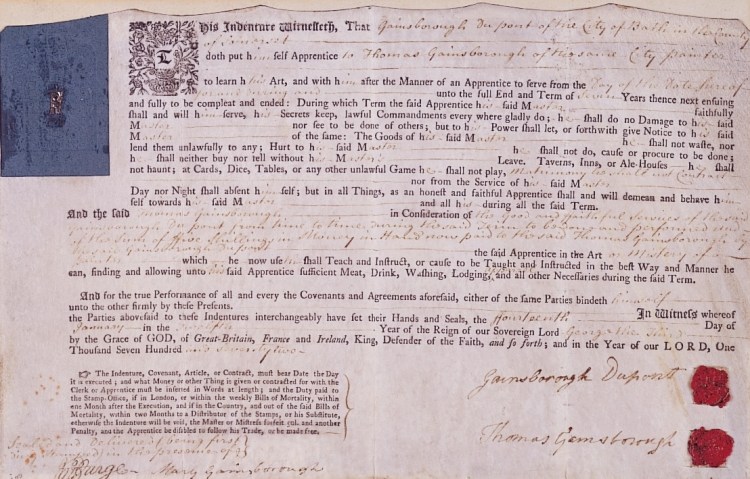
Articles of apprenticeship for Gainsborough Dupont to Thomas Gainsborough, 14 January 1772.
Vellum.
Gainsborough’s House, Sudbury. 1979.003 © Gainsborough’s House.
Text : Mahaut de La Motte-Broöns, Assistant Curator, Gainsborough’s House.
Gainsborough Dupont (1754-97) was the younger son of Thomas Gainsborough’s sister Sarah and her husband Philip Dupont. He moved in with his uncle’s family in Bath from an early age. The Portrait of the Pitminster Boy (private collection, on loan to Gainsborough’s House, and currently on loan to the National Gallery) is thought to represent the artist’s nephew around fourteen helping in his uncle’s studio. He was formally apprenticed to his uncle in 1772 by this document. The printed form for the contract was completely by hand. It lists the articles of the contracts – the rights and obligations of both the master and apprentice. Gainsborough Dupont was to be duly trained “in the mastery of a Painter” for seven years. Besides training, he was to receive “sufficient Meat, Drink, Washing, Lodging”, and also “apparel” which was added by hand. The contract was a legally binding document. It is called “indenture” due to its indented margin. All copies were placed together, cut in a wavy pattern, and then distributed to each party to prevent counterfeiting and authenticate each copy. The blue paper embossed with tin foil is the Shilling Sixpence British Revenue stamp used for most legal documents in the 1770s. The foil attaches the stamp to the document to prevent the illegal reuse of the tax stamp. A Royal Cypher Seal is attached on the back of the document for the same purpose. The tax stamp was increased in the following years to fund the war against the American independentists – who, themselves, were originally protesting against the tax stamp designed specifically for the American colonies. It was signed and sealed by both Gainsborough and Dupont in the presence of two witnesses, the artist’s daughter Mary and E. Burge, who is otherwise unknown.

